 Add to Chrome
 Add to Firefox
 Add to Edge
Data-Driven Response Regime Exploration and Identification for Dynamical Systems
Apr 07, 2023
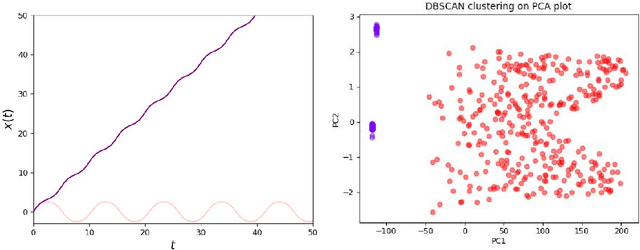
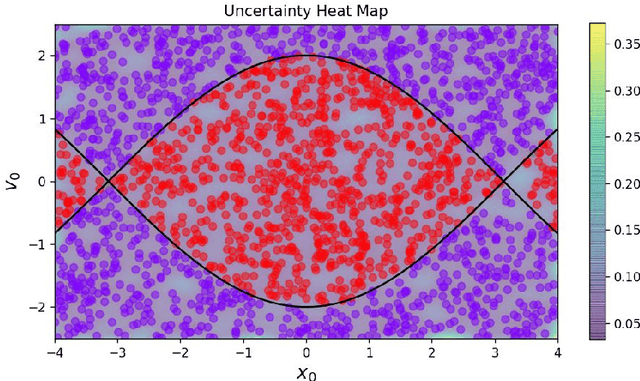
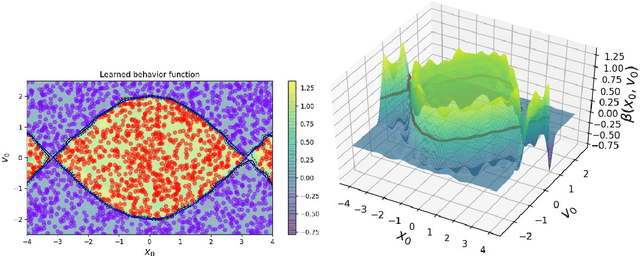
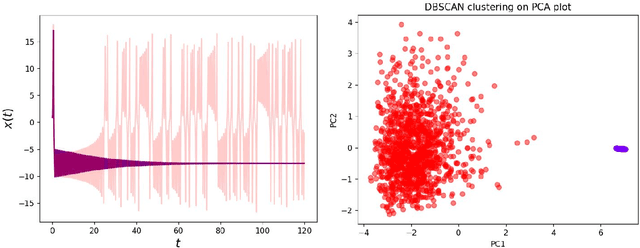
Data-Driven Response Regime Exploration and Identification (DR$^2$EI) is a novel and fully data-driven method for identifying and classifying response regimes of a dynamical system without requiring human intervention. This approach is a valuable tool for exploring and discovering response regimes in complex dynamical systems, especially when the governing equations and the number of response regimes are unknown, and the system is expensive to sample. Additionally, the method is useful for order reduction, as it can be used to identify the most dominant response regimes of a given dynamical system. DR$^2$EI utilizes unsupervised learning algorithms to transform the system's response into an embedding space that facilitates regime classification. An active sequential sampling approach based on Gaussian Process Regression (GPR) is used to efficiently sample the parameter space, quantify uncertainty, and provide optimal trade-offs between exploration and exploitation. The performance of the DR$^2$EI method was evaluated by analyzing three established dynamical systems: the mathematical pendulum, the Lorenz system, and the Duffing oscillator. The method was shown to effectively identify a variety of response regimes with both similar and distinct topological features and frequency content, demonstrating its versatility in capturing a wide range of behaviors. While it may not be possible to guarantee that all possible regimes will be identified, the method provides an automated and efficient means for exploring the parameter space of a dynamical system and identifying its underlying "sufficiently dominant" response regimes without prior knowledge of the system's equations or behavior.

Data-driven method for real-time prediction and uncertainty quantification of fatigue failure under stochastic loading using artificial neural networks and Gaussian process regression
Apr 05, 2021
Various engineering systems such as naval and aerial vehicles, offshore structures, and mechanical components of motorized systems, are exposed to fatigue failures due to stochastic loadings. Methods for early failure prediction are essential for engineering, military, and civil applications. In addition to the prediction of time to failure (TtF), uncertainty quantification (UQ) is of major importance for real-time decision-making purposes. Usually, time domain or frequency domain methods are used for fatigue prediction, such as rainflow counting and Miner's rule or Dirlik's method. However, those methods suffer from over-simplistic modeling and inaccurate failure predictions under stochastic loadings. During the last years, several data-driven models were suggested for offline fatigue failure. However, most of them are not capable of both accurate real-time fatigue prediction and UQ. In the current work, a probabilistic data-driven model is introduced. A hybrid architecture of a fully-connected artificial neural network (FC-ANN) and Gaussian process regression (GPR) is proposed to ensure enhanced predictive abilities and simultaneous UQ of the predicted TtF. The real-time prediction and UQ performances of the suggested model are validated using both synthetic and experimental data. This novel hybrid method is fully data-driven and extends the forecasting capabilities of existing time-domain and machine learning-based methods for fatigue prediction. It paves the way towards the development of a preventive system that provides real-time safety and operational instructions and insights for structural health monitoring (SHM) purposes, allowing prevention of environmental damage, and loss of human lives.