 Add to Chrome
 Add to Firefox
 Add to Edge
COAgents: Multi-Agent Framework to Learn and Navigate Routing Problems Search Space
May 20, 2026
Although Vehicle Routing Problems (VRP) are essential to many real-world systems, they remain computationally intractable at scale due to their combinatorial complexity. Traditional heuristics rely on handcrafted rules for local improvements and occasional \textit{jumps} to escape local minima, but often struggle to generalize across diverse instances. We introduce \textbf{COAgents}, a cooperative multi-agent framework that models the search process as a graph: nodes represent solutions, and edges correspond to either local refinements or large perturbations for diversification (i.e., jumps). A \textit{Partial Search Graph} (PSG) is dynamically constructed during search, enabling COAgents to train a Node Selection Agent and a Move Selection Agent to guide intensification, and a Jump Agent to trigger well-timed explorations of new regions. Unlike end-to-end learning approaches, COAgents cleanly separates problem-agnostic search control from compact domain-specific encoding, facilitating adaptability across tasks. Extensive experiments on the CVRP and VRPTW benchmarks show that COAgents remains competitive with several learn-to-search baselines on CVRP and sets a new state of the art among learning-based methods on the more challenging VRPTW instances, reducing the gap to the best-known solutions by 14\% at $N\!=\!100$ and 44\% at $N\!=\!50$ relative to the strongest neural solver (POMO), and by 21\% and 40\% respectively relative to ALNS. Code is available at https://github.com/mahdims/COAgents.

The Machine Learning for Combinatorial Optimization Competition (ML4CO): Results and Insights
Mar 17, 2022

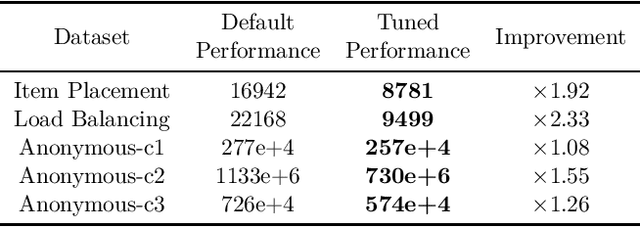
Combinatorial optimization is a well-established area in operations research and computer science. Until recently, its methods have focused on solving problem instances in isolation, ignoring that they often stem from related data distributions in practice. However, recent years have seen a surge of interest in using machine learning as a new approach for solving combinatorial problems, either directly as solvers or by enhancing exact solvers. Based on this context, the ML4CO aims at improving state-of-the-art combinatorial optimization solvers by replacing key heuristic components. The competition featured three challenging tasks: finding the best feasible solution, producing the tightest optimality certificate, and giving an appropriate solver configuration. Three realistic datasets were considered: balanced item placement, workload apportionment, and maritime inventory routing. This last dataset was kept anonymous for the contestants.