 Add to Chrome
 Add to Firefox
 Add to Edge
AQMP: Image compression through Adaptive Quadtree Refinement and Matching Pursuit with Hyperparameter Optimization
May 09, 2026
We present AQMP, a novel image codec combining Adaptive Quadtree Refinement with Matching Pursuit. Unlike conventional Matching Pursuit methods that operate on fixed-size sub-images, AQMP dynamically adapts block sizes to local image structure, allocating finer partitions where the image is complex and coarser ones where it is smooth. This adaptivity yields superior compression ratios compared to fixed-size block Matching Pursuit at equivalent image quality, while offering significant parallelization opportunities at both the tree-leaf level and during compression of individual nodes. The algorithm is governed by user-specified accuracy and sparsity parameters alongside a small set of additional hyperparameters. To navigate the trade-off between compression efficiency and visual quality, we perform multi-objective hyperparameter optimization using the Tree-Structured Parzen Estimator, producing comprehensive Pareto fronts. Experimental results show that AQMP achieves up to $4\times$ higher compression rates than JPEG at comparable SSIM values, while maintaining competitive quality across a broad range of compression regimes. Performance evaluation is provided using a representative set of test images. To ensure reproducibility and promote adoption, we have made our implementation publicly available on GitHub under the MIT license.

Hyperparameter optimization of hp-greedy reduced basis for gravitational wave surrogates
Oct 23, 2023In a previous work we introduced, in the context of gravitational wave science, an initial study on an automated domain-decomposition approach for reduced basis through hp-greedy refinement. The approach constructs local reduced bases of lower dimensionality than global ones, with the same or higher accuracy. These ``light'' local bases should imply both faster evaluations when predicting new waveforms and faster data analysis, in particular faster statistical inference (the forward and inverse problems, respectively). In this approach, however, we have previously found important dependence on several hyperparameters, which do not appear in global reduced basis. This naturally leads to the problem of hyperparameter optimization (HPO), which is the subject of this paper. We tackle the problem through a Bayesian optimization, and show its superiority when compared to grid or random searches. We find that for gravitational waves from the collision of two spinning but non-precessing black holes, for the same accuracy, local hp-greedy reduced bases with HPO have a lower dimensionality of up to $4 \times$ for the cases here studied, depending on the desired accuracy. This factor should directly translate in a parameter estimation speedup, for instance. Such acceleration might help in the near real-time requirements for electromagnetic counterparts of gravitational waves from compact binary coalescences. In addition, we find that the Bayesian approach used in this paper for HPO is two orders of magnitude faster than, for example, a grid search, with about a $100 \times$ acceleration. The code developed for this project is available as open source from public repositories.
An automated parameter domain decomposition approach for gravitational wave surrogates using hp-greedy refinement
Dec 16, 2022We introduce hp-greedy, a refinement approach for building gravitational wave surrogates as an extension of the standard reduced basis framework. Our proposal is data-driven, with a domain decomposition of the parameter space, local reduced basis, and a binary tree as the resulting structure, which are obtained in an automated way. When compared to the standard global reduced basis approach, the numerical simulations of our proposal show three salient features: i) representations of lower dimension with no loss of accuracy, ii) a significantly higher accuracy for a fixed maximum dimensionality of the basis, in some cases by orders of magnitude, and iii) results that depend on the reduced basis seed choice used by the refinement algorithm. We first illustrate the key parts of our approach with a toy model and then present a more realistic use case of gravitational waves emitted by the collision of two spinning, non-precessing black holes. We discuss performance aspects of hp-greedy, such as overfitting with respect to the depth of the tree structure, and other hyperparameter dependences. As two direct applications of the proposed hp-greedy refinement, we envision: i) a further acceleration of statistical inference, which might be complementary to focused reduced-order quadratures, and ii) the search of gravitational waves through clustering and nearest neighbors.
Gravitational wave surrogates through automated machine learning
Oct 17, 2021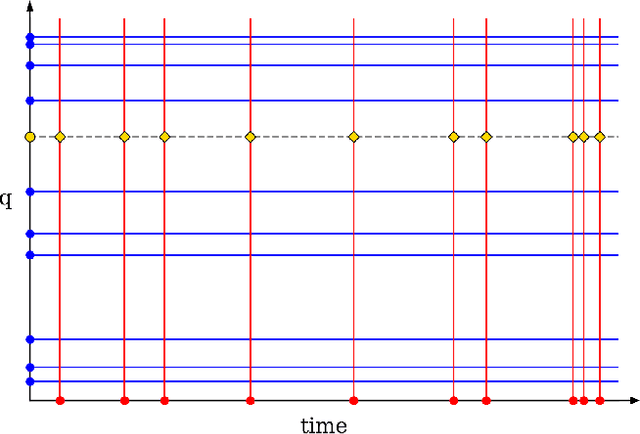
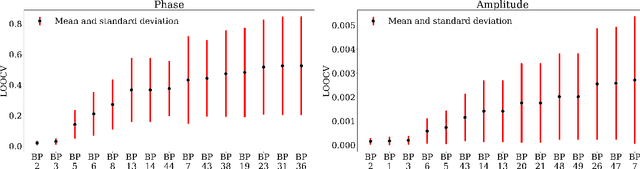
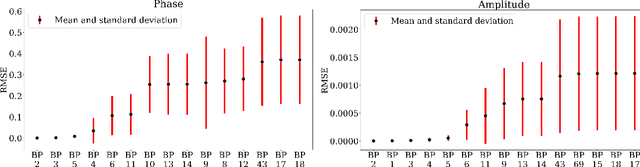
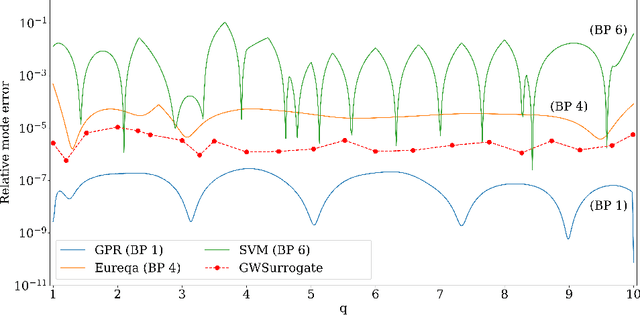
We analyze a prospect for predicting gravitational waveforms from compact binaries based on automated machine learning (AutoML) from around a hundred different possible regression models, without having to resort to tedious and manual case-by-case analyses and fine-tuning. The particular study of this article is within the context of the gravitational waves emitted by the collision of two spinless black holes in initial quasi-circular orbit. We find, for example, that approaches such as Gaussian process regression with radial bases as kernels do provide a sufficiently accurate solution, an approach which is generalizable to multiple dimensions with low computational evaluation cost. The results here presented suggest that AutoML might provide a framework for regression in the field of surrogates for gravitational waveforms. Our study is within the context of surrogates of numerical relativity simulations based on Reduced Basis and the Empirical Interpolation Method, where we find that for the particular case analyzed AutoML can produce surrogates which are essentially indistinguishable from the NR simulations themselves.