 Add to Chrome
 Add to Firefox
 Add to Edge
The Harder Text Embedding Benchmark (HTEB): Beyond One-dimensional Static Robustness
May 27, 2026
Embedding benchmarks like MTEB report a single score per model, implicitly treating robustness as a static, scalar property. We argue that embedding robustness is multidimensional, since models respond differently to different types of variation, and requires dynamic evaluation to expose failures hidden by static benchmarks. We introduce the Harder Text Embedding Benchmark (HTEB), a dynamic evaluation framework that challenges model robustness along three practically interpretable axes (Lexical/Stylistic, Length and Language) by stochastically transforming inputs at evaluation time with an LLM. Evaluating 16 open-weight embedding models on 32 datasets covering 42 languages under transformations validated by 4,800 human ratings on an English subsample, we find three patterns: (1) Models exhibit specific, partly decoupled robustness profiles across axes. (2) Across three model families, scale increases absolute scores but does not close the gap between original and transformed evaluations. Here, scaling tends to improve specifically the Language axis. (3) English datasets are more sensitive to HTEB transformations than multilingual datasets. This demonstrates that HTEB identifies strengths and weaknesses of models along deployment-relevant axes, challenging current embedding benchmarks and arguing for multidimensional, dynamic robustness evaluation.

GASE: Generatively Augmented Sentence Encoding
Nov 07, 2024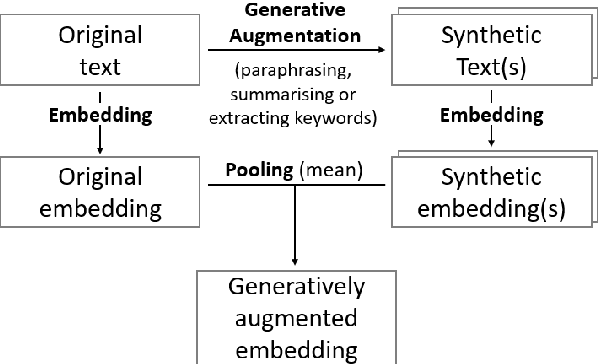
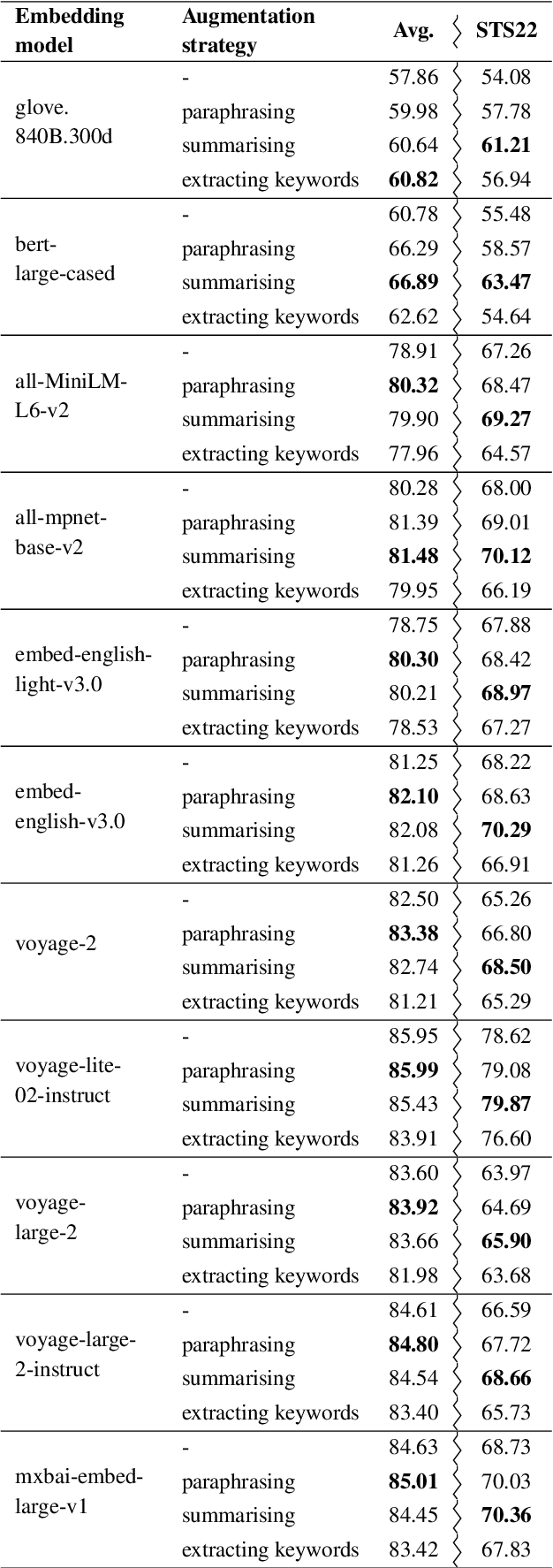
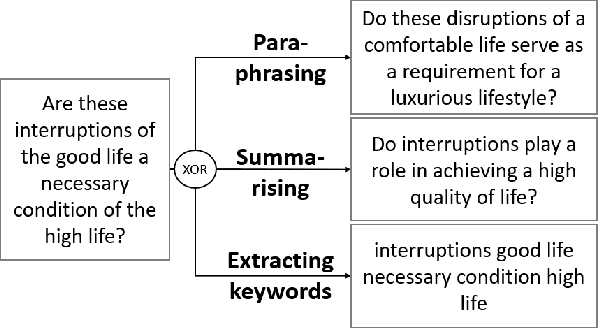
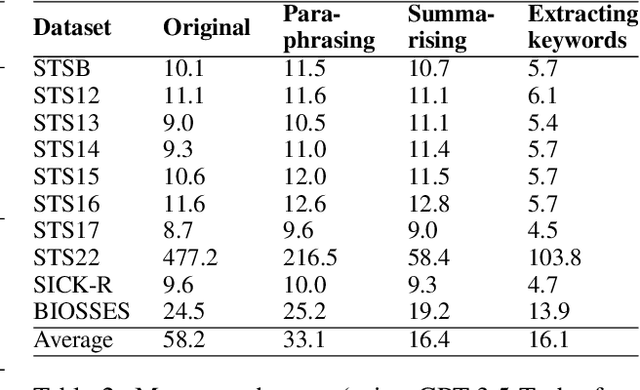
We propose an approach to enhance sentence embeddings by applying generative text models for data augmentation at inference time. Unlike conventional data augmentation that utilises synthetic training data, our approach does not require access to model parameters or the computational resources typically required for fine-tuning state-of-the-art models. Generatively Augmented Sentence Encoding uses diverse linguistic synthetic variants of input texts generated by paraphrasing, summarising, or extracting keywords, followed by pooling the original and synthetic embeddings. Experimental results on the Massive Text Embedding Benchmark for Semantic Textual Similarity (STS) demonstrate performance improvements across a range of embedding models using different generative models for augmentation. We find that generative augmentation leads to larger performance improvements for embedding models with lower baseline performance. These findings suggest that integrating generative augmentation at inference time adds semantic diversity and can enhance the robustness and generalizability of sentence embeddings for embedding models. Our results show that the degree to which generative augmentation can improve STS performance depends not only on the embedding model but also on the dataset. From a broader perspective, the approach allows trading training for inference compute.