 Add to Chrome
 Add to Firefox
 Add to Edge
Exploring the Social Life of Data: Finding Data You Can Trust
Aug 11, 2026
Artificial intelligence is changing the scale and tempo of scientific inquiry. Models can now search, integrate, and reason over data far beyond data repositories familiar to any individual researcher. Yet this expansion creates a prior problem: before a model can produce a trustworthy scientific result, it must locate data that are appropriate for the question, sufficiently reliable for the intended analysis, and accompanied by enough context to support responsible interpretation. As data becomes increasingly abundant, the challenge of finding data has been overcome by the challenge of finding data that you can trust. This paper explores how the social and empirical evidence that accumulates when data are used in research can be used, analogous to social trust networks, to determine fit for purpose and trust. Specifically, the paper explores data-usage graphs as a new layer of scientific data infrastructure. A data-usage graph connects datasets to the publications, people, institutions, topics, software, models, workflows, and other datasets through which they are produced and used. These connections reveal the {\it social life of data:} who has relied on a source, for which questions, in what combinations, with which methods, and with what observable impact. They can turn scattered traces of practice into data-usage descriptors that complement conventional metadata and support judgments of trust and fitness for purpose. The central claim is not that popularity establishes trust, but that this can be grown with appropriate contextual history. Usage evidence must therefore be combined with production quality, provenance, governance, semantic clarity, and community validation. The feasibility and value of data usage graphs is demonstrated by implementing the prototype data insights discovery service within the National Data Platform (NDP).

Scalable Graph Embedding LearningOn A Single GPU
Oct 13, 2021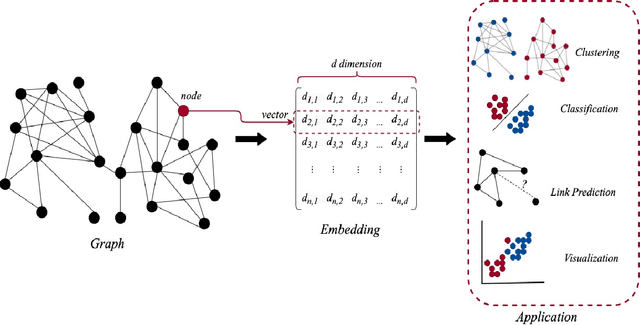
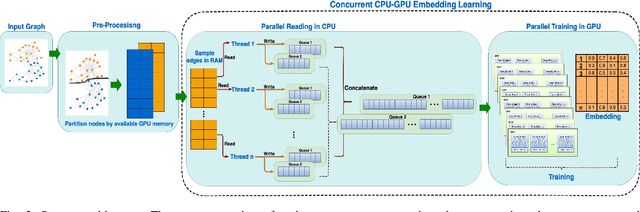

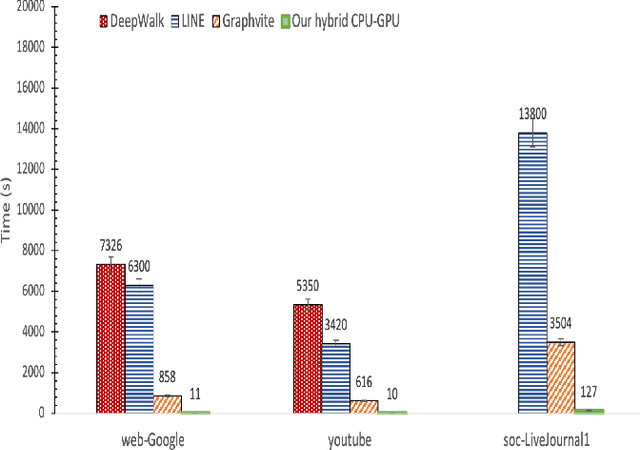
Graph embedding techniques have attracted growing interest since they convert the graph data into continuous and low-dimensional space. Effective graph analytic provides users a deeper understanding of what is behind the data and thus can benefit a variety of machine learning tasks. With the current scale of real-world applications, most graph analytic methods suffer high computation and space costs. These methods and systems can process a network with thousands to a few million nodes. However, scaling to large-scale networks remains a challenge. The complexity of training graph embedding system requires the use of existing accelerators such as GPU. In this paper, we introduce a hybrid CPU-GPU framework that addresses the challenges of learning embedding of large-scale graphs. The performance of our method is compared qualitatively and quantitatively with the existing embedding systems on common benchmarks. We also show that our system can scale training to datasets with an order of magnitude greater than a single machine's total memory capacity. The effectiveness of the learned embedding is evaluated within multiple downstream applications. The experimental results indicate the effectiveness of the learned embedding in terms of performance and accuracy.