 Add to Chrome
 Add to Firefox
 Add to Edge
Bridging data-driven priors via the score function for posterior sampling -- Comparative review and experimental study
Jun 11, 2026
This paper reviews how a diverse set of popular data-driven priors commonly used in Bayesian inverse problems can be unified through their respective score functions. By framing these priors under this common perspective, we show that they can benefit from their straightfoward and effective integration into a recently proposed sampling algorithm. The applicability of this common framework is illustrated by considering several data-driven priors, namely regularization-by-denoising, normalizing flow-based priors, score-based generative models, and convex-ridge regularizers. For these four particular priors, the performance of the method is evaluated when conducting image inpainting and single image super-resolution. These results, as well as those obtained when restoring real images acquired in a geological context, demonstrate the efficiency of the method. This unified framework proves versatile enough to handle any posterior distribution defined by a broad class of score function-based priors, beyond the specific cases considered in this paper.

Bregman geometry-aware split Gibbs sampling for Bayesian Poisson inverse problems
Nov 15, 2025This paper proposes a novel Bayesian framework for solving Poisson inverse problems by devising a Monte Carlo sampling algorithm which accounts for the underlying non-Euclidean geometry. To address the challenges posed by the Poisson likelihood -- such as non-Lipschitz gradients and positivity constraints -- we derive a Bayesian model which leverages exact and asymptotically exact data augmentations. In particular, the augmented model incorporates two sets of splitting variables both derived through a Bregman divergence based on the Burg entropy. Interestingly the resulting augmented posterior distribution is characterized by conditional distributions which benefit from natural conjugacy properties and preserve the intrinsic geometry of the latent and splitting variables. This allows for efficient sampling via Gibbs steps, which can be performed explicitly for all conditionals, except the one incorporating the regularization potential. For this latter, we resort to a Hessian Riemannian Langevin Monte Carlo (HRLMC) algorithm which is well suited to handle priors with explicit or easily computable score functions. By operating on a mirror manifold, this Langevin step ensures that the sampling satisfies the positivity constraints and more accurately reflects the underlying problem structure. Performance results obtained on denoising, deblurring, and positron emission tomography (PET) experiments demonstrate that the method achieves competitive performance in terms of reconstruction quality compared to optimization- and sampling-based approaches.
Regularization by denoising: Bayesian model and Langevin-within-split Gibbs sampling
Feb 19, 2024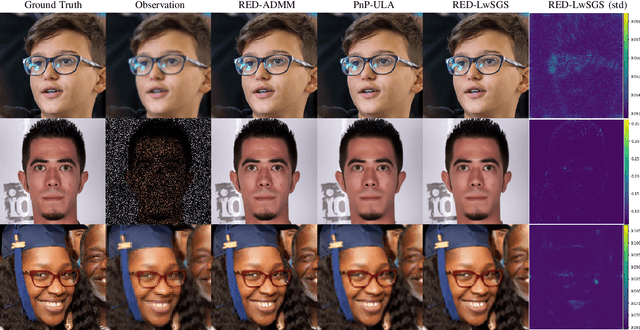
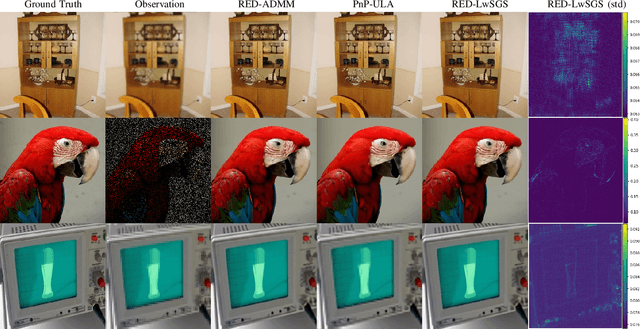
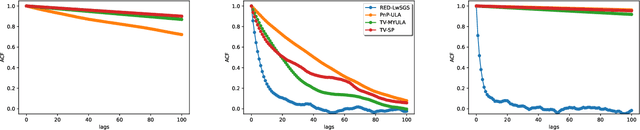
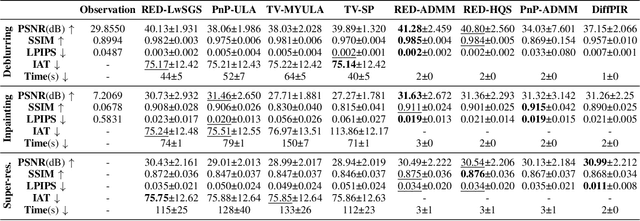
This paper introduces a Bayesian framework for image inversion by deriving a probabilistic counterpart to the regularization-by-denoising (RED) paradigm. It additionally implements a Monte Carlo algorithm specifically tailored for sampling from the resulting posterior distribution, based on an asymptotically exact data augmentation (AXDA). The proposed algorithm is an approximate instance of split Gibbs sampling (SGS) which embeds one Langevin Monte Carlo step. The proposed method is applied to common imaging tasks such as deblurring, inpainting and super-resolution, demonstrating its efficacy through extensive numerical experiments. These contributions advance Bayesian inference in imaging by leveraging data-driven regularization strategies within a probabilistic framework.