 Add to Chrome
 Add to Firefox
 Add to Edge
Directing the Robot: Scaffolding Creative Human-AI-Robot Interaction
Mar 08, 2026
Robots are moving beyond industrial settings into creative, educational, and public environments where interaction is open-ended and improvisational. Yet much of human-AI-robot interaction remains framed around performance and efficiency, positioning humans as supervisors rather than collaborators. We propose a re-framing of AI interaction with robots as scaffolding: infrastructure that enables humans to shape robotic behaviour over time while remaining meaningfully in control. Through scenarios from creative practice, learning-by-teaching, and embodied interaction, we illustrate how humans can act as executive directors, defining intent and steering revisions, while AI mediates between human expression and robotic execution. We outline design and evaluation implications that foreground creativity, agency, and flow. Finally, we discuss open challenges in social, scalable, and mission-critical contexts. We invite the community to rethink interacting with Robots and AI not as autonomy, but as sustained support for human creativity.
* 4 pages, 1 figure

Text-to-Image Generation for Vocabulary Learning Using the Keyword Method
Jan 28, 2025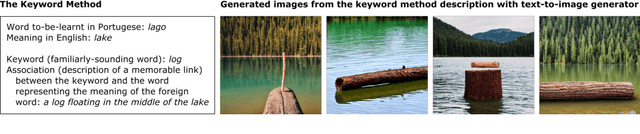
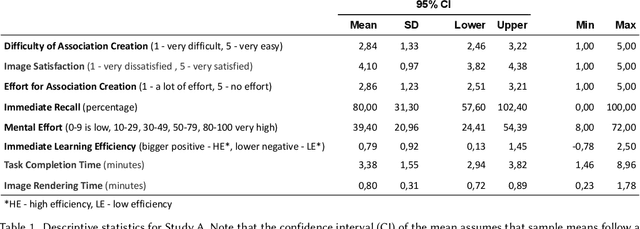
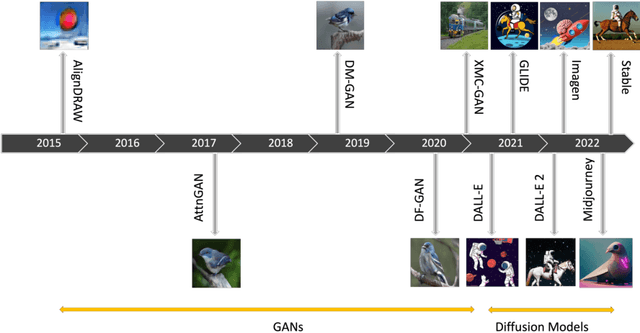
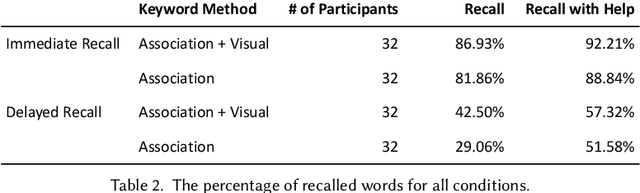
The 'keyword method' is an effective technique for learning vocabulary of a foreign language. It involves creating a memorable visual link between what a word means and what its pronunciation in a foreign language sounds like in the learner's native language. However, these memorable visual links remain implicit in the people's mind and are not easy to remember for a large set of words. To enhance the memorisation and recall of the vocabulary, we developed an application that combines the keyword method with text-to-image generators to externalise the memorable visual links into visuals. These visuals represent additional stimuli during the memorisation process. To explore the effectiveness of this approach we first run a pilot study to investigate how difficult it is to externalise the descriptions of mental visualisations of memorable links, by asking participants to write them down. We used these descriptions as prompts for text-to-image generator (DALL-E2) to convert them into images and asked participants to select their favourites. Next, we compared different text-to-image generators (DALL-E2, Midjourney, Stable and Latent Diffusion) to evaluate the perceived quality of the generated images by each. Despite heterogeneous results, participants mostly preferred images generated by DALL-E2, which was used also for the final study. In this study, we investigated whether providing such images enhances the retention of vocabulary being learned, compared to the keyword method only. Our results indicate that people did not encounter difficulties describing their visualisations of memorable links and that providing corresponding images significantly improves memory retention.