 Add to Chrome
 Add to Firefox
 Add to Edge
Spacing Out: On the Reliability of Binaural Music Source Separation Metrics
Jul 28, 2026
Despite the rising popularity of immersive audio, binaural music remains underexplored in music information retrieval (MIR), particularly regarding the task of music source separation (MSS). While existing stereo MSS models can process binaural audio, they often degrade the spatial quality of the separated stems and undermine listener immersion. Through a perceptual study comparing binaural and stereo MSS outputs, we evaluate how well objective spatial distortion metrics correlate with human perception. Our findings reveal varied agreement between these metrics and human judgment, highlighting a lack of reliability when used to evaluate binaural music tasks. Specifically, we find that Interaural Time Difference (ITD) estimation is highly sensitive to noise and separation artifacts. In evaluating two alternative ITD estimation methods, we uncover a critical trade-off between robustness and accuracy, particularly for narrow-band instruments like bass. These results underscore the need for accurate, interpretable spatial metrics designed for binaural music to develop models that preserve source localization and listener immersion.

An Evaluation Framework for Structured Audio Captions Validated by Controlled Perturbations
Jul 23, 2026Recent advancements in automated audio captioning (AAC) have shifted from monolithic sentence generation toward structured formats that explicitly disentangle distinct acoustic and semantic properties. However, evaluating this heterogeneous data remains a significant challenge. Existing caption metrics focus on flat textual outputs and fail to reliably assess multimodal attributes. To bridge this gap, we propose a multi-axis evaluation framework tailored for structured audio descriptions. Building on the AudioCards dataset, we evaluate outputs across five orthogonal axes: tag-sets, descriptions, logical reasoning, numeric measurements, and spectral profiles. Our approach combines Large Language Model (LLM) judges to capture semantic nuance with deterministic computational metrics to precisely measure acoustic deviations. To rigorously validate the reliability of this framework, we introduce a controlled perturbation testing protocol that injects typed, graded errors into groundtruth annotations. Our results demonstrate that this framework successfully distinguishes meaning-preserving paraphrases from genuine semantic and acoustic corruptions.
Twenty-Five Years of MIR Research: Achievements, Practices, Evaluations, and Future Challenges
Nov 10, 2025In this paper, we trace the evolution of Music Information Retrieval (MIR) over the past 25 years. While MIR gathers all kinds of research related to music informatics, a large part of it focuses on signal processing techniques for music data, fostering a close relationship with the IEEE Audio and Acoustic Signal Processing Technical Commitee. In this paper, we reflect the main research achievements of MIR along the three EDICS related to music analysis, processing and generation. We then review a set of successful practices that fuel the rapid development of MIR research. One practice is the annual research benchmark, the Music Information Retrieval Evaluation eXchange, where participants compete on a set of research tasks. Another practice is the pursuit of reproducible and open research. The active engagement with industry research and products is another key factor for achieving large societal impacts and motivating younger generations of students to join the field. Last but not the least, the commitment to diversity, equity and inclusion ensures MIR to be a vibrant and open community where various ideas, methodologies, and career pathways collide. We finish by providing future challenges MIR will have to face.
Learning from Silence and Noise for Visual Sound Source Localization
Aug 29, 2025Visual sound source localization is a fundamental perception task that aims to detect the location of sounding sources in a video given its audio. Despite recent progress, we identify two shortcomings in current methods: 1) most approaches perform poorly in cases with low audio-visual semantic correspondence such as silence, noise, and offscreen sounds, i.e. in the presence of negative audio; and 2) most prior evaluations are limited to positive cases, where both datasets and metrics convey scenarios with a single visible sound source in the scene. To address this, we introduce three key contributions. First, we propose a new training strategy that incorporates silence and noise, which improves performance in positive cases, while being more robust against negative sounds. Our resulting self-supervised model, SSL-SaN, achieves state-of-the-art performance compared to other self-supervised models, both in sound localization and cross-modal retrieval. Second, we propose a new metric that quantifies the trade-off between alignment and separability of auditory and visual features across positive and negative audio-visual pairs. Third, we present IS3+, an extended and improved version of the IS3 synthetic dataset with negative audio. Our data, metrics and code are available on the https://xavijuanola.github.io/SSL-SaN/.
Domain Adaptation Method and Modality Gap Impact in Audio-Text Models for Prototypical Sound Classification
Jun 04, 2025Audio-text models are widely used in zero-shot environmental sound classification as they alleviate the need for annotated data. However, we show that their performance severely drops in the presence of background sound sources. Our analysis reveals that this degradation is primarily driven by SNR levels of background soundscapes, and independent of background type. To address this, we propose a novel method that quantifies and integrates the contribution of background sources into the classification process, improving performance without requiring model retraining. Our domain adaptation technique enhances accuracy across various backgrounds and SNR conditions. Moreover, we analyze the modality gap between audio and text embeddings, showing that narrowing this gap improves classification performance. The method generalizes effectively across state-of-the-art prototypical approaches, showcasing its scalability and robustness for diverse environments.
Musical Source Separation of Brazilian Percussion
Mar 06, 2025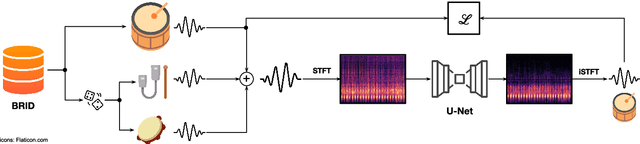
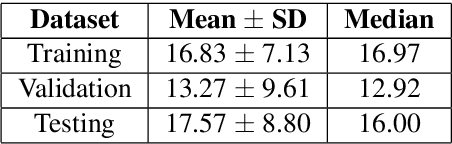
Musical source separation (MSS) has recently seen a big breakthrough in separating instruments from a mixture in the context of Western music, but research on non-Western instruments is still limited due to a lack of data. In this demo, we use an existing dataset of Brazilian sama percussion to create artificial mixtures for training a U-Net model to separate the surdo drum, a traditional instrument in samba. Despite limited training data, the model effectively isolates the surdo, given the drum's repetitive patterns and its characteristic low-pitched timbre. These results suggest that MSS systems can be successfully harnessed to work in more culturally-inclusive scenarios without the need of collecting extensive amounts of data.
Self-Supervised Multi-View Learning for Disentangled Music Audio Representations
Nov 05, 2024Self-supervised learning (SSL) offers a powerful way to learn robust, generalizable representations without labeled data. In music, where labeled data is scarce, existing SSL methods typically use generated supervision and multi-view redundancy to create pretext tasks. However, these approaches often produce entangled representations and lose view-specific information. We propose a novel self-supervised multi-view learning framework for audio designed to incentivize separation between private and shared representation spaces. A case study on audio disentanglement in a controlled setting demonstrates the effectiveness of our method.
SONIQUE: Video Background Music Generation Using Unpaired Audio-Visual Data
Oct 04, 2024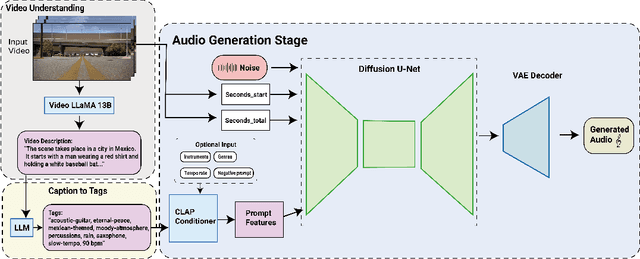
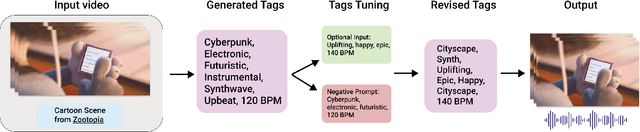
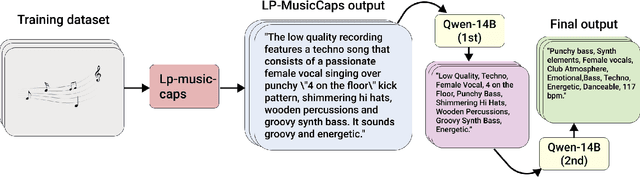

We present SONIQUE, a model for generating background music tailored to video content. Unlike traditional video-to-music generation approaches, which rely heavily on paired audio-visual datasets, SONIQUE leverages unpaired data, combining royalty-free music and independent video sources. By utilizing large language models (LLMs) for video understanding and converting visual descriptions into musical tags, alongside a U-Net-based conditional diffusion model, SONIQUE enables customizable music generation. Users can control specific aspects of the music, such as instruments, genres, tempo, and melodies, ensuring the generated output fits their creative vision. SONIQUE is open-source, with a demo available online.
A Critical Assessment of Visual Sound Source Localization Models Including Negative Audio
Oct 01, 2024The task of Visual Sound Source Localization (VSSL) involves identifying the location of sound sources in visual scenes, integrating audio-visual data for enhanced scene understanding. Despite advancements in state-of-the-art (SOTA) models, we observe three critical flaws: i) The evaluation of the models is mainly focused in sounds produced by objects that are visible in the image, ii) The evaluation often assumes a prior knowledge of the size of the sounding object, and iii) No universal threshold for localization in real-world scenarios is established, as previous approaches only consider positive examples without accounting for both positive and negative cases. In this paper, we introduce a novel test set and metrics designed to complete the current standard evaluation of VSSL models by testing them in scenarios where none of the objects in the image corresponds to the audio input, i.e. a negative audio. We consider three types of negative audio: silence, noise and offscreen. Our analysis reveals that numerous SOTA models fail to appropriately adjust their predictions based on audio input, suggesting that these models may not be leveraging audio information as intended. Additionally, we provide a comprehensive analysis of the range of maximum values in the estimated audio-visual similarity maps, in both positive and negative audio cases, and show that most of the models are not discriminative enough, making them unfit to choose a universal threshold appropriate to perform sound localization without any a priori information of the sounding object, that is, object size and visibility.
Two vs. Four-Channel Sound Event Localization and Detection
Sep 23, 2023Sound event localization and detection (SELD) systems estimate both the direction-of-arrival (DOA) and class of sound sources over time. In the DCASE 2022 SELD Challenge (Task 3), models are designed to operate in a 4-channel setting. While beneficial to further the development of SELD systems using a multichannel recording setup such as first-order Ambisonics (FOA), most consumer electronics devices rarely are able to record using more than two channels. For this reason, in this work we investigate the performance of the DCASE 2022 SELD baseline model using three audio input representations: FOA, binaural, and stereo. We perform a novel comparative analysis illustrating the effect of these audio input representations on SELD performance. Crucially, we show that binaural and stereo (i.e. 2-channel) audio-based SELD models are still able to localize and detect sound sources laterally quite well, despite overall performance degrading as less audio information is provided. Further, we segment our analysis by scenes containing varying degrees of sound source polyphony to better understand the effect of audio input representation on localization and detection performance as scene conditions become increasingly complex.