 Add to Chrome
 Add to Firefox
 Add to Edge
No evaluation without fair representation : Impact of label and selection bias on the evaluation, performance and mitigation of classification models
Mar 10, 2026
Bias can be introduced in diverse ways in machine learning datasets, for example via selection or label bias. Although these bias types in themselves have an influence on important aspects of fair machine learning, their different impact has been understudied. In this work, we empirically analyze the effect of label bias and several subtypes of selection bias on the evaluation of classification models, on their performance, and on the effectiveness of bias mitigation methods. We also introduce a biasing and evaluation framework that allows to model fair worlds and their biased counterparts through the introduction of controlled bias in real-life datasets with low discrimination. Using our framework, we empirically analyze the impact of each bias type independently, while obtaining a more representative evaluation of models and mitigation methods than with the traditional use of a subset of biased data as test set. Our results highlight different factors that influence how impactful bias is on model performance. They also show an absence of trade-off between fairness and accuracy, and between individual and group fairness, when models are evaluated on a test set that does not exhibit unwanted bias. They furthermore indicate that the performance of bias mitigation methods is influenced by the type of bias present in the data. Our findings call for future work to develop more accurate evaluations of prediction models and fairness interventions, but also to better understand other types of bias, more complex scenarios involving the combination of different bias types, and other factors that impact the efficiency of the mitigation methods, such as dataset characteristics.

Compatibility of Fairness Metrics with EU Non-Discrimination Laws: Demographic Parity & Conditional Demographic Disparity
Jun 14, 2023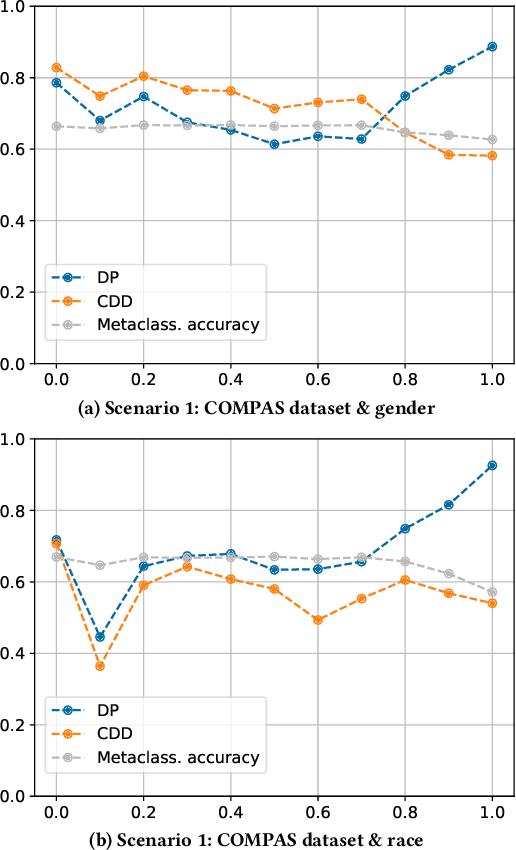
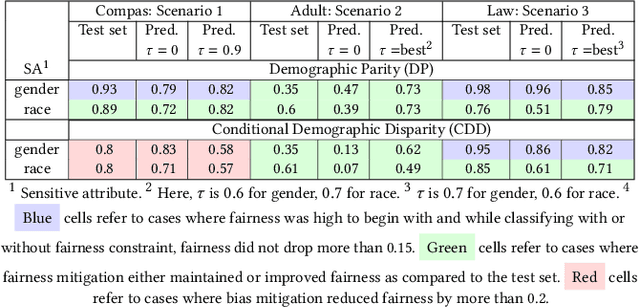
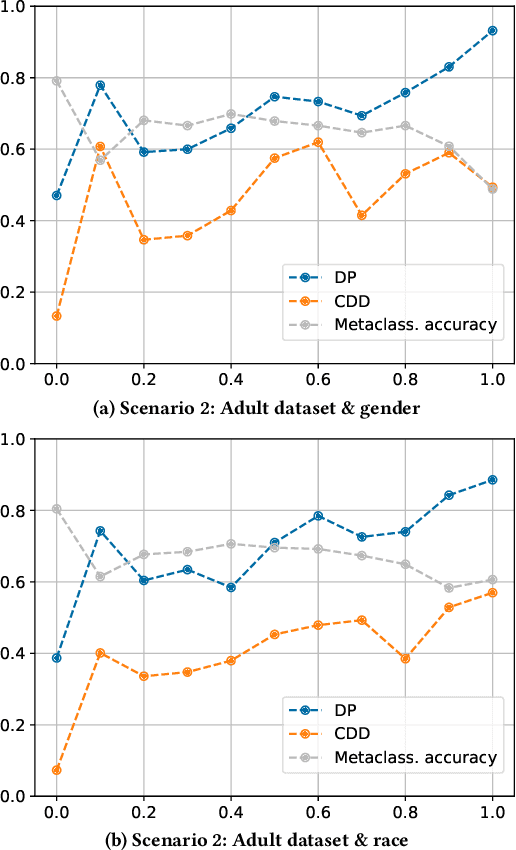
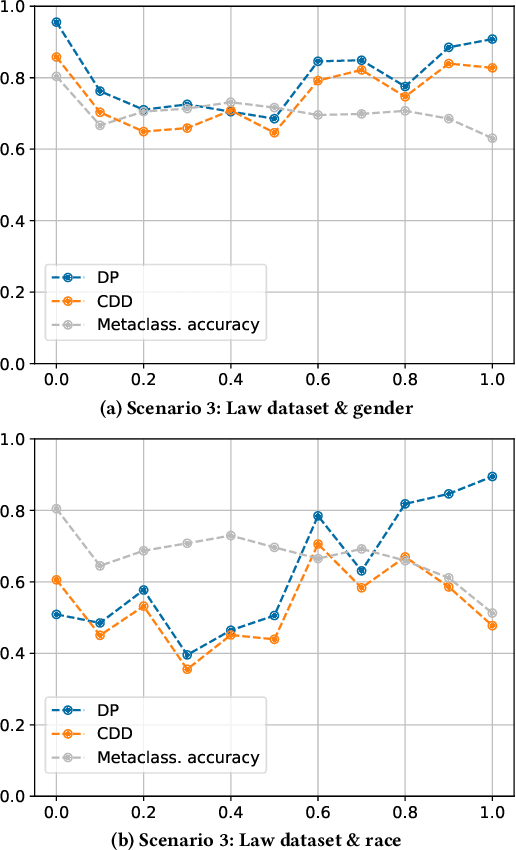
Empirical evidence suggests that algorithmic decisions driven by Machine Learning (ML) techniques threaten to discriminate against legally protected groups or create new sources of unfairness. This work supports the contextual approach to fairness in EU non-discrimination legal framework and aims at assessing up to what point we can assure legal fairness through fairness metrics and under fairness constraints. For that, we analyze the legal notion of non-discrimination and differential treatment with the fairness definition Demographic Parity (DP) through Conditional Demographic Disparity (CDD). We train and compare different classifiers with fairness constraints to assess whether it is possible to reduce bias in the prediction while enabling the contextual approach to judicial interpretation practiced under EU non-discrimination laws. Our experimental results on three scenarios show that the in-processing bias mitigation algorithm leads to different performances in each of them. Our experiments and analysis suggest that AI-assisted decision-making can be fair from a legal perspective depending on the case at hand and the legal justification. These preliminary results encourage future work which will involve further case studies, metrics, and fairness notions.