 Add to Chrome
 Add to Firefox
 Add to Edge
When May a Model Replace the Experiment? Audits, Licenses, and the Price of Trust in Surrogate-Driven Design
Aug 02, 2026
Design campaigns in chemistry, materials science, and machine learning share a bottleneck: determining how good a candidate truly is requires an expensive evaluation - an experiment, a first-principles simulation, or a full training run. Machine-learning surrogates that predict these outcomes are increasingly used not only to propose candidates but to grade them, and even to feed their own predictions back into the search as though they were measurements. Through mathematical analysis validated on three exhaustively ground-truthed design tasks, we establish when this practice is safe, what any certificate of safety must cost, and when the substitution provably pays. Predictive accuracy cannot anchor trust: near-perfect R^2 is compatible with worst-possible selections, and screening N candidates inflates the over-prediction at the selected candidate by a quantifiable "selection tax" with matching upper and lower bounds. Safety follows instead from an architectural rule - predictions may propose and train without restriction, but every certified conclusion must rest on true evaluations - which is sufficient with no assumptions on the surrogate, and necessary, since admitting predictions into certification with the standing of measurements opens a deterministic self-confirmation failure mode. We derive the minimal criterion under which a model may act as an oracle (rank preservation, not accuracy), show that trust must be purchased through selection-aware audits that are optimal in query complexity, and prove a dichotomy fixing when audited surrogates cut certified evaluation cost. Across 432 surrogate fits over six task-regime conditions, the audit statistic tracks deployed search performance at Spearman rank correlation 0.80-0.99, while the rank correlation of R^2 with deployed regret falls as low as 0.33; audited screening reduces certified oracle cost by a measured factor of 25.

Analyzing Examinee Comments using DistilBERT and Machine Learning to Ensure Quality Control in Exam Content
Apr 08, 2025
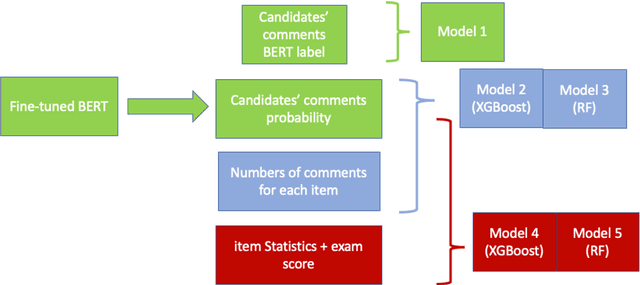
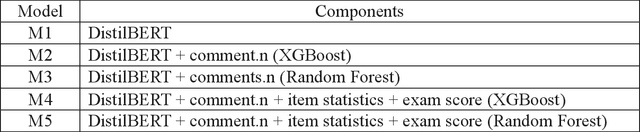
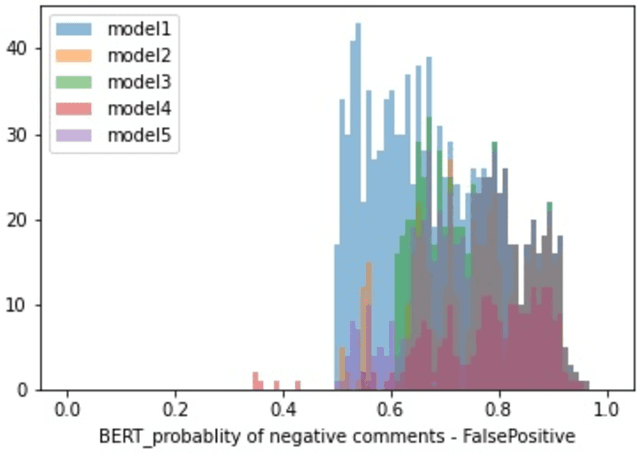
This study explores using Natural Language Processing (NLP) to analyze candidate comments for identifying problematic test items. We developed and validated machine learning models that automatically identify relevant negative feedback, evaluated approaches of incorporating psychometric features enhances model performance, and compared NLP-flagged items with traditionally flagged items. Results demonstrate that candidate feedback provides valuable complementary information to statistical methods, potentially improving test validity while reducing manual review burden. This research offers testing organizations an efficient mechanism to incorporate direct candidate experience into quality assurance processes.
Beyond Current Boundaries: Integrating Deep Learning and AlphaFold for Enhanced Protein Structure Prediction from Low-Resolution Cryo-EM Maps
Oct 30, 2024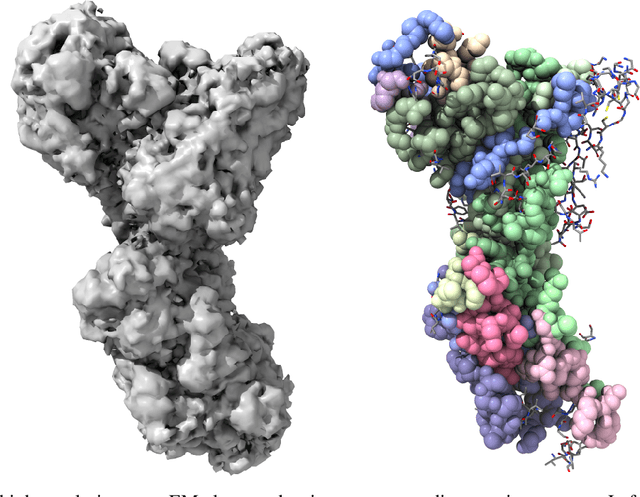
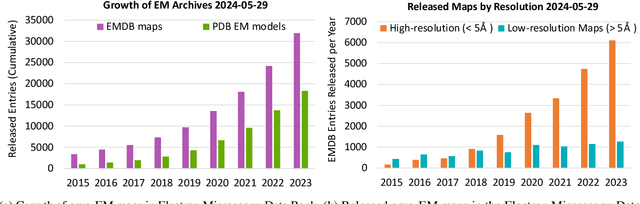
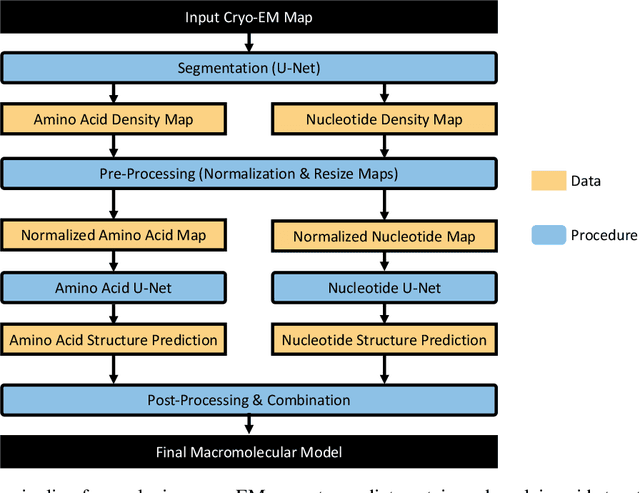
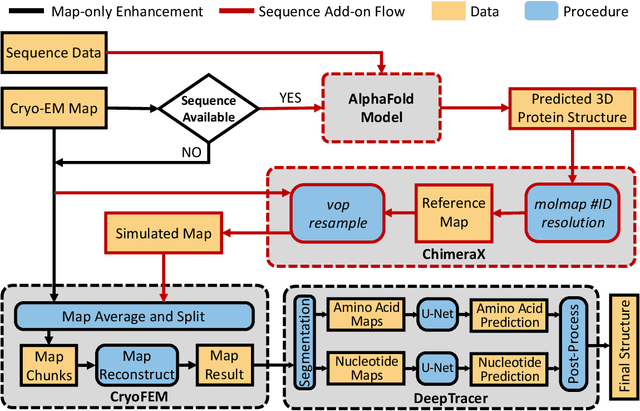
Constructing atomic models from cryo-electron microscopy (cryo-EM) maps is a crucial yet intricate task in structural biology. While advancements in deep learning, such as convolutional neural networks (CNNs) and graph neural networks (GNNs), have spurred the development of sophisticated map-to-model tools like DeepTracer and ModelAngelo, their efficacy notably diminishes with low-resolution maps beyond 4 {\AA}. To address this shortfall, our research introduces DeepTracer-LowResEnhance, an innovative framework that synergizes a deep learning-enhanced map refinement technique with the power of AlphaFold. This methodology is designed to markedly improve the construction of models from low-resolution cryo-EM maps. DeepTracer-LowResEnhance was rigorously tested on a set of 37 protein cryo-EM maps, with resolutions ranging between 2.5 to 8.4 {\AA}, including 22 maps with resolutions lower than 4 {\AA}. The outcomes were compelling, demonstrating that 95.5\% of the low-resolution maps exhibited a significant uptick in the count of total predicted residues. This denotes a pronounced improvement in atomic model building for low-resolution maps. Additionally, a comparative analysis alongside Phenix's auto-sharpening functionality delineates DeepTracer-LowResEnhance's superior capability in rendering more detailed and precise atomic models, thereby pushing the boundaries of current computational structural biology methodologies.