 Add to Chrome
 Add to Firefox
 Add to Edge
Euclid Quick Data Release (Q1). Active galactic nuclei identification using diffusion-based inpainting of Euclid VIS images
Mar 19, 2025
Light emission from galaxies exhibit diverse brightness profiles, influenced by factors such as galaxy type, structural features and interactions with other galaxies. Elliptical galaxies feature more uniform light distributions, while spiral and irregular galaxies have complex, varied light profiles due to their structural heterogeneity and star-forming activity. In addition, galaxies with an active galactic nucleus (AGN) feature intense, concentrated emission from gas accretion around supermassive black holes, superimposed on regular galactic light, while quasi-stellar objects (QSO) are the extreme case of the AGN emission dominating the galaxy. The challenge of identifying AGN and QSO has been discussed many times in the literature, often requiring multi-wavelength observations. This paper introduces a novel approach to identify AGN and QSO from a single image. Diffusion models have been recently developed in the machine-learning literature to generate realistic-looking images of everyday objects. Utilising the spatial resolving power of the Euclid VIS images, we created a diffusion model trained on one million sources, without using any source pre-selection or labels. The model learns to reconstruct light distributions of normal galaxies, since the population is dominated by them. We condition the prediction of the central light distribution by masking the central few pixels of each source and reconstruct the light according to the diffusion model. We further use this prediction to identify sources that deviate from this profile by examining the reconstruction error of the few central pixels regenerated in each source's core. Our approach, solely using VIS imaging, features high completeness compared to traditional methods of AGN and QSO selection, including optical, near-infrared, mid-infrared, and X-rays. [abridged]

Medical Waste Sorting: a computer vision approach for assisted primary sorting
Mar 08, 2023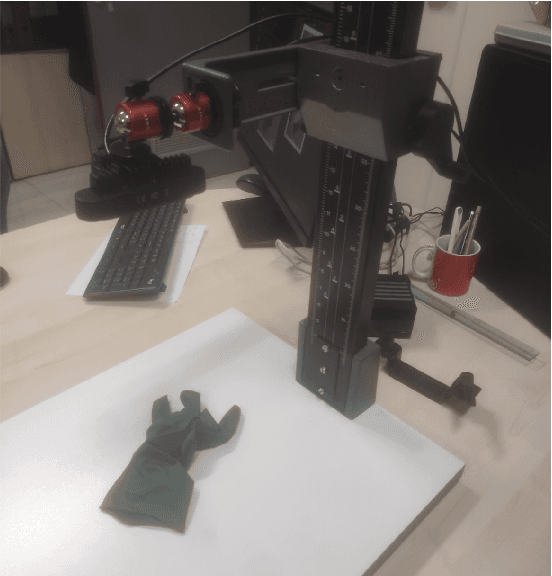
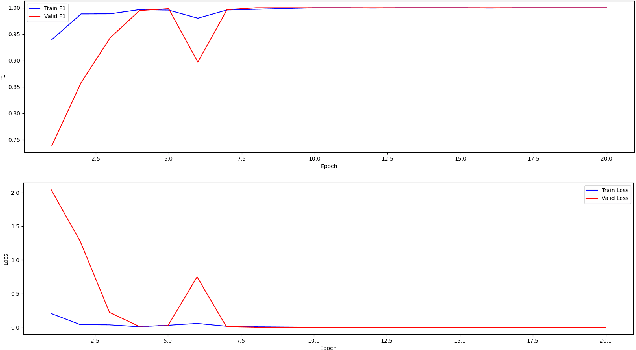
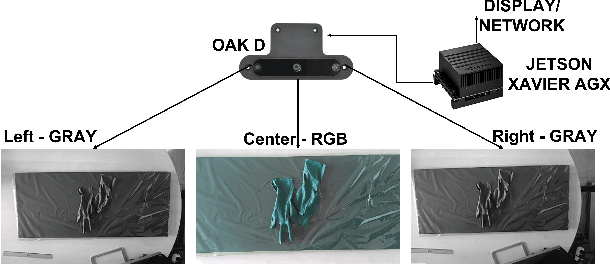
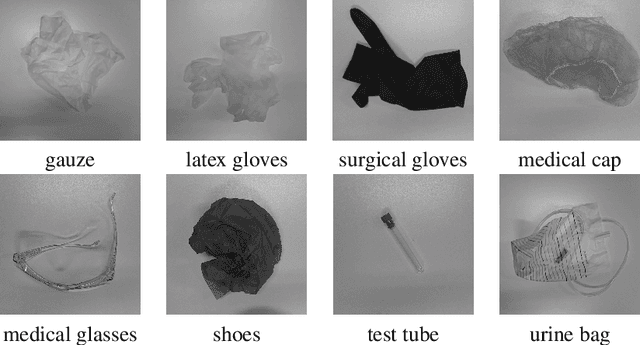
Medical waste, i.e. waste produced during medical activities in hospitals, clinics and laboratories, represents hazardous waste whose management involves special care and high costs. However, this kind of waste contains a significant fraction of highly valued materials that can enter a circular economy process. To this end, in this paper, we propose a computer vision approach for assisting in the primary sorting of medical waste. The feasibility of our approach is demonstrated on a representative dataset we collected and made available to the community, with which we have trained a model that achieves 100\% accuracy, and a new dataset on which the trained model exhibits good generalization.