 Add to Chrome
 Add to Firefox
 Add to Edge
ACE-LoRA: Graph-Attentive Context Enhancement for Parameter-Efficient Adaptation of Medical Vision-Language Models
Mar 17, 2026
The success of CLIP-like vision-language models (VLMs) on natural images has inspired medical counterparts, yet existing approaches largely fall into two extremes: specialist models trained on single-domain data, which capture domain-specific details but generalize poorly, and generalist medical VLMs trained on multi-domain data, which retain broad semantics but dilute fine-grained diagnostic cues. Bridging this specialization-generalization trade-off remains challenging. To address this problem, we propose ACE-LoRA, a parameter-efficient adaptation framework for generalist medical VLMs that maintains robust zero-shot generalization. ACE-LoRA integrates Low-Rank Adaptation (LoRA) modules into frozen image-text encoders and introduces an Attention-based Context Enhancement Hypergraph Neural Network (ACE-HGNN) module that captures higher-order contextual interactions beyond pairwise similarity to enrich global representations with localized diagnostic cues, addressing a key limitation of prior Parameter-Efficient Fine-Tuning (PEFT) methods that overlook fine-grained details. To further enhance cross-modal alignment, we formulate a label-guided InfoNCE loss to effectively suppress false negatives between semantically related image-text pairs. Despite adding only 0.95M trainable parameters, ACE-LoRA consistently outperforms state-of-the-art medical VLMs and PEFT baselines across zero-shot classification, segmentation, and detection benchmarks spanning multiple domains. Our code is available at https://github.com/icon-lab/ACE-LoRA.

ITACLIP: Boosting Training-Free Semantic Segmentation with Image, Text, and Architectural Enhancements
Nov 18, 2024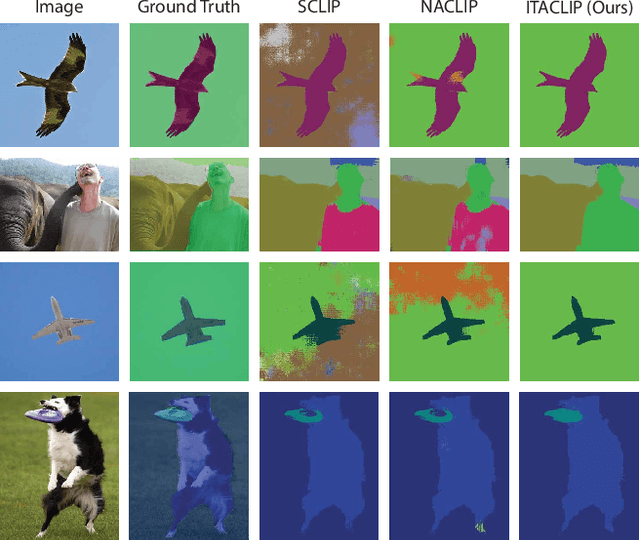
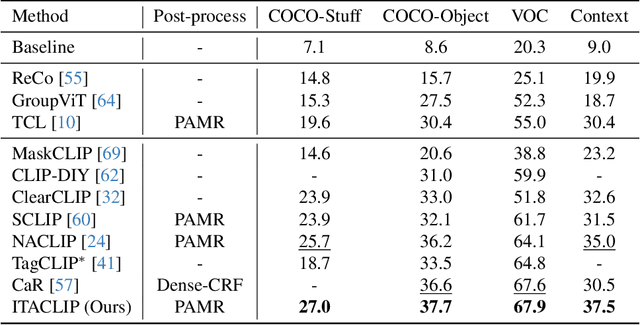
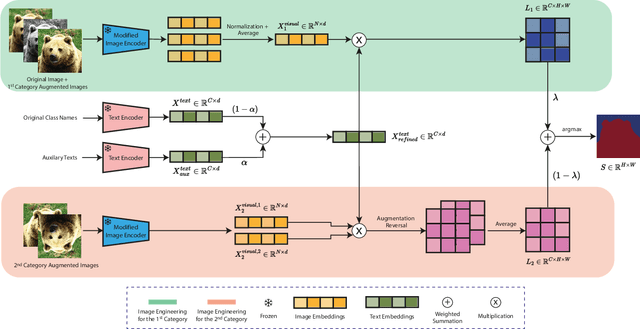
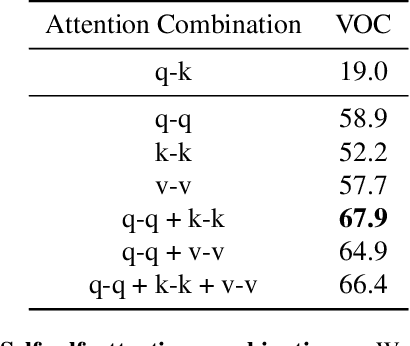
Recent advances in foundational Vision Language Models (VLMs) have reshaped the evaluation paradigm in computer vision tasks. These foundational models, especially CLIP, have accelerated research in open-vocabulary computer vision tasks, including Open-Vocabulary Semantic Segmentation (OVSS). Although the initial results are promising, the dense prediction capabilities of VLMs still require further improvement. In this study, we enhance the semantic segmentation performance of CLIP by introducing new modules and modifications: 1) architectural changes in the last layer of ViT and the incorporation of attention maps from the middle layers with the last layer, 2) Image Engineering: applying data augmentations to enrich input image representations, and 3) using Large Language Models (LLMs) to generate definitions and synonyms for each class name to leverage CLIP's open-vocabulary capabilities. Our training-free method, ITACLIP, outperforms current state-of-the-art approaches on segmentation benchmarks such as COCO-Stuff, COCO-Object, Pascal Context, and Pascal VOC. Our code is available at https://github.com/m-arda-aydn/ITACLIP.