 Add to Chrome
 Add to Firefox
 Add to Edge
DRL-Based Pose Control for Double-Ackermann Robots Under Actuation Uncertainties
May 29, 2026
Robust deployment of deep reinforcement learning (DRL) policies on real robots remains challenging due to discrepancies between simulation and real-world dynamics. We address this issue in the context of maneuvering with double-Ackermann-steering mobile robots, which introduce additional constraints due to their non-holonomic nature. Building upon the DRL framework ManeuverNet, we extend its objective from position control to full pose control, resulting in a more challenging task. We further investigate the impact of actuation-related uncertainties on policy transfer. The use of simplified actuation models during training of the extended policy can lead to poor generalization, shown by a success rate drop from 100% in PyBullet to 25% in Gazebo under stricter evaluation conditions. To address this limitation, we adopt a sim-to-sim-to-real approach, where actuation effects observed in Gazebo are incorporated into the PyBullet training environment. Using multi-environment DRL with SAC and CrossQ, we learn policies that remain robust despite modeling inaccuracies. This approach can significantly reduce the performance gap across simulators, achieving up to 92% success rate in Gazebo and maintaining 69% under stricter thresholds, with successful transfer to a real robot without additional tuning.

ManeuverNet: A Soft Actor-Critic Framework for Precise Maneuvering of Double-Ackermann-Steering Robots with Optimized Reward Functions
Feb 16, 2026Autonomous control of double-Ackermann-steering robots is essential in agricultural applications, where robots must execute precise and complex maneuvers within a limited space. Classical methods, such as the Timed Elastic Band (TEB) planner, can address this problem, but they rely on parameter tuning, making them highly sensitive to changes in robot configuration or environment and impractical to deploy without constant recalibration. At the same time, end-to-end deep reinforcement learning (DRL) methods often fail due to unsuitable reward functions for non-holonomic constraints, resulting in sub-optimal policies and poor generalization. To address these challenges, this paper presents ManeuverNet, a DRL framework tailored for double-Ackermann systems, combining Soft Actor-Critic with CrossQ. Furthermore, ManeuverNet introduces four specifically designed reward functions to support maneuver learning. Unlike prior work, ManeuverNet does not depend on expert data or handcrafted guidance. We extensively evaluate ManeuverNet against both state-of-the-art DRL baselines and the TEB planner. Experimental results demonstrate that our framework substantially improves maneuverability and success rates, achieving more than a 40% gain over DRL baselines. Moreover, ManeuverNet effectively mitigates the strong parameter sensitivity observed in the TEB planner. In real-world trials, ManeuverNet achieved up to a 90% increase in maneuvering trajectory efficiency, highlighting its robustness and practical applicability.
FRASA: An End-to-End Reinforcement Learning Agent for Fall Recovery and Stand Up of Humanoid Robots
Oct 11, 2024
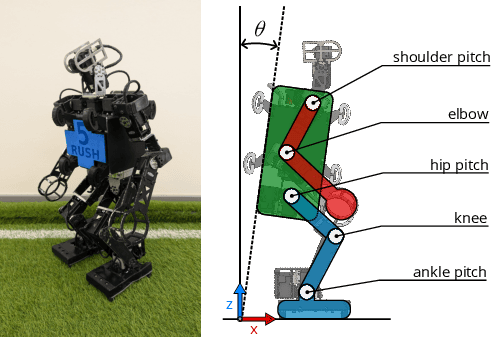


Humanoid robotics faces significant challenges in achieving stable locomotion and recovering from falls in dynamic environments. Traditional methods, such as Model Predictive Control (MPC) and Key Frame Based (KFB) routines, either require extensive fine-tuning or lack real-time adaptability. This paper introduces FRASA, a Deep Reinforcement Learning (DRL) agent that integrates fall recovery and stand up strategies into a unified framework. Leveraging the Cross-Q algorithm, FRASA significantly reduces training time and offers a versatile recovery strategy that adapts to unpredictable disturbances. Comparative tests on Sigmaban humanoid robots demonstrate FRASA superior performance against the KFB method deployed in the RoboCup 2023 by the Rhoban Team, world champion of the KidSize League.
FootstepNet: an Efficient Actor-Critic Method for Fast On-line Bipedal Footstep Planning and Forecasting
Mar 19, 2024
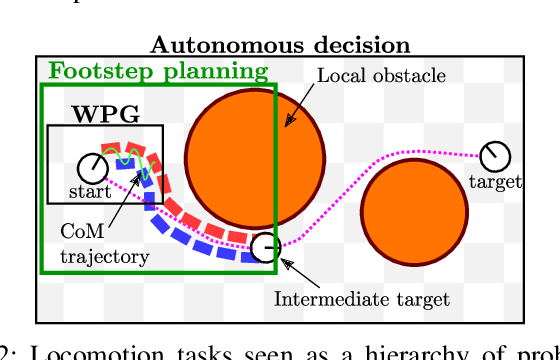
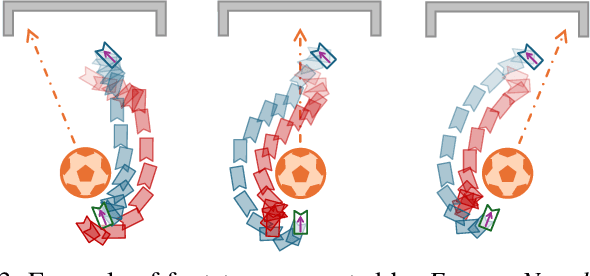
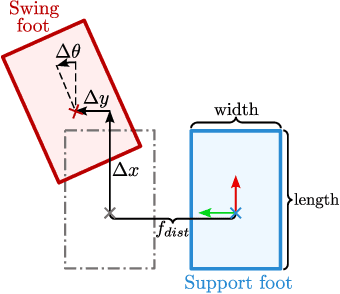
Designing a humanoid locomotion controller is challenging and classically split up in sub-problems. Footstep planning is one of those, where the sequence of footsteps is defined. Even in simpler environments, finding a minimal sequence, or even a feasible sequence, yields a complex optimization problem. In the literature, this problem is usually addressed by search-based algorithms (e.g. variants of A*). However, such approaches are either computationally expensive or rely on hand-crafted tuning of several parameters. In this work, at first, we propose an efficient footstep planning method to navigate in local environments with obstacles, based on state-of-the art Deep Reinforcement Learning (DRL) techniques, with very low computational requirements for on-line inference. Our approach is heuristic-free and relies on a continuous set of actions to generate feasible footsteps. In contrast, other methods necessitate the selection of a relevant discrete set of actions. Second, we propose a forecasting method, allowing to quickly estimate the number of footsteps required to reach different candidates of local targets. This approach relies on inherent computations made by the actor-critic DRL architecture. We demonstrate the validity of our approach with simulation results, and by a deployment on a kid-size humanoid robot during the RoboCup 2023 competition.
Multi Actor-Critic DDPG for Robot Action Space Decomposition: A Framework to Control Large 3D Deformation of Soft Linear Objects
Dec 08, 2023
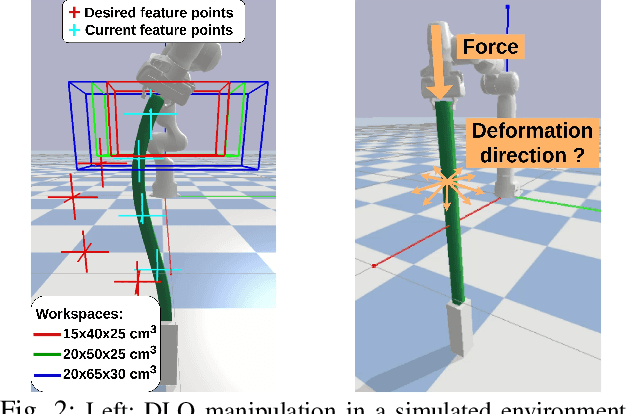


Robotic manipulation of deformable linear objects (DLOs) has great potential for applications in diverse fields such as agriculture or industry. However, a major challenge lies in acquiring accurate deformation models that describe the relationship between robot motion and DLO deformations. Such models are difficult to calculate analytically and vary among DLOs. Consequently, manipulating DLOs poses significant challenges, particularly in achieving large deformations that require highly accurate global models. To address these challenges, this paper presents MultiAC6: a new multi Actor-Critic framework for robot action space decomposition to control large 3D deformations of DLOs. In our approach, two deep reinforcement learning (DRL) agents orient and position a robot gripper to deform a DLO into the desired shape. Unlike previous DRL-based studies, MultiAC6 is able to solve the sim-to-real gap, achieving large 3D deformations up to 40 cm in real-world settings. Experimental results also show that MultiAC6 has a 66\% higher success rate than a single-agent approach. Further experimental studies demonstrate that MultiAC6 generalizes well, without retraining, to DLOs with different lengths or materials.