 Add to Chrome
 Add to Firefox
 Add to Edge
Log NeRF: Comparing Spaces for Learning Radiance Fields
Dec 10, 2025
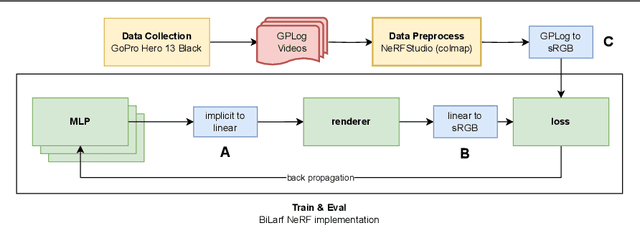
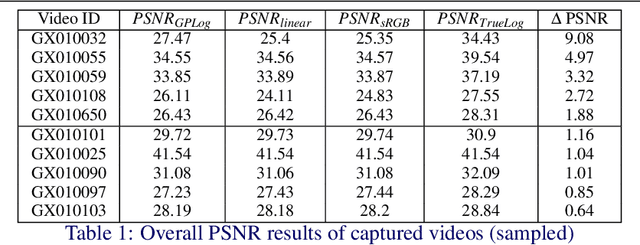
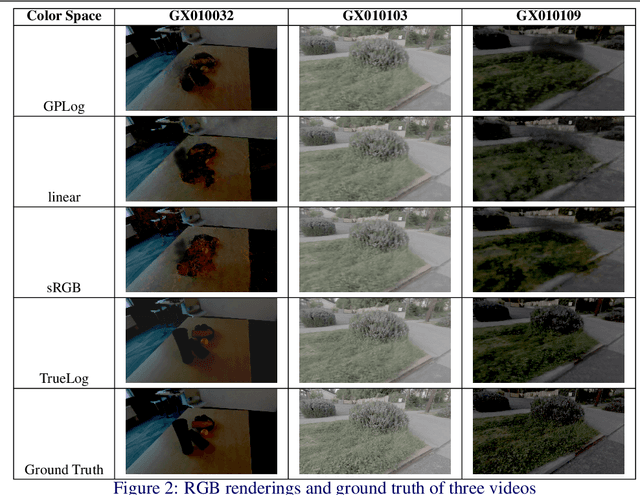
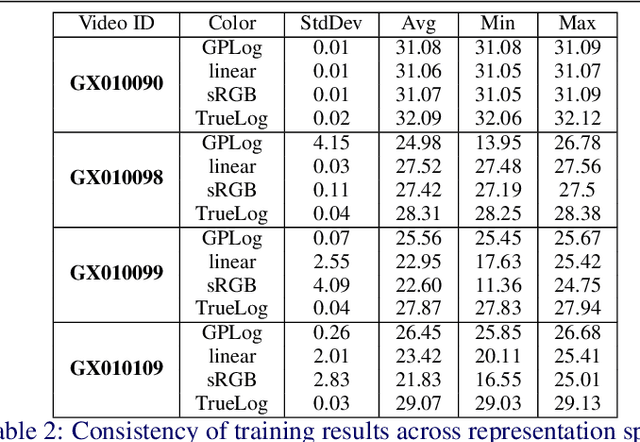
Neural Radiance Fields (NeRF) have achieved remarkable results in novel view synthesis, typically using sRGB images for supervision. However, little attention has been paid to the color space in which the network is learning the radiance field representation. Inspired by the BiIlluminant Dichromatic Reflection (BIDR) model, which suggests that a logarithmic transformation simplifies the separation of illumination and reflectance, we hypothesize that log RGB space enables NeRF to learn a more compact and effective representation of scene appearance. To test this, we captured approximately 30 videos using a GoPro camera, ensuring linear data recovery through inverse encoding. We trained NeRF models under various color space interpretations linear, sRGB, GPLog, and log RGB by converting each network output to a common color space before rendering and loss computation, enforcing representation learning in different color spaces. Quantitative and qualitative evaluations demonstrate that using a log RGB color space consistently improves rendering quality, exhibits greater robustness across scenes, and performs particularly well in low light conditions while using the same bit-depth input images. Further analysis across different network sizes and NeRF variants confirms the generalization and stability of the log space advantage.

Optimizing transformer-based machine translation model for single GPU training: a hyperparameter ablation study
Aug 11, 2023In machine translation tasks, the relationship between model complexity and performance is often presumed to be linear, driving an increase in the number of parameters and consequent demands for computational resources like multiple GPUs. To explore this assumption, this study systematically investigates the effects of hyperparameters through ablation on a sequence-to-sequence machine translation pipeline, utilizing a single NVIDIA A100 GPU. Contrary to expectations, our experiments reveal that combinations with the most parameters were not necessarily the most effective. This unexpected insight prompted a careful reduction in parameter sizes, uncovering "sweet spots" that enable training sophisticated models on a single GPU without compromising translation quality. The findings demonstrate an intricate relationship between hyperparameter selection, model size, and computational resource needs. The insights from this study contribute to the ongoing efforts to make machine translation more accessible and cost-effective, emphasizing the importance of precise hyperparameter tuning over mere scaling.
Vector quantization loss analysis in VQGANs: a single-GPU ablation study for image-to-image synthesis
Aug 09, 2023This study performs an ablation analysis of Vector Quantized Generative Adversarial Networks (VQGANs), concentrating on image-to-image synthesis utilizing a single NVIDIA A100 GPU. The current work explores the nuanced effects of varying critical parameters including the number of epochs, image count, and attributes of codebook vectors and latent dimensions, specifically within the constraint of limited resources. Notably, our focus is pinpointed on the vector quantization loss, keeping other hyperparameters and loss components (GAN loss) fixed. This was done to delve into a deeper understanding of the discrete latent space, and to explore how varying its size affects the reconstruction. Though, our results do not surpass the existing benchmarks, however, our findings shed significant light on VQGAN's behaviour for a smaller dataset, particularly concerning artifacts, codebook size optimization, and comparative analysis with Principal Component Analysis (PCA). The study also uncovers the promising direction by introducing 2D positional encodings, revealing a marked reduction in artifacts and insights into balancing clarity and overfitting.