 Add to Chrome
 Add to Firefox
 Add to Edge
Extending Multi-Source Bayesian Optimization With Causality Principles
Feb 16, 2026
Multi-Source Bayesian Optimization (MSBO) serves as a variant of the traditional Bayesian Optimization (BO) framework applicable to situations involving optimization of an objective black-box function over multiple information sources such as simulations, surrogate models, or real-world experiments. However, traditional MSBO assumes the input variables of the objective function to be independent and identically distributed, limiting its effectiveness in scenarios where causal information is available and interventions can be performed, such as clinical trials or policy-making. In the single-source domain, Causal Bayesian Optimization (CBO) extends standard BO with the principles of causality, enabling better modeling of variable dependencies. This leads to more accurate optimization, improved decision-making, and more efficient use of low-cost information sources. In this article, we propose a principled integration of the MSBO and CBO methodologies in the multi-source domain, leveraging the strengths of both to enhance optimization efficiency and reduce computational complexity in higher-dimensional problems. We present the theoretical foundations of both Causal and Multi-Source Bayesian Optimization, and demonstrate how their synergy informs our Multi-Source Causal Bayesian Optimization (MSCBO) algorithm. We compare the performance of MSCBO against its foundational counterparts for both synthetic and real-world datasets with varying levels of noise, highlighting the robustness and applicability of MSCBO. Based on our findings, we conclude that integrating MSBO with the causality principles of CBO facilitates dimensionality reduction and lowers operational costs, ultimately improving convergence speed, performance, and scalability.

FlowMRI-Net: A generalizable self-supervised physics-driven 4D Flow MRI reconstruction network for aortic and cerebrovascular applications
Oct 11, 2024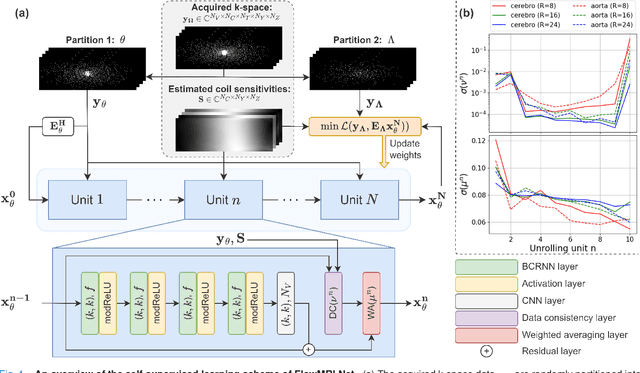


In this work, we propose FlowMRI-Net, a novel deep learning-based framework for fast reconstruction of accelerated 4D flow magnetic resonance imaging (MRI) using physics-driven unrolled optimization and a complexvalued convolutional recurrent neural network trained in a self-supervised manner. The generalizability of the framework is evaluated using aortic and cerebrovascular 4D flow MRI acquisitions acquired on systems from two different vendors for various undersampling factors (R=8,16,24) and compared to state-of-the-art compressed sensing (CS-LLR) and deep learning-based (FlowVN) reconstructions. Evaluation includes quantitative analysis of image magnitudes, velocity magnitudes, and peak velocity curves. FlowMRINet outperforms CS-LLR and FlowVN for aortic 4D flow MRI reconstruction, resulting in vectorial normalized root mean square errors of $0.239\pm0.055$, $0.308\pm0.066$, and $0.302\pm0.085$ and mean directional errors of $0.023\pm0.015$, $0.036\pm0.018$, and $0.039\pm0.025$ for velocities in the thoracic aorta for R=16, respectively. Furthermore, FlowMRI-Net outperforms CS-LLR for cerebrovascular 4D flow MRI reconstruction, where no FlowVN can be trained due to the lack of a highquality reference, resulting in a consistent increase in SNR of around 6 dB and more accurate peak velocity curves for R=8,16,24. Reconstruction times ranged from 1 to 7 minutes on commodity CPU/GPU hardware. FlowMRI-Net enables fast and accurate quantification of aortic and cerebrovascular flow dynamics, with possible applications to other vascular territories. This will improve clinical adaptation of 4D flow MRI and hence may aid in the diagnosis and therapeutic management of cardiovascular diseases.
Generalizable synthetic MRI with physics-informed convolutional networks
May 21, 2023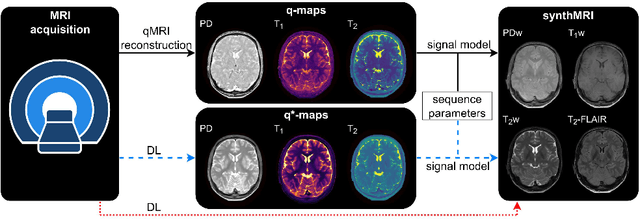
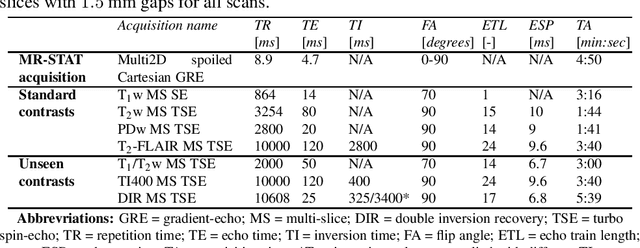
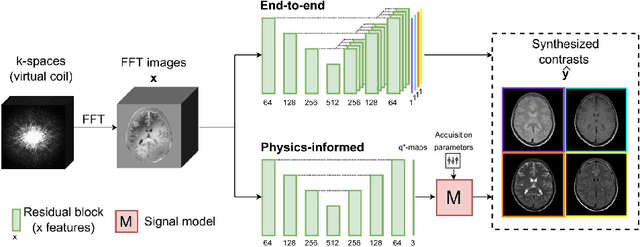
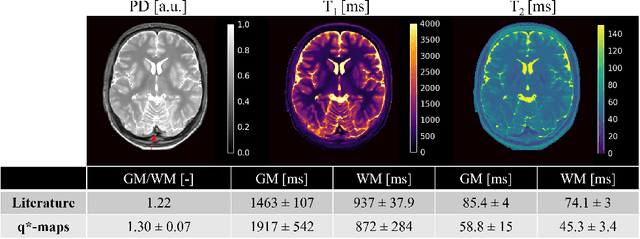
In this study, we develop a physics-informed deep learning-based method to synthesize multiple brain magnetic resonance imaging (MRI) contrasts from a single five-minute acquisition and investigate its ability to generalize to arbitrary contrasts to accelerate neuroimaging protocols. A dataset of fifty-five subjects acquired with a standard MRI protocol and a five-minute transient-state sequence was used to develop a physics-informed deep learning-based method. The model, based on a generative adversarial network, maps data acquired from the five-minute scan to "effective" quantitative parameter maps, here named q*-maps, by using its generated PD, T1, and T2 values in a signal model to synthesize four standard contrasts (proton density-weighted, T1-weighted, T2-weighted, and T2-weighted fluid-attenuated inversion recovery), from which losses are computed. The q*-maps are compared to literature values and the synthetic contrasts are compared to an end-to-end deep learning-based method proposed by literature. The generalizability of the proposed method is investigated for five volunteers by synthesizing three non-standard contrasts unseen during training and comparing these to respective ground truth acquisitions via contrast-to-noise ratio and quantitative assessment. The physics-informed method was able to match the high-quality synthMRI of the end-to-end method for the four standard contrasts, with mean \pm standard deviation structural similarity metrics above 0.75 \pm 0.08 and peak signal-to-noise ratios above 22.4 \pm 1.9 and 22.6 \pm 2.1. Additionally, the physics-informed method provided retrospective contrast adjustment, with visually similar signal contrast and comparable contrast-to-noise ratios to the ground truth acquisitions for three sequences unused for model training, demonstrating its generalizability and potential application to accelerate neuroimaging protocols.