 Add to Chrome
 Add to Firefox
 Add to Edge
Federated generative event models for tokenized electronic health records
Aug 03, 2026
Electronic health record foundation models are limited by institutionally siloed data and substantial performance degradation under cross-site transfer. We evaluated federated training of tokenized generative event models (GEMs) across 122,251 intensive care hospitalizations from three independent health systems harmonized to the Common Longitudinal ICU Data Format. Models were assessed on 12 post-24-hour clinical prediction tasks using within-site, cross-site, centralized, and federated training configurations. GEMs achieved the highest mean within-site and cross-site ROC-AUC and were substantially more transportable than conventional supervised models: their average cross-site penalties were 0.025 ROC-AUC and 0.027 PR-AUC, compared with 0.079 and 0.089 for LightGBM. Federated Learning (FedAvg and FedAvgM) approached the performance of centralized GEM training, with most gains obtained within 5-10 communication rounds. However, centralized multi-site training provided only modest improvements over complete local training. Multi-site models were most useful when local training data were limited, with their advantage narrowing as institutional data accumulated. These findings show that federated GEM training is technically feasible and preserves most centralized performance, but that the main open challenge is learning transportable representations to translate larger, but heterogeneous data from multiple health systems into a reliable target-site benefit.

Efficient Variance-reduced Estimation from Generative EHR Models: The SCOPE and REACH Estimators
Feb 03, 2026Generative models trained using self-supervision of tokenized electronic health record (EHR) timelines show promise for clinical outcome prediction. This is typically done using Monte Carlo simulation for future patient trajectories. However, existing approaches suffer from three key limitations: sparse estimate distributions that poorly differentiate patient risk levels, extreme computational costs, and high sampling variance. We propose two new estimators: the Sum of Conditional Outcome Probability Estimator (SCOPE) and Risk Estimation from Anticipated Conditional Hazards (REACH), that leverage next-token probability distributions discarded by standard Monte Carlo. We prove both estimators are unbiased and that REACH guarantees variance reduction over Monte Carlo sampling for any model and outcome. Empirically, on hospital mortality prediction in MIMIC-IV using the ETHOS-ARES framework, SCOPE and REACH match 100-sample Monte Carlo performance using only 10-11 samples (95% CI: [9,11]), representing a ~10x reduction in inference cost without degrading calibration. For ICU admission prediction, efficiency gains are more modest (~1.2x), which we attribute to the outcome's lower "spontaneity," a property we characterize theoretically and empirically. These methods substantially improve the feasibility of deploying generative EHR models in resource-constrained clinical settings.
Quantifying surprise in clinical care: Detecting highly informative events in electronic health records with foundation models
Jul 30, 2025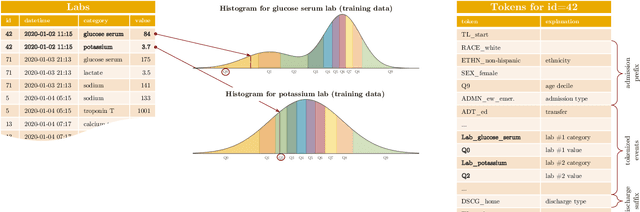
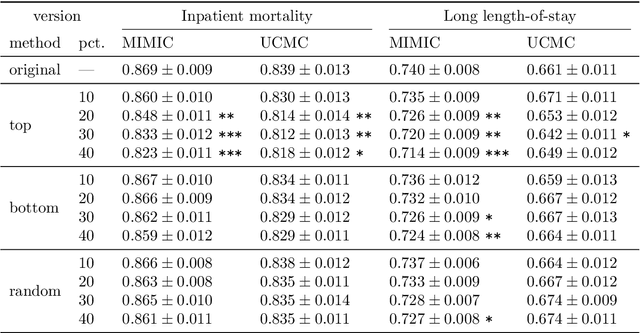
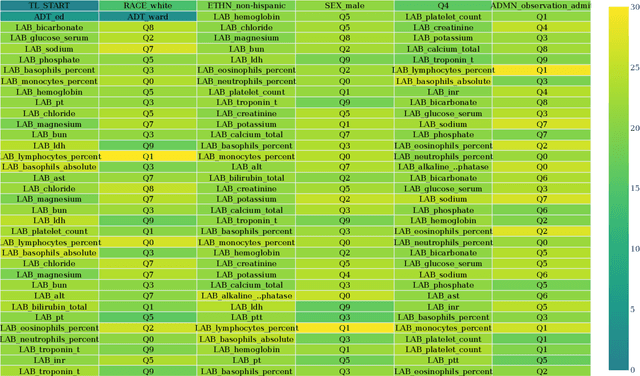
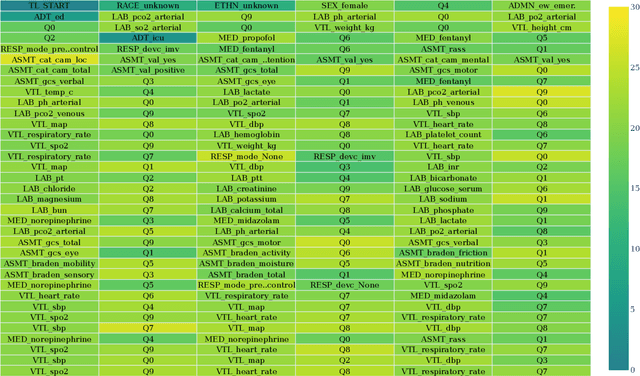
We present a foundation model-derived method to identify highly informative tokens and events in electronic health records. Our approach considers incoming data in the entire context of a patient's hospitalization and so can flag anomalous events that rule-based approaches would consider within a normal range. We demonstrate that the events our model flags are significant for predicting downstream patient outcomes and that a fraction of events identified as carrying little information can safely be dropped. Additionally, we show how informativeness can help interpret the predictions of prognostic models trained on foundation model-derived representations.