 Add to Chrome
 Add to Firefox
 Add to Edge
Lower Bounds for the Algorithmic Complexity of Learned Indexes
Jan 10, 2026
Learned index structures aim to accelerate queries by training machine learning models to approximate the rank function associated with a database attribute. While effective in practice, their theoretical limitations are not fully understood. We present a general framework for proving lower bounds on query time for learned indexes, expressed in terms of their space overhead and parameterized by the model class used for approximation. Our formulation captures a broad family of learned indexes, including most existing designs, as piecewise model-based predictors. We solve the problem of lower bounding query time in two steps: first, we use probabilistic tools to control the effect of sampling when the database attribute is drawn from a probability distribution. Then, we analyze the approximation-theoretic problem of how to optimally represent a cumulative distribution function with approximators from a given model class. Within this framework, we derive lower bounds under a range of modeling and distributional assumptions, paying particular attention to the case of piecewise linear and piecewise constant model classes, which are common in practical implementations. Our analysis shows how tools from approximation theory, such as quantization and Kolmogorov widths, can be leveraged to formalize the space-time tradeoffs inherent to learned index structures. The resulting bounds illuminate core limitations of these methods.

Single Exposure Quantitative Phase Imaging with a Conventional Microscope using Diffusion Models
Jun 06, 2024Phase imaging is gaining importance due to its applications in fields like biomedical imaging and material characterization. In biomedical applications, it can provide quantitative information missing in label-free microscopy modalities. One of the most prominent methods in phase quantification is the Transport-of-Intensity Equation (TIE). TIE often requires multiple acquisitions at different defocus distances, which is not always feasible in a clinical setting. To address this issue, we propose to use chromatic aberrations to induce the required through-focus images with a single exposure, effectively generating a through-focus stack. Since the defocus distance induced by the aberrations is small, conventional TIE solvers are insufficient to address the resulting artifacts. We propose Zero-Mean Diffusion, a modified version of diffusion models designed for quantitative image prediction, and train it with synthetic data to ensure robust phase retrieval. Our contributions offer an alternative TIE approach that leverages chromatic aberrations, achieving accurate single-exposure phase measurement with white light and thus improving the efficiency of phase imaging. Moreover, we present a new class of diffusion models that are well-suited for quantitative data and have a sound theoretical basis. To validate our approach, we employ a widespread brightfield microscope equipped with a commercially available color camera. We apply our model to clinical microscopy of patients' urine, obtaining accurate phase measurements.
Conditional Variational Diffusion Models
Dec 04, 2023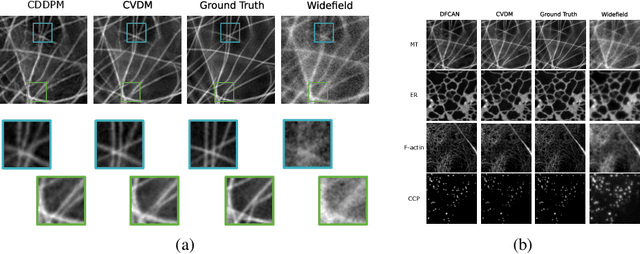


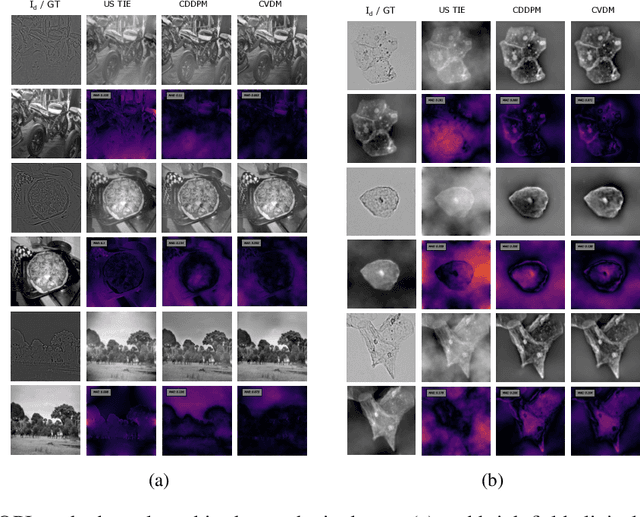
Inverse problems aim to determine parameters from observations, a crucial task in engineering and science. Lately, generative models, especially diffusion models, have gained popularity in this area for their ability to produce realistic solutions and their good mathematical properties. Despite their success, an important drawback of diffusion models is their sensitivity to the choice of variance schedule, which controls the dynamics of the diffusion process. Fine-tuning this schedule for specific applications is crucial but time-costly and does not guarantee an optimal result. We propose a novel approach for learning the schedule as part of the training process. Our method supports probabilistic conditioning on data, provides high-quality solutions, and is flexible, proving able to adapt to different applications with minimum overhead. This approach is tested in two unrelated inverse problems: super-resolution microscopy and quantitative phase imaging, yielding comparable or superior results to previous methods and fine-tuned diffusion models. We conclude that fine-tuning the schedule by experimentation should be avoided because it can be learned during training in a stable way that yields better results.