 Add to Chrome
 Add to Firefox
 Add to Edge
Generative vector search to improve pathology foundation models across multimodal vision-language tasks
Dec 22, 2025
Retrieval-augmented generation improves large language models by grounding outputs in external knowledge sources, reducing hallucinations and addressing knowledge cutoffs. However, standard embedding-based retrieval fails to capture the complexity of multi-concept queries, particularly in domains like biomedicine, where biological data are inherently high-dimensional. For example,omics datasets, and clinical reports simultaneously exhibit numerous molecular, cellular, and physiological features. We present Stochastic Latent Matching (STHLM), a generative vector search method that samples query-conditioned embeddings from text or image inputs to enhance retrieval performance. Analogous to how Chain-of-Thought reasoning enables language models to "think longer" on complex problems, STHLM allows retrieval systems to "search wider" through iterative sampling. STHLM demonstrates critical improvements over classical vector retrieval across diverse benchmarks, including scientific literature, clinical notes, and tissue images, boosting retrieval performance by 10-30% through test-time compute (trading latency for accuracy), while enabling up to a 10-fold compression of embedding dimensions.

Learning Stationary Markov Processes with Contrastive Adjustment
Mar 17, 2023
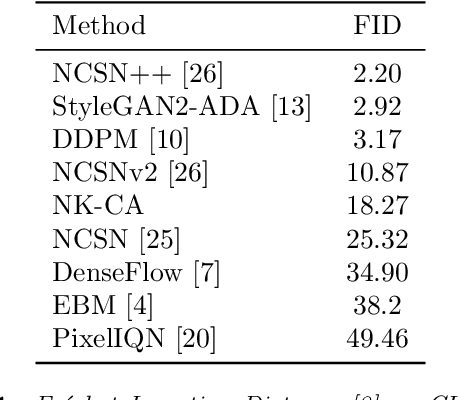
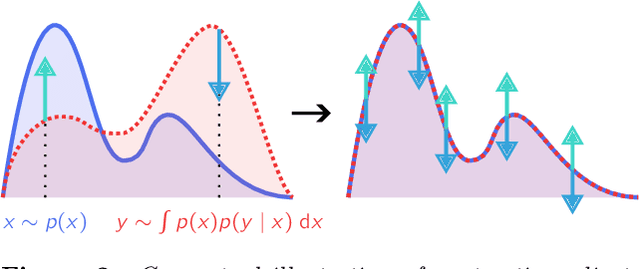
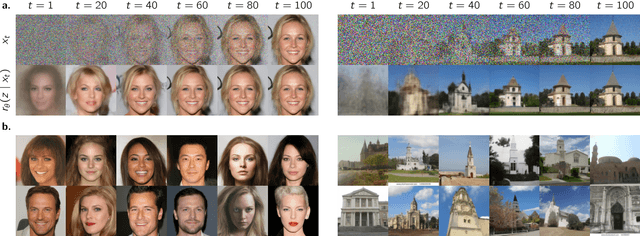
We introduce a new optimization algorithm, termed contrastive adjustment, for learning Markov transition kernels whose stationary distribution matches the data distribution. Contrastive adjustment is not restricted to a particular family of transition distributions and can be used to model data in both continuous and discrete state spaces. Inspired by recent work on noise-annealed sampling, we propose a particular transition operator, the noise kernel, that can trade mixing speed for sample fidelity. We show that contrastive adjustment is highly valuable in human-computer design processes, as the stationarity of the learned Markov chain enables local exploration of the data manifold and makes it possible to iteratively refine outputs by human feedback. We compare the performance of noise kernels trained with contrastive adjustment to current state-of-the-art generative models and demonstrate promising results on a variety of image synthesis tasks.