 Add to Chrome
 Add to Firefox
 Add to Edge
From Division to Decision: Leveraging Temporal Cell-Stage Segmentation for Embryo Transferability Prediction
May 18, 2026
Accurate selection of bovine embryos is a challenging task, as current practice relies on a single expert assessment on the seventh day after insemination, resulting in high rates of pregnancy loss. Time-lapse videomicroscopy provides detailed information on early development, but is difficult to exploit because of complex motion patterns and time-consuming analysis. We propose TransFACT, a transformer-based framework for modeling early developmental stages and embryo transferability using 2D time-lapse videos from the first four days of development. TransFACT combines frame-level temporal features with stage-level representations, using developmental stages as auxiliary supervision to predict transferability on day four. Our experiments demonstrate that TransFACT, by leveraging an existing method designed for action recognition, achieves superior performance than its competitor in predicting embryo transferability.

Supervised contrastive learning for cell stage classification of animal embryos
Feb 11, 2025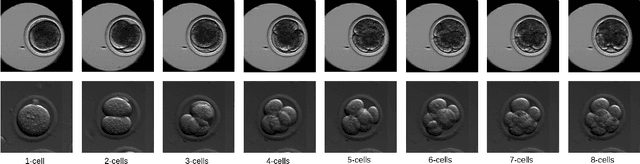
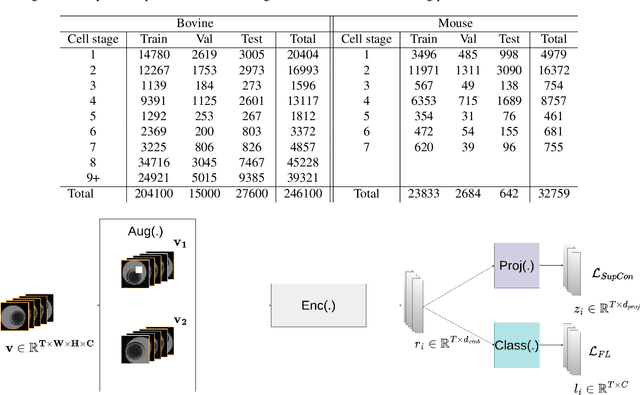
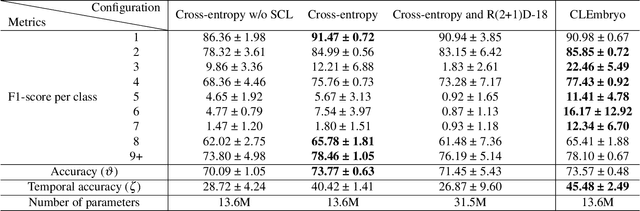

Video microscopy, when combined with machine learning, offers a promising approach for studying the early development of in vitro produced (IVP) embryos. However, manually annotating developmental events, and more specifically cell divisions, is time-consuming for a biologist and cannot scale up for practical applications. We aim to automatically classify the cell stages of embryos from 2D time-lapse microscopy videos with a deep learning approach. We focus on the analysis of bovine embryonic development using video microscopy, as we are primarily interested in the application of cattle breeding, and we have created a Bovine Embryos Cell Stages (ECS) dataset. The challenges are three-fold: (1) low-quality images and bovine dark cells that make the identification of cell stages difficult, (2) class ambiguity at the boundaries of developmental stages, and (3) imbalanced data distribution. To address these challenges, we introduce CLEmbryo, a novel method that leverages supervised contrastive learning combined with focal loss for training, and the lightweight 3D neural network CSN-50 as an encoder. We also show that our method generalizes well. CLEmbryo outperforms state-of-the-art methods on both our Bovine ECS dataset and the publicly available NYU Mouse Embryos dataset.
Early prediction of the transferability of bovine embryos from videomicroscopy
Jan 14, 2025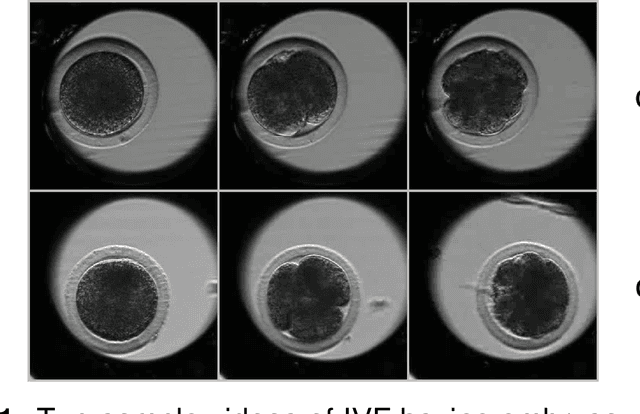
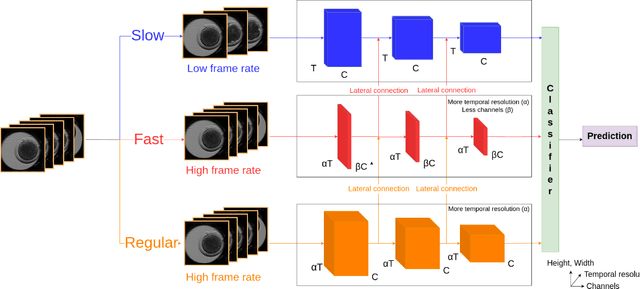
Videomicroscopy is a promising tool combined with machine learning for studying the early development of in vitro fertilized bovine embryos and assessing its transferability as soon as possible. We aim to predict the embryo transferability within four days at most, taking 2D time-lapse microscopy videos as input. We formulate this problem as a supervised binary classification problem for the classes transferable and not transferable. The challenges are three-fold: 1) poorly discriminating appearance and motion, 2) class ambiguity, 3) small amount of annotated data. We propose a 3D convolutional neural network involving three pathways, which makes it multi-scale in time and able to handle appearance and motion in different ways. For training, we retain the focal loss. Our model, named SFR, compares favorably to other methods. Experiments demonstrate its effectiveness and accuracy for our challenging biological task.
* Accepted at the 2024 IEEE International Conference on Image Processing