 Add to Chrome
 Add to Firefox
 Add to Edge
DeepLog: A Software Framework for Modular Neurosymbolic AI
May 11, 2026
DeepLog is an operational neurosymbolic framework that unifies logic and deep learning within standard PyTorch workflows. While existing neurosymbolic systems focus on a particular paradigm and semantics, DeepLog serves as a universal backend that can emulate many systems in the neurosymbolic alphabet soup. By treating diverse neurosymbolic languages as high-level specifications, the DeepLog software automatically compiles them into optimized arithmetic circuits. This design lowers the barrier for machine learning practitioners by treating logic as composable modules, while providing neurosymbolic developers with a shared, high-performance basis for prototyping new integration strategies. The code is available here: https://github.com/ML-KULeuven/deeplog

ProbLog4Fairness: A Neurosymbolic Approach to Modeling and Mitigating Bias
Nov 12, 2025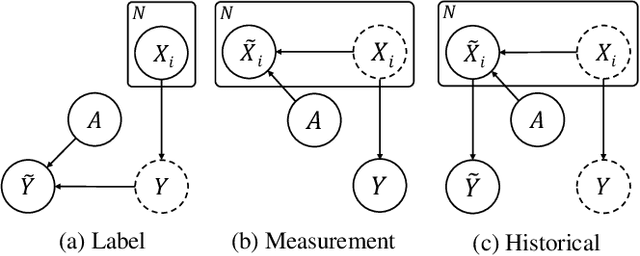

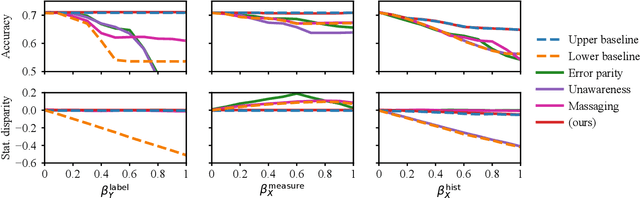

Operationalizing definitions of fairness is difficult in practice, as multiple definitions can be incompatible while each being arguably desirable. Instead, it may be easier to directly describe algorithmic bias through ad-hoc assumptions specific to a particular real-world task, e.g., based on background information on systemic biases in its context. Such assumptions can, in turn, be used to mitigate this bias during training. Yet, a framework for incorporating such assumptions that is simultaneously principled, flexible, and interpretable is currently lacking. Our approach is to formalize bias assumptions as programs in ProbLog, a probabilistic logic programming language that allows for the description of probabilistic causal relationships through logic. Neurosymbolic extensions of ProbLog then allow for easy integration of these assumptions in a neural network's training process. We propose a set of templates to express different types of bias and show the versatility of our approach on synthetic tabular datasets with known biases. Using estimates of the bias distortions present, we also succeed in mitigating algorithmic bias in real-world tabular and image data. We conclude that ProbLog4Fairness outperforms baselines due to its ability to flexibly model the relevant bias assumptions, where other methods typically uphold a fixed bias type or notion of fairness.