 Add to Chrome
 Add to Firefox
 Add to Edge
A self-supervised learning approach to deep filter banks for texture recognition
May 27, 2026
An important challenge in texture recognition is the limited amount of data for training frequently found in real-world applications. In computer vision in general, a successful strategy to mitigate this issue is the use of a pretraining stage where the neural network learns to identify relations between parts of the data in a self-supervised manner. A well-established framework in this direction is masked autoencoder. Nevertheless, these models usually rely on computationally intensive architectures, such as vision transformers. In the particular case of texture images, most of the relevant information is compacted within a delimited area around each pixel, which suggests that capturing long-range dependence via the attention mechanism may be unnecessary. Based on that assumption, here we propose a framework where the pretraining model is a convolutional autoencoder. To leverage the rich information conveyed by texture patterns, we employ deep filters coupled with Fisher vector pooling. In this way, we improve the performance of texture recognition without adding significant computational burden. Our approach is compared with several state-of-the-art methods in different texture databases, confirming its potential both in terms of classification accuracy and computational complexity.

Multilayer deep feature extraction for visual texture recognition
Aug 22, 2022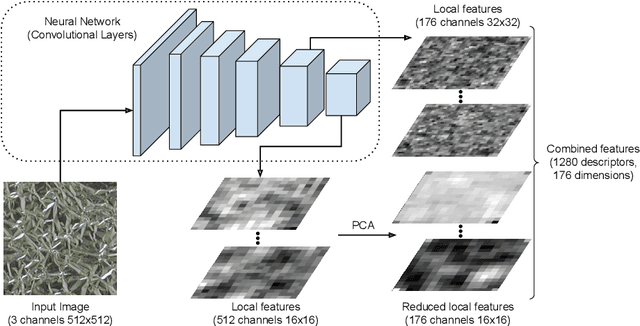
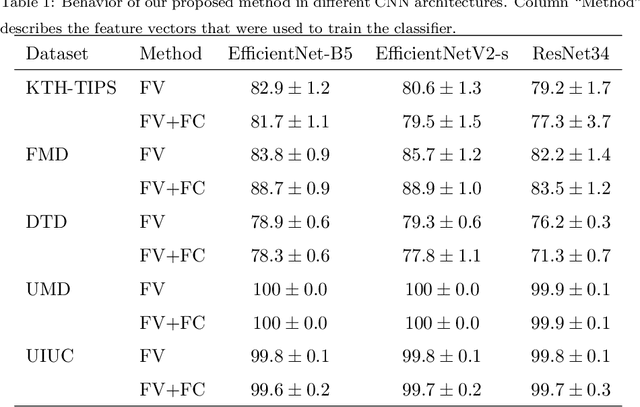
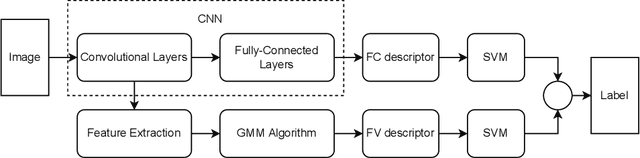
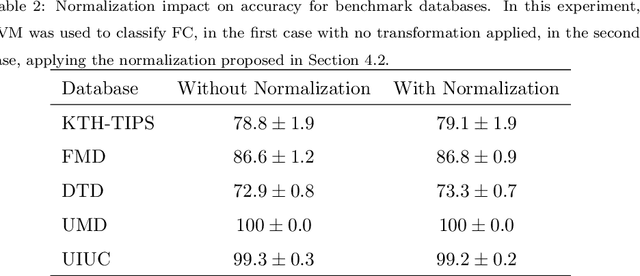
Convolutional neural networks have shown successful results in image classification achieving real-time results superior to the human level. However, texture images still pose some challenge to these models due, for example, to the limited availability of data for training in several problems where these images appear, high inter-class similarity, the absence of a global viewpoint of the object represented, and others. In this context, the present paper is focused on improving the accuracy of convolutional neural networks in texture classification. This is done by extracting features from multiple convolutional layers of a pretrained neural network and aggregating such features using Fisher vector. The reason for using features from earlier convolutional layers is obtaining information that is less domain specific. We verify the effectiveness of our method on texture classification of benchmark datasets, as well as on a practical task of Brazilian plant species identification. In both scenarios, Fisher vectors calculated on multiple layers outperform state-of-art methods, confirming that early convolutional layers provide important information about the texture image for classification.