 Add to Chrome
 Add to Firefox
 Add to Edge
Crab: Multi Layer Contrastive Supervision to Improve Speech Emotion Recognition Under Both Acted and Natural Speech Condition
Mar 24, 2026
Speech Emotion Recognition (SER) in real-world scenarios remains challenging due to severe class imbalance and the prevalence of spontaneous, natural speech. While recent approaches leverage self-supervised learning (SSL) representations and multimodal fusion of speech and text, most existing methods apply supervision only at the final classification layer, limiting the discriminative power of intermediate representations. In this work, we propose Crab (Contrastive Representation and Multimodal Aligned Bottleneck), a bimodal Cross-Modal Transformer architecture that integrates speech representations from WavLM and textual representations from RoBERTa, together with a novel \textit{Multi Layer Contrastive Supervision} (MLCS) strategy. MLCS injects multi-positive contrastive learning signals at multiple layers of the network, encouraging emotionally discriminative representations throughout the model without introducing additional parameters at inference time. To further address data imbalance, we adopt weighted cross-entropy during training. We evaluate the proposed approach on three benchmark datasets covering different degrees of emotional naturalness: IEMOCAP, MELD, and MSP-Podcast 2.0. Experimental results demonstrate that Crab consistently outperforms strong unimodal and multimodal baselines across all datasets, with particularly large gains under naturalistic and highly imbalanced conditions. These findings highlight the effectiveness of \textit{Multi Layer Contrastive Supervision} as a general and robust strategy for SER. Official implementation can be found in https://github.com/AI-Unicamp/Crab.

SelfTTS: cross-speaker style transfer through explicit embedding disentanglement and self-refinement using self-augmentation
Mar 23, 2026This paper presents SelfTTS, a text-to-speech (TTS) model designed for cross-speaker style transfer that eliminates the need for external pre-trained speaker or emotion encoders. The architecture achieves emotional expressivity in neutral speakers through an explicit disentanglement strategy utilizing Gradient Reversal Layers (GRL) combined with cosine similarity loss to decouple speaker and emotion information. We introduce Multi Positive Contrastive Learning (MPCL) to induce clustered representations of speaker and emotion embeddings based on their respective labels. Furthermore, SelfTTS employs a self-refinement strategy via Self-Augmentation, exploiting the model's voice conversion capabilities to enhance the naturalness of synthesized speech. Experimental results demonstrate that SelfTTS achieves superior emotional naturalness (eMOS) and robust stability in target timbre and emotion compared to state-of-the-art baselines.
Improving Data Augmentation-based Cross-Speaker Style Transfer for TTS with Singing Voice, Style Filtering, and F0 Matching
Oct 08, 2024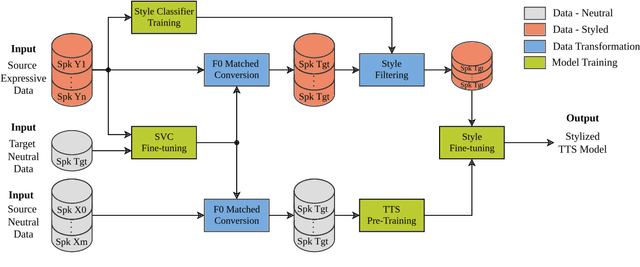
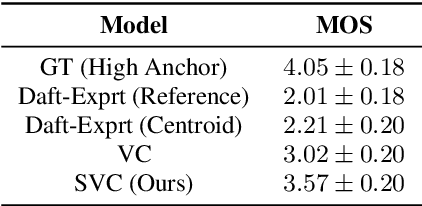
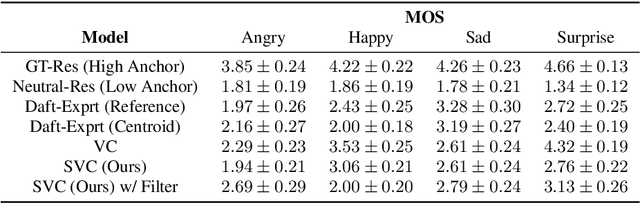
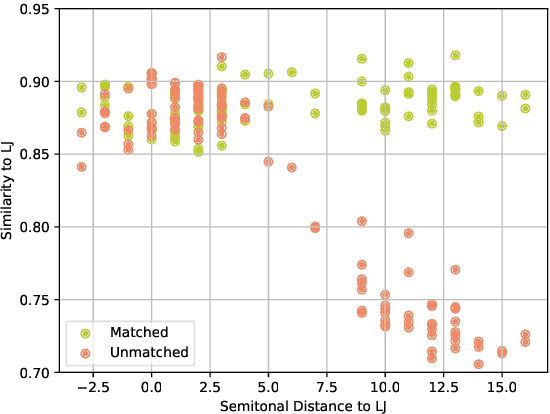
The goal of cross-speaker style transfer in TTS is to transfer a speech style from a source speaker with expressive data to a target speaker with only neutral data. In this context, we propose using a pre-trained singing voice conversion (SVC) model to convert the expressive data into the target speaker's voice. In the conversion process, we apply a fundamental frequency (F0) matching technique to mitigate tonal variances between speakers with significant timbral differences. A style classifier filter is proposed to select the most expressive output audios for the TTS training. Our approach is comparable to state-of-the-art with only a few minutes of neutral data from the target speaker, while other methods require hours. A perceptual assessment showed improvements brought by the SVC and the style filter in naturalness and style intensity for the styles that display more vocal effort. Also, increased speaker similarity is obtained with the proposed F0 matching algorithm.
Exploring synthetic data for cross-speaker style transfer in style representation based TTS
Sep 25, 2024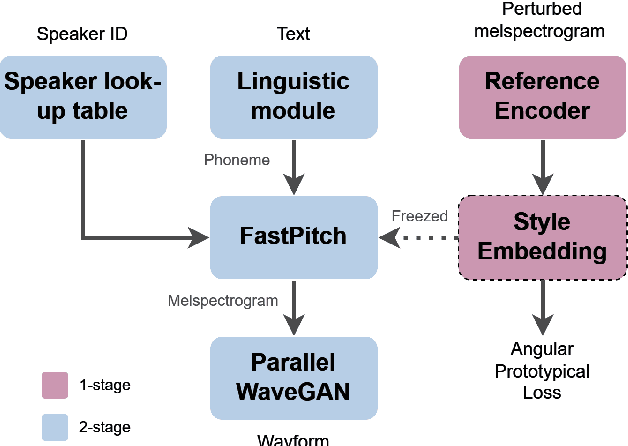
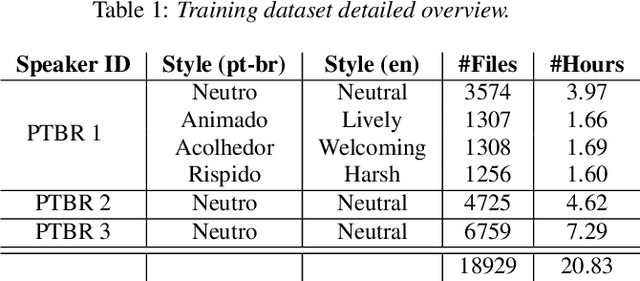
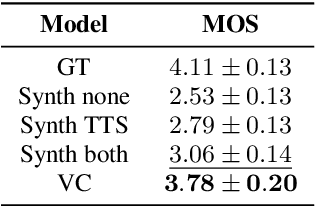
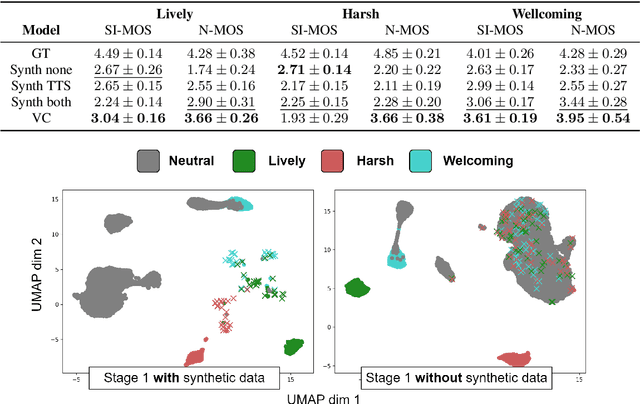
Incorporating cross-speaker style transfer in text-to-speech (TTS) models is challenging due to the need to disentangle speaker and style information in audio. In low-resource expressive data scenarios, voice conversion (VC) can generate expressive speech for target speakers, which can then be used to train the TTS model. However, the quality and style transfer ability of the VC model are crucial for the overall TTS model quality. In this work, we explore the use of synthetic data generated by a VC model to assist the TTS model in cross-speaker style transfer tasks. Additionally, we employ pre-training of the style encoder using timbre perturbation and prototypical angular loss to mitigate speaker leakage. Our results show that using VC synthetic data can improve the naturalness and speaker similarity of TTS in cross-speaker scenarios. Furthermore, we extend this approach to a cross-language scenario, enhancing accent transfer.