 Add to Chrome
 Add to Firefox
 Add to Edge
Semantic-Aware Confidence Calibration for Automated Audio Captioning
Dec 11, 2025
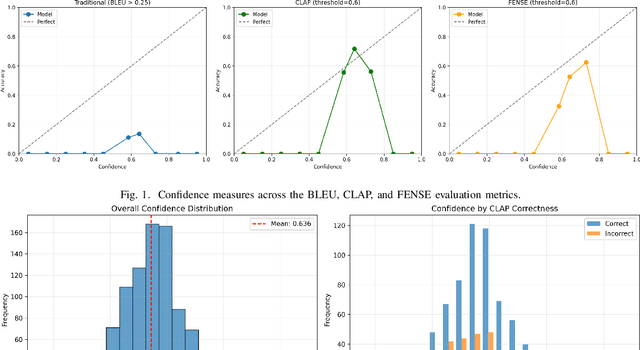
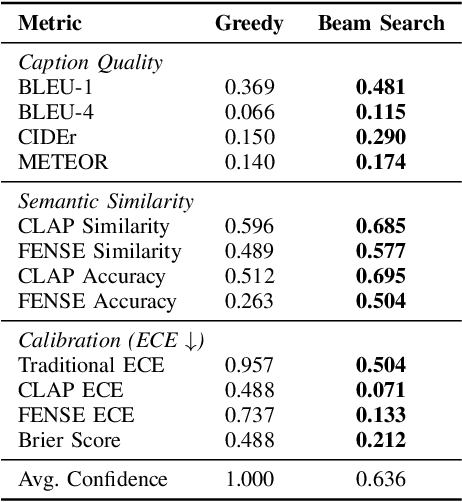
Automated audio captioning models frequently produce overconfident predictions regardless of semantic accuracy, limiting their reliability in deployment. This deficiency stems from two factors: evaluation metrics based on n-gram overlap that fail to capture semantic correctness, and the absence of calibrated confidence estimation. We present a framework that addresses both limitations by integrating confidence prediction into audio captioning and redefining correctness through semantic similarity. Our approach augments a Whisper-based audio captioning model with a learned confidence prediction head that estimates uncertainty from decoder hidden states. We employ CLAP audio-text embeddings and sentence transformer similarities (FENSE) to define semantic correctness, enabling Expected Calibration Error (ECE) computation that reflects true caption quality rather than surface-level text overlap. Experiments on Clotho v2 demonstrate that confidence-guided beam search with semantic evaluation achieves dramatically improved calibration (CLAP-based ECE of 0.071) compared to greedy decoding baselines (ECE of 0.488), while simultaneously improving caption quality across standard metrics. Our results establish that semantic similarity provides a more meaningful foundation for confidence calibration in audio captioning than traditional n-gram metrics.

Source Separation & Automatic Transcription for Music
Dec 09, 2024Source separation is the process of isolating individual sounds in an auditory mixture of multiple sounds [1], and has a variety of applications ranging from speech enhancement and lyric transcription [2] to digital audio production for music. Furthermore, Automatic Music Transcription (AMT) is the process of converting raw music audio into sheet music that musicians can read [3]. Historically, these tasks have faced challenges such as significant audio noise, long training times, and lack of free-use data due to copyright restrictions. However, recent developments in deep learning have brought new promising approaches to building low-distortion stems and generating sheet music from audio signals [4]. Using spectrogram masking, deep neural networks, and the MuseScore API, we attempt to create an end-to-end pipeline that allows for an initial music audio mixture (e.g...wav file) to be separated into instrument stems, converted into MIDI files, and transcribed into sheet music for each component instrument.