 Add to Chrome
 Add to Firefox
 Add to Edge
Can You Hear Me Now? A Benchmark for Long-Range Graph Propagation
Dec 19, 2025
Effectively capturing long-range interactions remains a fundamental yet unresolved challenge in graph neural network (GNN) research, critical for applications across diverse fields of science. To systematically address this, we introduce ECHO (Evaluating Communication over long HOps), a novel benchmark specifically designed to rigorously assess the capabilities of GNNs in handling very long-range graph propagation. ECHO includes three synthetic graph tasks, namely single-source shortest paths, node eccentricity, and graph diameter, each constructed over diverse and structurally challenging topologies intentionally designed to introduce significant information bottlenecks. ECHO also includes two real-world datasets, ECHO-Charge and ECHO-Energy, which define chemically grounded benchmarks for predicting atomic partial charges and molecular total energies, respectively, with reference computations obtained at the density functional theory (DFT) level. Both tasks inherently depend on capturing complex long-range molecular interactions. Our extensive benchmarking of popular GNN architectures reveals clear performance gaps, emphasizing the difficulty of true long-range propagation and highlighting design choices capable of overcoming inherent limitations. ECHO thereby sets a new standard for evaluating long-range information propagation, also providing a compelling example for its need in AI for science.

Towards Efficient Molecular Property Optimization with Graph Energy Based Models
Feb 17, 2025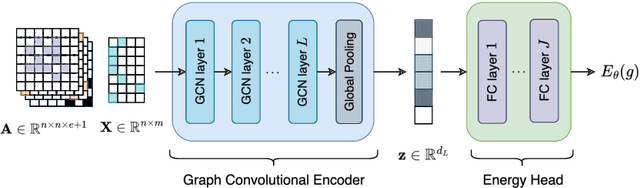
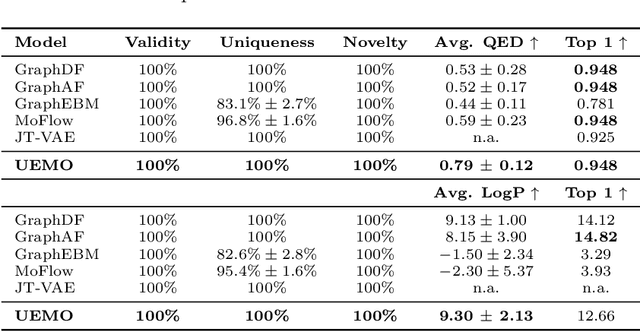
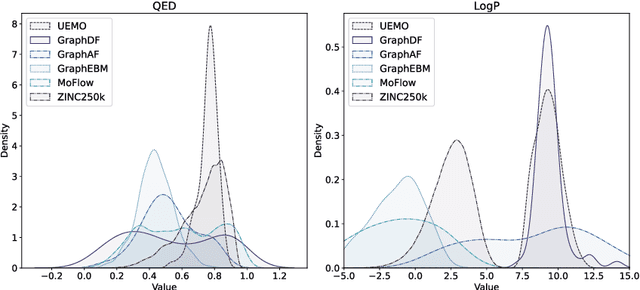

Optimizing chemical properties is a challenging task due to the vastness and complexity of chemical space. Here, we present a generative energy-based architecture for implicit chemical property optimization, designed to efficiently generate molecules that satisfy target properties without explicit conditional generation. We use Graph Energy Based Models and a training approach that does not require property labels. We validated our approach on well-established chemical benchmarks, showing superior results to state-of-the-art methods and demonstrating robustness and efficiency towards de novo drug design.
On the effectiveness of smartphone IMU sensors and Deep Learning in the detection of cardiorespiratory conditions
Aug 27, 2024This research introduces an innovative method for the early screening of cardiorespiratory diseases based on an acquisition protocol, which leverages commodity smartphone's Inertial Measurement Units (IMUs) and deep learning techniques. We collected, in a clinical setting, a dataset featuring recordings of breathing kinematics obtained by accelerometer and gyroscope readings from five distinct body regions. We propose an end-to-end deep learning pipeline for early cardiorespiratory disease screening, incorporating a preprocessing step segmenting the data into individual breathing cycles, and a recurrent bidirectional module capturing features from diverse body regions. We employed Leave-one-out-cross-validation with Bayesian optimization for hyperparameter tuning and model selection. The experimental results consistently demonstrated the superior performance of a bidirectional Long-Short Term Memory (Bi-LSTM) as a feature encoder architecture, yielding an average sensitivity of $0.81 \pm 0.02$, specificity of $0.82 \pm 0.05$, F1 score of $0.81 \pm 0.02$, and accuracy of $80.2\% \pm 3.9$ across diverse seed variations. We also assessed generalization capabilities on a skewed distribution, comprising exclusively healthy patients not used in training, revealing a true negative rate of $74.8 \% \pm 4.5$. The sustained accuracy of predictions over time during breathing cycles within a single patient underscores the efficacy of the preprocessing strategy, highlighting the model's ability to discern significant patterns throughout distinct phases of the respiratory cycle. This investigation underscores the potential usefulness of widely available smartphones as devices for timely cardiorespiratory disease screening in the general population, in at-home settings, offering crucial assistance to public health efforts (especially during a pandemic outbreaks, such as the recent COVID-19).