 Add to Chrome
 Add to Firefox
 Add to Edge
Beyond Questions: Evaluating What Large Language Models (Actually) Know
May 26, 2026
Parametric knowledge in large language models (LLMs) is a cornerstone of their success, yet remains poorly understood. Existing knowledge benchmarks typically rely on predefined questions (e.g., "What is the birth date of M.L. King?"), evaluating only knowledge that benchmark designers explicitly choose to query, a problematic availability bias. In this paper, we introduce open knowledge evaluation, a new paradigm for LLM knowledge benchmarking. Instead of asking narrow questions, it evaluates models on the knowledge they choose to surface in response to open-ended elicitation prompts (e.g., "Tell me everything you know about M.L. King"). This shifts the focus from predefined answer retrieval toward characterizing the knowledge models naturally express. We instantiate this paradigm with BeQu (Beyond Questions), a benchmark of 10,000 entities paired with reference corpora for statement verification. Using BeQu, we evaluate a broad range of language models and analyze the effects of reasoning effort, model scale, prompt format, and knowledge domain. Data and leaderboard are available on this work's GitHub repository and at the benchmark's website.

Mining the Mind: What 100M Beliefs Reveal About Frontier LLM Knowledge
Oct 08, 2025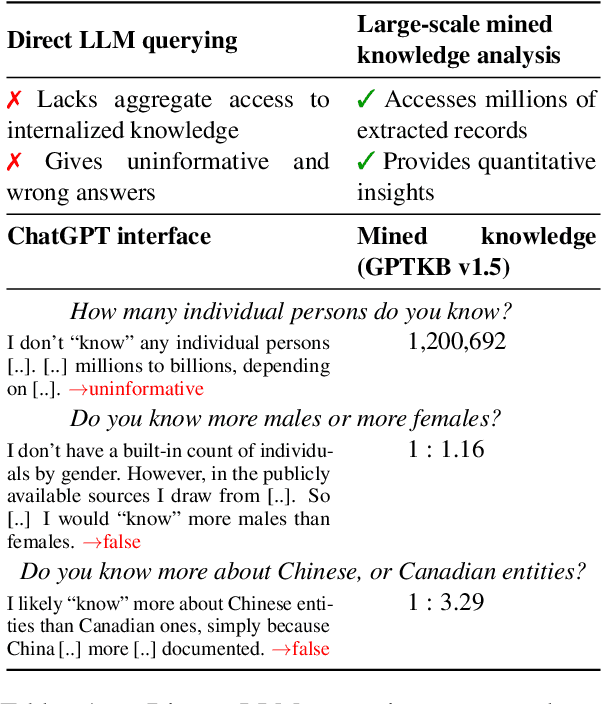
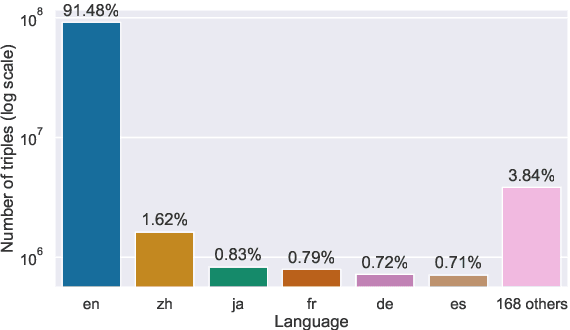
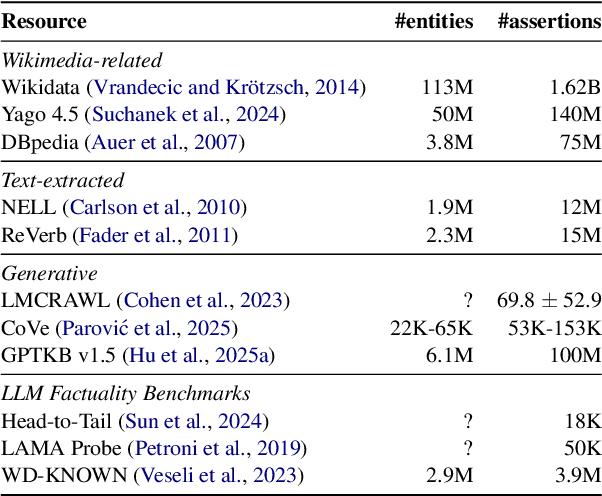
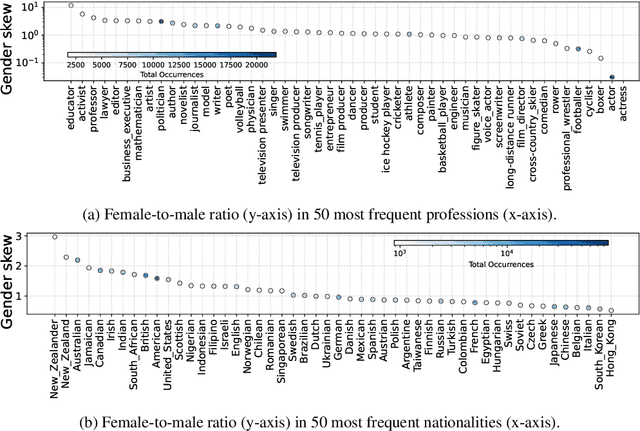
LLMs are remarkable artifacts that have revolutionized a range of NLP and AI tasks. A significant contributor is their factual knowledge, which, to date, remains poorly understood, and is usually analyzed from biased samples. In this paper, we take a deep tour into the factual knowledge (or beliefs) of a frontier LLM, based on GPTKB v1.5 (Hu et al., 2025a), a recursively elicited set of 100 million beliefs of one of the strongest currently available frontier LLMs, GPT-4.1. We find that the models' factual knowledge differs quite significantly from established knowledge bases, and that its accuracy is significantly lower than indicated by previous benchmarks. We also find that inconsistency, ambiguity and hallucinations are major issues, shedding light on future research opportunities concerning factual LLM knowledge.