 Add to Chrome
 Add to Firefox
 Add to Edge
Rashomon Sets and Model Multiplicity in Federated Learning
Feb 10, 2026
The Rashomon set captures the collection of models that achieve near-identical empirical performance yet may differ substantially in their decision boundaries. Understanding the differences among these models, i.e., their multiplicity, is recognized as a crucial step toward model transparency, fairness, and robustness, as it reveals decision boundaries instabilities that standard metrics obscure. However, the existing definitions of Rashomon set and multiplicity metrics assume centralized learning and do not extend naturally to decentralized, multi-party settings like Federated Learning (FL). In FL, multiple clients collaboratively train models under a central server's coordination without sharing raw data, which preserves privacy but introduces challenges from heterogeneous client data distribution and communication constraints. In this setting, the choice of a single best model may homogenize predictive behavior across diverse clients, amplify biases, or undermine fairness guarantees. In this work, we provide the first formalization of Rashomon sets in FL.First, we adapt the Rashomon set definition to FL, distinguishing among three perspectives: (I) a global Rashomon set defined over aggregated statistics across all clients, (II) a t-agreement Rashomon set representing the intersection of local Rashomon sets across a fraction t of clients, and (III) individual Rashomon sets specific to each client's local distribution.Second, we show how standard multiplicity metrics can be estimated under FL's privacy constraints. Finally, we introduce a multiplicity-aware FL pipeline and conduct an empirical study on standard FL benchmark datasets. Our results demonstrate that all three proposed federated Rashomon set definitions offer valuable insights, enabling clients to deploy models that better align with their local data, fairness considerations, and practical requirements.

PUFFLE: Balancing Privacy, Utility, and Fairness in Federated Learning
Jul 21, 2024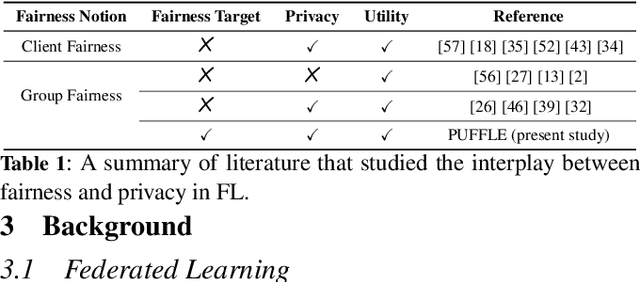
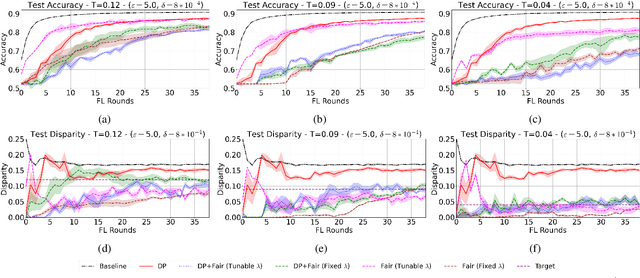
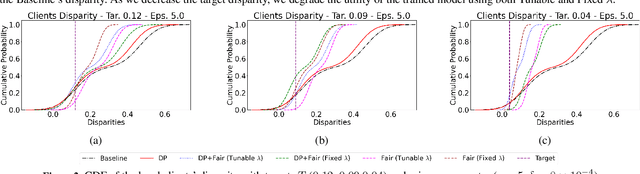
Training and deploying Machine Learning models that simultaneously adhere to principles of fairness and privacy while ensuring good utility poses a significant challenge. The interplay between these three factors of trustworthiness is frequently underestimated and remains insufficiently explored. Consequently, many efforts focus on ensuring only two of these factors, neglecting one in the process. The decentralization of the datasets and the variations in distributions among the clients exacerbate the complexity of achieving this ethical trade-off in the context of Federated Learning (FL). For the first time in FL literature, we address these three factors of trustworthiness. We introduce PUFFLE, a high-level parameterised approach that can help in the exploration of the balance between utility, privacy, and fairness in FL scenarios. We prove that PUFFLE can be effective across diverse datasets, models, and data distributions, reducing the model unfairness up to 75%, with a maximum reduction in the utility of 17% in the worst-case scenario, while maintaining strict privacy guarantees during the FL training.