 Add to Chrome
 Add to Firefox
 Add to Edge
Singular Value Decomposition and Entropy Dimension of Fractals
Nov 15, 2022
We analyze the singular value decomposition (SVD) and SVD entropy of Cantor fractals produced by the Kronecker product. Our primary results show that SVD entropy is a measure of image ``complexity dimension" that is invariant under the number of Kronecker-product self-iterations (i.e., fractal order). SVD entropy is therefore similar to the fractal Hausdorff complexity dimension but suitable for characterizing fractal wave phenomena. Our field-based normalization (Renyi entropy index = 1) illustrates the uncommon step-shaped and cluster-patterned distributions of the fractal singular values and their SVD entropy. As a modal measure of complexity, SVD entropy has uses for a variety of wireless communication, free-space optical, and remote sensing applications.

Small-brain neural networks rapidly solve inverse problems with vortex Fourier encoders
May 15, 2020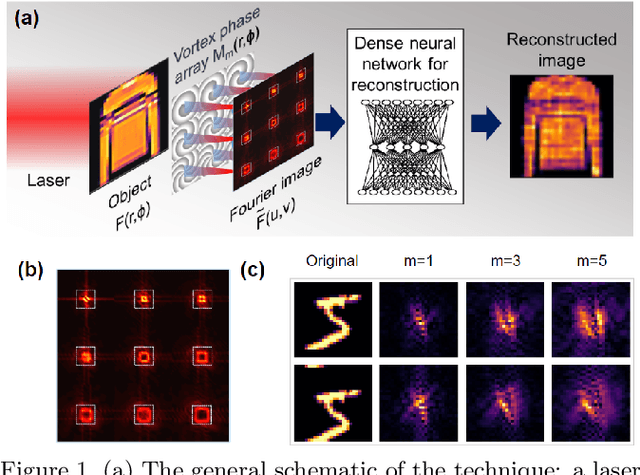
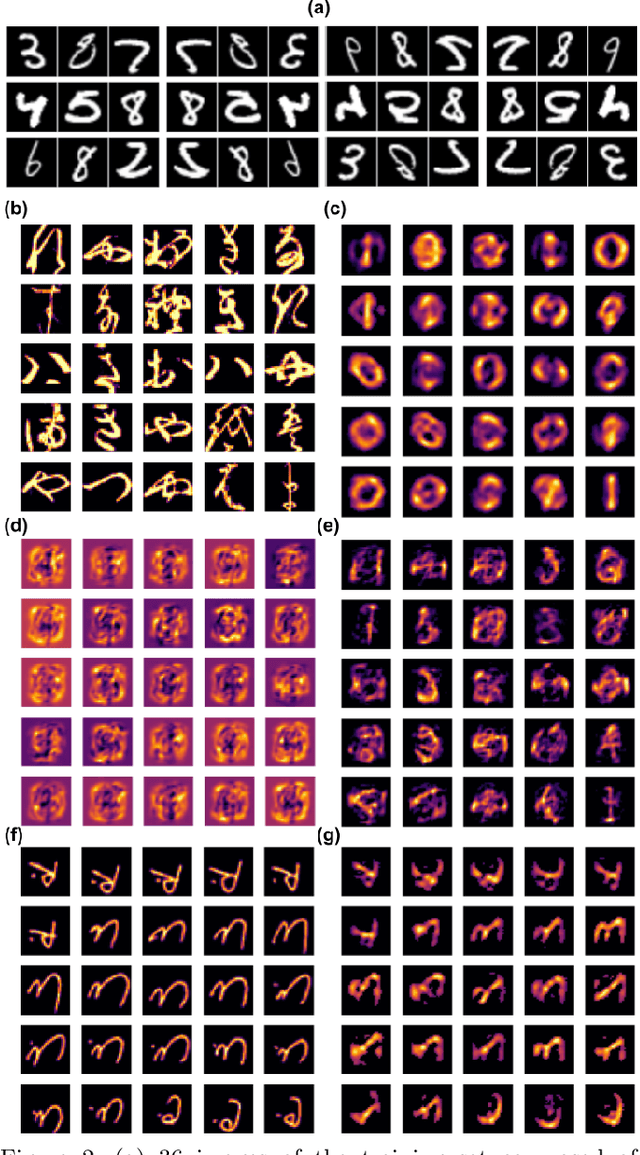
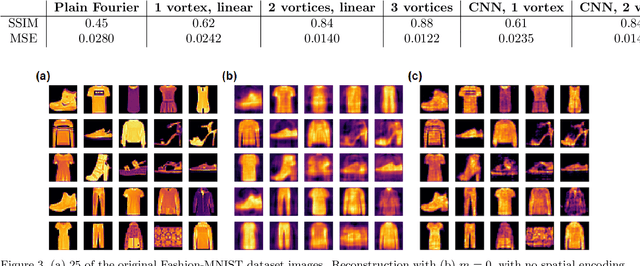
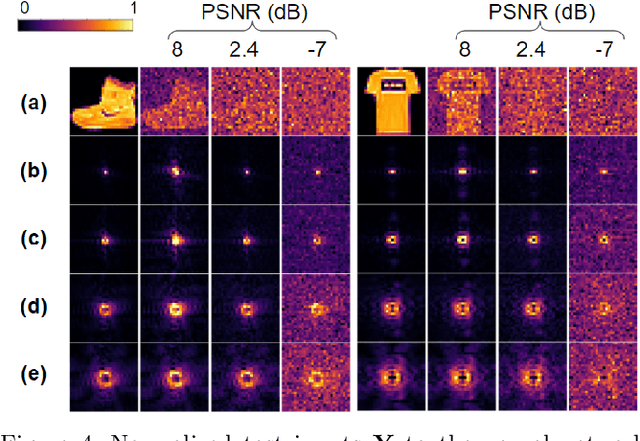
We introduce a vortex phase transform with a lenslet-array to accompany shallow, dense, ``small-brain'' neural networks for high-speed and low-light imaging. Our single-shot ptychographic approach exploits the coherent diffraction, compact representation, and edge enhancement of Fourier-tranformed spiral-phase gradients. With vortex spatial encoding, a small brain is trained to deconvolve images at rates 5-20 times faster than those achieved with random encoding schemes, where greater advantages are gained in the presence of noise. Once trained, the small brain reconstructs an object from intensity-only data, solving an inverse mapping without performing iterations on each image and without deep-learning schemes. With this hybrid, optical-digital, vortex Fourier encoded, small-brain scheme, we reconstruct MNIST Fashion objects illuminated with low-light flux (5 nJ/cm$^2$) at a rate of several thousand frames per second on a 15 W central processing unit, two orders of magnitude faster than convolutional neural networks.