 Add to Chrome
 Add to Firefox
 Add to Edge
Neuro-symbolic Zero-Shot Code Cloning with Cross-Language Intermediate Representation
Apr 26, 2023
In this paper, we define a neuro-symbolic approach to address the task of finding semantically similar clones for the codes of the legacy programming language COBOL, without training data. We define a meta-model that is instantiated to have an Intermediate Representation (IR) in the form of Abstract Syntax Trees (ASTs) common across codes in C and COBOL. We linearize the IRs using Structure Based Traversal (SBT) to create sequential inputs. We further fine-tune UnixCoder, the best-performing model for zero-shot cross-programming language code search, for the Code Cloning task with the SBT IRs of C code-pairs, available in the CodeNet dataset. This allows us to learn latent representations for the IRs of the C codes, which are transferable to the IRs of the COBOL codes. With this fine-tuned UnixCoder, we get a performance improvement of 12.85 MAP@2 over the pre-trained UniXCoder model, in a zero-shot setting, on the COBOL test split synthesized from the CodeNet dataset. This demonstrates the efficacy of our meta-model based approach to facilitate cross-programming language transfer.

DeepEpiSolver: Unravelling Inverse problems in Covid, HIV, Ebola and Disease Transmission
Mar 24, 2023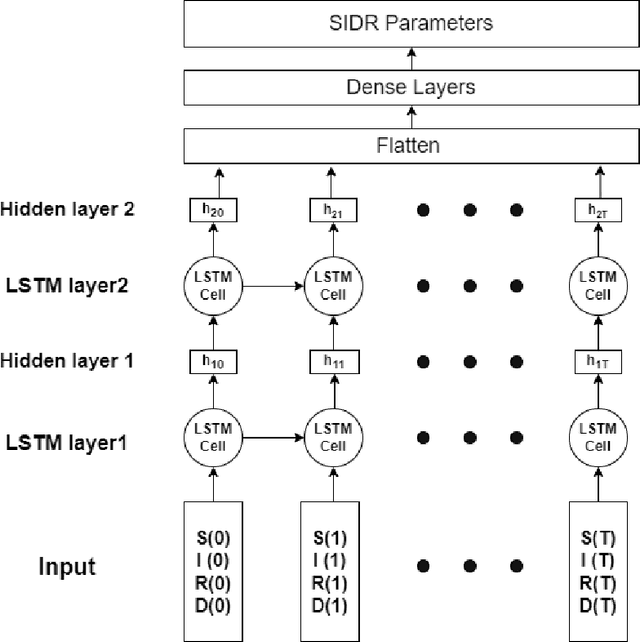
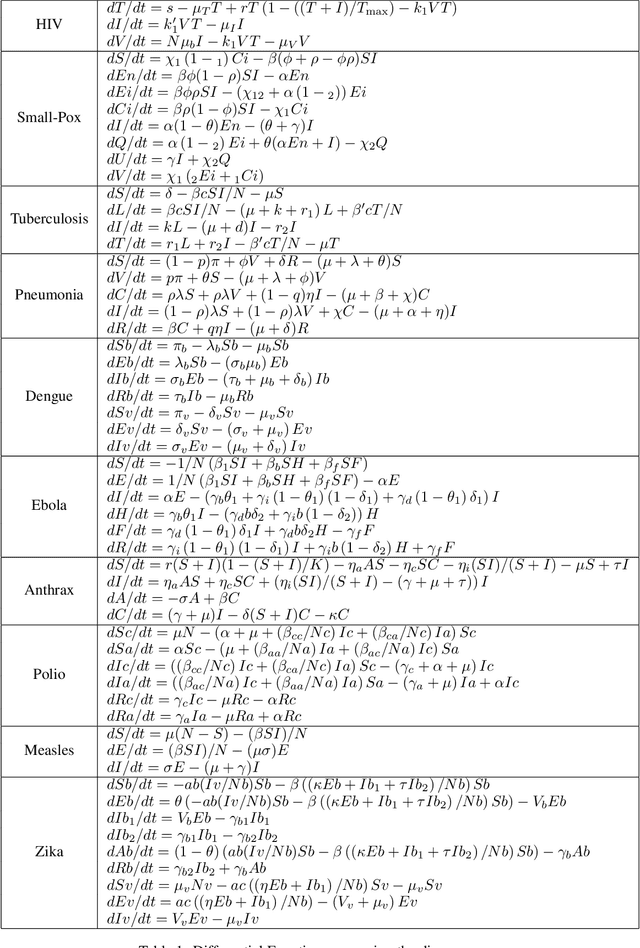
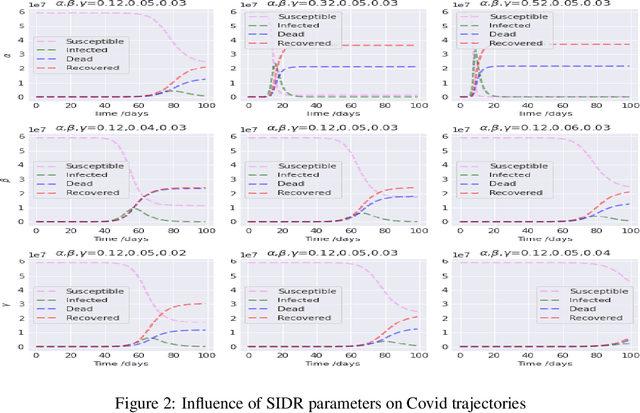
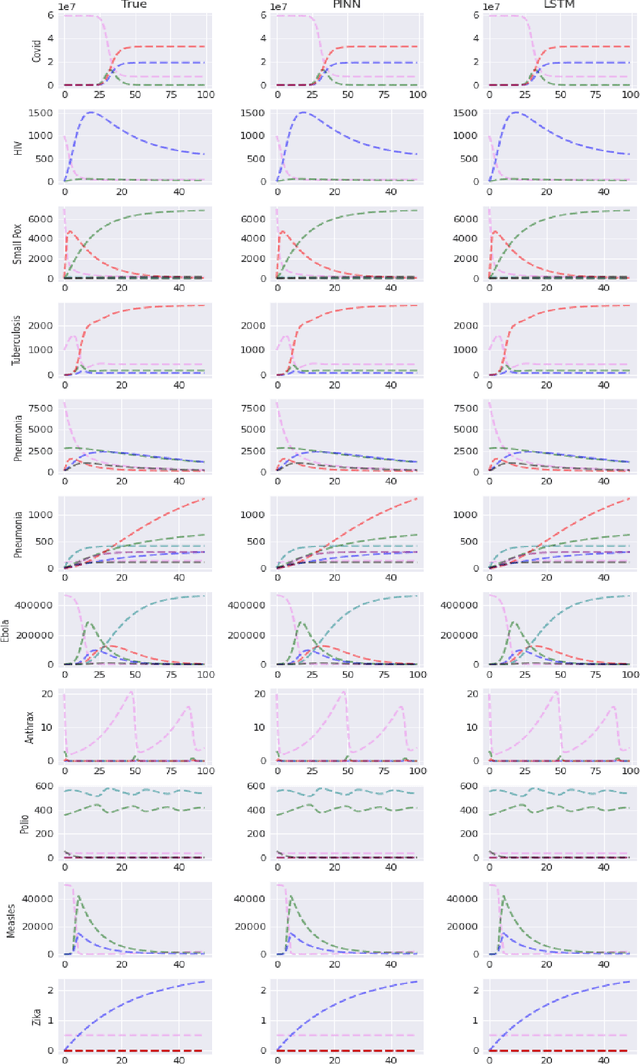
The spread of many infectious diseases is modeled using variants of the SIR compartmental model, which is a coupled differential equation. The coefficients of the SIR model determine the spread trajectories of disease, on whose basis proactive measures can be taken. Hence, the coefficient estimates must be both fast and accurate. Shaier et al. in the paper "Disease Informed Neural Networks" used Physics Informed Neural Networks (PINNs) to estimate the parameters of the SIR model. There are two drawbacks to this approach. First, the training time for PINNs is high, with certain diseases taking close to 90 hrs to train. Second, PINNs don't generalize for a new SIDR trajectory, and learning its corresponding SIR parameters requires retraining the PINN from scratch. In this work, we aim to eliminate both of these drawbacks. We generate a dataset between the parameters of ODE and the spread trajectories by solving the forward problem for a large distribution of parameters using the LSODA algorithm. We then use a neural network to learn the mapping between spread trajectories and coefficients of SIDR in an offline manner. This allows us to learn the parameters of a new spread trajectory without having to retrain, enabling generalization at test time. We observe a speed-up of 3-4 orders of magnitude with accuracy comparable to that of PINNs for 11 highly infectious diseases. Further finetuning of neural network inferred ODE coefficients using PINN further leads to 2-3 orders improvement of estimated coefficients.
Knowledge Transfer for Pseudo-code Generation from Low Resource Programming Language
Mar 16, 2023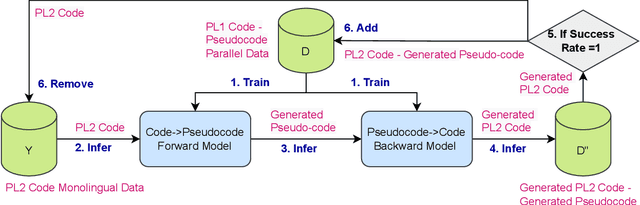
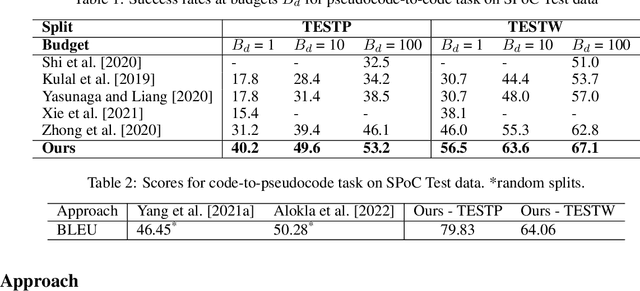


Generation of pseudo-code descriptions of legacy source code for software maintenance is a manually intensive task. Recent encoder-decoder language models have shown promise for automating pseudo-code generation for high resource programming languages such as C++, but are heavily reliant on the availability of a large code-pseudocode corpus. Soliciting such pseudocode annotations for codes written in legacy programming languages (PL) is a time consuming and costly affair requiring a thorough understanding of the source PL. In this paper, we focus on transferring the knowledge acquired by the code-to-pseudocode neural model trained on a high resource PL (C++) using parallel code-pseudocode data. We aim to transfer this knowledge to a legacy PL (C) with no PL-pseudocode parallel data for training. To achieve this, we utilize an Iterative Back Translation (IBT) approach with a novel test-cases based filtration strategy, to adapt the trained C++-to-pseudocode model to C-to-pseudocode model. We observe an improvement of 23.27% in the success rate of the generated C codes through back translation, over the successive IBT iteration, illustrating the efficacy of our approach.
Symbolic Regression for PDEs using Pruned Differentiable Programs
Mar 13, 2023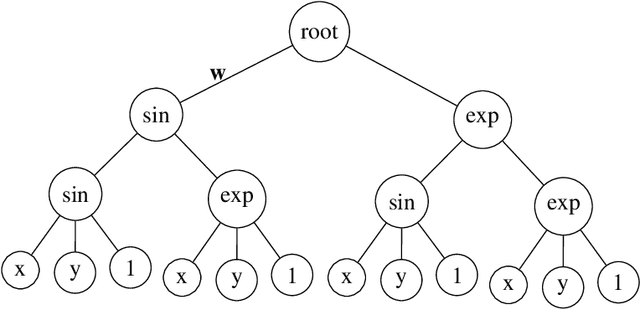
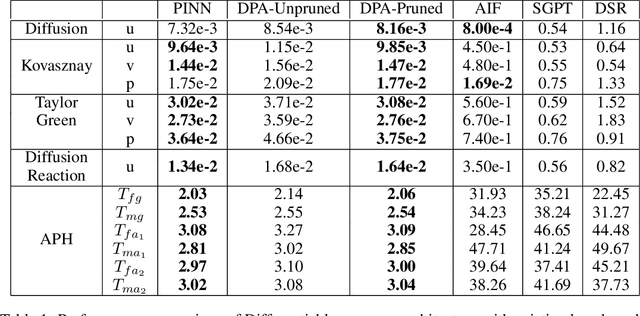
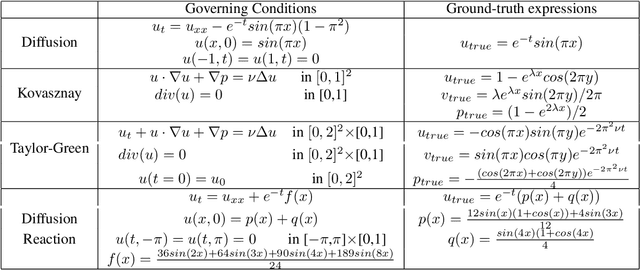
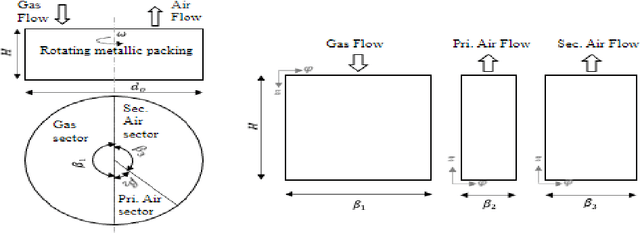
Physics-informed Neural Networks (PINNs) have been widely used to obtain accurate neural surrogates for a system of Partial Differential Equations (PDE). One of the major limitations of PINNs is that the neural solutions are challenging to interpret, and are often treated as black-box solvers. While Symbolic Regression (SR) has been studied extensively, very few works exist which generate analytical expressions to directly perform SR for a system of PDEs. In this work, we introduce an end-to-end framework for obtaining mathematical expressions for solutions of PDEs. We use a trained PINN to generate a dataset, upon which we perform SR. We use a Differentiable Program Architecture (DPA) defined using context-free grammar to describe the space of symbolic expressions. We improve the interpretability by pruning the DPA in a depth-first manner using the magnitude of weights as our heuristic. On average, we observe a 95.3% reduction in parameters of DPA while maintaining accuracy at par with PINNs. Furthermore, on an average, pruning improves the accuracy of DPA by 7.81% . We demonstrate our framework outperforms the existing state-of-the-art SR solvers on systems of complex PDEs like Navier-Stokes: Kovasznay flow and Taylor-Green Vortex flow. Furthermore, we produce analytical expressions for a complex industrial use-case of an Air-Preheater, without suffering from performance loss viz-a-viz PINNs.
IKD+: Reliable Low Complexity Deep Models For Retinopathy Classification
Mar 04, 2023
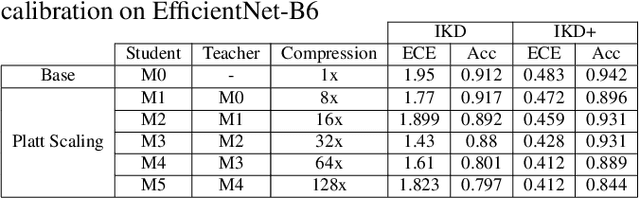
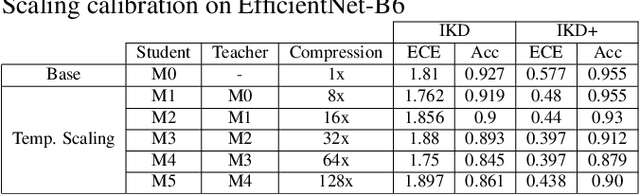
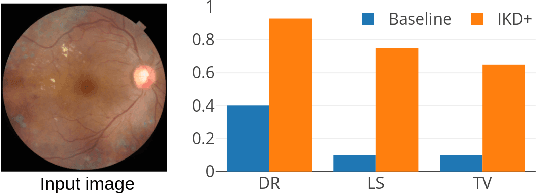
Deep neural network (DNN) models for retinopathy have estimated predictive accuracies in the mid-to-high 90%. However, the following aspects remain unaddressed: State-of-the-art models are complex and require substantial computational infrastructure to train and deploy; The reliability of predictions can vary widely. In this paper, we focus on these aspects and propose a form of iterative knowledge distillation(IKD), called IKD+ that incorporates a tradeoff between size, accuracy and reliability. We investigate the functioning of IKD+ using two widely used techniques for estimating model calibration (Platt-scaling and temperature-scaling), using the best-performing model available, which is an ensemble of EfficientNets with approximately 100M parameters. We demonstrate that IKD+ equipped with temperature-scaling results in models that show up to approximately 500-fold decreases in the number of parameters than the original ensemble without a significant loss in accuracy. In addition, calibration scores (reliability) for the IKD+ models are as good as or better than the base mode
Domain-Specific Pretraining Improves Confidence in Whole Slide Image Classification
Feb 20, 2023Whole Slide Images (WSIs) or histopathology images are used in digital pathology. WSIs pose great challenges to deep learning models for clinical diagnosis, owing to their size and lack of pixel-level annotations. With the recent advancements in computational pathology, newer multiple-instance learning-based models have been proposed. Multiple-instance learning for WSIs necessitates creating patches and uses the encoding of these patches for diagnosis. These models use generic pre-trained models (ResNet-50 pre-trained on ImageNet) for patch encoding. The recently proposed KimiaNet, a DenseNet121 model pre-trained on TCGA slides, is a domain-specific pre-trained model. This paper shows the effect of domain-specific pre-training on WSI classification. To investigate the impact of domain-specific pre-training, we considered the current state-of-the-art multiple-instance learning models, 1) CLAM, an attention-based model, and 2) TransMIL, a self-attention-based model, and evaluated the models' confidence and predictive performance in detecting primary brain tumors - gliomas. Domain-specific pre-training improves the confidence of the models and also achieves a new state-of-the-art performance of WSI-based glioma subtype classification, showing a high clinical applicability in assisting glioma diagnosis.
Do I have the Knowledge to Answer? Investigating Answerability of Knowledge Base Questions
Dec 20, 2022

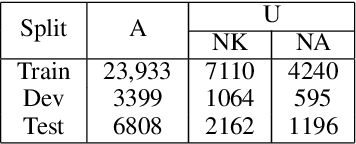
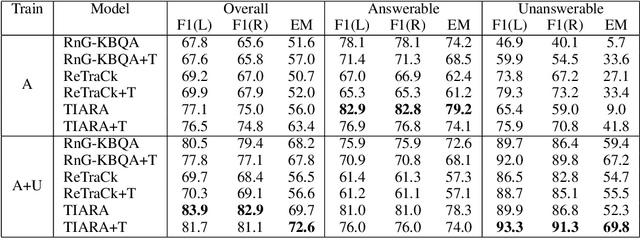
When answering natural language questions over knowledge bases (KBs), incompleteness in the KB can naturally lead to many questions being unanswerable. While answerability has been explored in other QA settings, it has not been studied for QA over knowledge bases (KBQA). We first identify various forms of KB incompleteness that can result in a question being unanswerable. We then propose GrailQAbility, a new benchmark dataset, which systematically modifies GrailQA (a popular KBQA dataset) to represent all these incompleteness issues. Testing two state-of-the-art KBQA models (trained on original GrailQA as well as our GrailQAbility), we find that both models struggle to detect unanswerable questions, or sometimes detect them for the wrong reasons. Consequently, both models suffer significant loss in performance, underscoring the need for further research in making KBQA systems robust to unanswerability.
Calibrating Deep Neural Networks using Explicit Regularisation and Dynamic Data Pruning
Dec 20, 2022

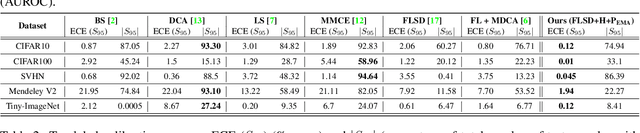

Deep neural networks (DNN) are prone to miscalibrated predictions, often exhibiting a mismatch between the predicted output and the associated confidence scores. Contemporary model calibration techniques mitigate the problem of overconfident predictions by pushing down the confidence of the winning class while increasing the confidence of the remaining classes across all test samples. However, from a deployment perspective, an ideal model is desired to (i) generate well-calibrated predictions for high-confidence samples with predicted probability say >0.95, and (ii) generate a higher proportion of legitimate high-confidence samples. To this end, we propose a novel regularization technique that can be used with classification losses, leading to state-of-the-art calibrated predictions at test time; From a deployment standpoint in safety-critical applications, only high-confidence samples from a well-calibrated model are of interest, as the remaining samples have to undergo manual inspection. Predictive confidence reduction of these potentially ``high-confidence samples'' is a downside of existing calibration approaches. We mitigate this by proposing a dynamic train-time data pruning strategy that prunes low-confidence samples every few epochs, providing an increase in "confident yet calibrated samples". We demonstrate state-of-the-art calibration performance across image classification benchmarks, reducing training time without much compromise in accuracy. We provide insights into why our dynamic pruning strategy that prunes low-confidence training samples leads to an increase in high-confidence samples at test time.
Real-time Health Monitoring of Heat Exchangers using Hypernetworks and PINNs
Dec 20, 2022We demonstrate a Physics-informed Neural Network (PINN) based model for real-time health monitoring of a heat exchanger, that plays a critical role in improving energy efficiency of thermal power plants. A hypernetwork based approach is used to enable the domain-decomposed PINN learn the thermal behavior of the heat exchanger in response to dynamic boundary conditions, eliminating the need to re-train. As a result, we achieve orders of magnitude reduction in inference time in comparison to existing PINNs, while maintaining the accuracy on par with the physics-based simulations. This makes the approach very attractive for predictive maintenance of the heat exchanger in digital twin environments.
Neural Feature-Adaptation for Symbolic Predictions Using Pre-Training and Semantic Loss
Nov 29, 2022


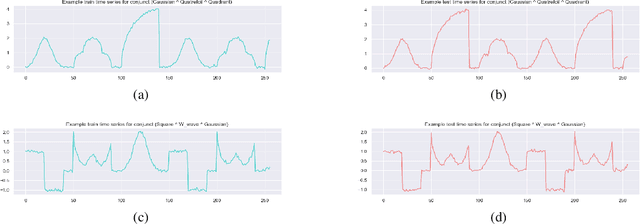
We are interested in neurosymbolic systems consisting of a high-level symbolic layer for explainable prediction in terms of human-intelligible concepts; and a low-level neural layer for extracting symbols required to generate the symbolic explanation. Real data is often imperfect meaning that even if the symbolic theory remains unchanged, we may still need to address the problem of mapping raw data to high-level symbols, each time there is a change in the data acquisition environment or equipment. Manual (re-)annotation of the raw data each time this happens is laborious and expensive; and automated labelling methods are often imperfect, especially for complex problems. NEUROLOG proposed the use of a semantic loss function that allows an existing feature-based symbolic model to guide the extraction of feature-values from raw data, using `abduction'. However, the experiments demonstrating the use of semantic loss through abduction appear to rely heavily on a domain-specific pre-processing step that enables a prior delineation of feature locations in the raw data. We examine the use of semantic loss in domains where such pre-processing is not possible, or is not obvious. We show that without any prior information about the features, the NEUROLOG approach can continue to predict accurately even with substantially incorrect feature predictions. We show also that prior information about the features in the form of even imperfect pre-training can help correct this situation. These findings are replicated on the original problem considered by NEUROLOG, without the use of feature-delineation. This suggests that symbolic explanations constructed for data in a domain could be re-used in a related domain, by `feature-adaptation' of pre-trained neural extractors using the semantic loss function constrained by abductive feedback.