 Add to Chrome
 Add to Firefox
 Add to Edge
From Hazard Functions to Language Space: Cox-Supervised Distillation of Survival Risk into a Large Language Model
Jun 08, 2026
We investigate whether information about time-to-event risk estimated by a Cox proportional hazards model can be transferred into a generative large language model. We propose a text-based survival modelling pipeline in which structured clinical covariates are converted into text prompts and a Qwen-based large language model is fine-tuned to generate patient-specific survival risk using Cox model predictions as a training target. Across GBSG2, ACTG320, and WHAS500, the model achieves competitive held-out discrimination and calibration despite being trained as a text-generation task rather than with a conventional survival-analysis loss. We further analyse the geometry of the model's hidden states, where t-SNE visualisations reveal smooth risk gradients in latent space, suggesting that the model represents survival risk as a continuous structure rather than isolated risk categories. Together, these findings suggest that large language models can internalise survival-risk structure while supporting calibrated prediction, providing a route towards time-to-event reasoning in language models.

Synthetic but Not Realistic: The Evaluation Challenge in Generative Modelling for Structured Electronic Medical Records
Jun 08, 2026Synthetic healthcare data are widely proposed as privacy-preserving substitutes for real patient data, yet their evaluation remains dominated by statistical similarity and predictive performance that do not reflect clinical validity. We introduce a multi-dimensional evaluation framework grounded in epidemiology, assessing descriptive fidelity, clinical utility, and structural validity, corresponding to descriptive, predictive, and causal questions. We evaluate four representative generative paradigms - GAN-based, VAE-boosted, diffusion-based, and masked modelling - using PRIME-CVD, a 50,000-person cohort with known ground-truth structure. While all models reproduce marginal distributions, none simultaneously preserve subgroup structure, effect estimates, and dependency structure. Notably, models with strong distributional fidelity can exhibit poor calibration and distorted relationships, leading to unreliable inference. These results show that current evaluation practices can overestimate synthetic data quality and motivate domain-informed assessment based on the ability to support valid clinical and scientific conclusions.
Limits of Generative Pre-Training in Structured EMR Trajectories with Irregular Sampling
Oct 27, 2025Foundation models refer to architectures trained on vast datasets using autoregressive pre-training from natural language processing to capture intricate patterns and motifs. They were originally developed to transfer such learned knowledge to downstream predictive tasks. Recently, however, some studies repurpose these learned representations for phenotype discovery without rigorous validation, risking superficially realistic but clinically incoherent embeddings. To test this mismatch, we trained two autoregressive models -- a sequence-to-sequence LSTM and a reduced Transformer -- on longitudinal ART for HIV and Acute Hypotension datasets. Controlled irregularity was added during training via random inter-visit gaps, while test sequences stayed complete. Patient-trajectory synthesis evaluated distributional and correlational fidelity. Both reproduced feature distributions but failed to preserve cross-feature structure -- showing that generative pre-training yields local realism but limited clinical coherence. These results highlight the need for domain-specific evaluation and support trajectory synthesis as a practical probe before fine-tuning or deployment.
Attention-Based Synthetic Data Generation for Calibration-Enhanced Survival Analysis: A Case Study for Chronic Kidney Disease Using Electronic Health Records
Mar 08, 2025Access to real-world healthcare data is limited by stringent privacy regulations and data imbalances, hindering advancements in research and clinical applications. Synthetic data presents a promising solution, yet existing methods often fail to ensure the realism, utility, and calibration essential for robust survival analysis. Here, we introduce Masked Clinical Modelling (MCM), an attention-based framework capable of generating high-fidelity synthetic datasets that preserve critical clinical insights, such as hazard ratios, while enhancing survival model calibration. Unlike traditional statistical methods like SMOTE and machine learning models such as VAEs, MCM supports both standalone dataset synthesis for reproducibility and conditional simulation for targeted augmentation, addressing diverse research needs. Validated on a chronic kidney disease electronic health records dataset, MCM reduced the general calibration loss over the entire dataset by 15%; and MCM reduced a mean calibration loss by 9% across 10 clinically stratified subgroups, outperforming 15 alternative methods. By bridging data accessibility with translational utility, MCM advances the precision of healthcare models, promoting more efficient use of scarce healthcare resources.
Masked Clinical Modelling: A Framework for Synthetic and Augmented Survival Data Generation
Oct 23, 2024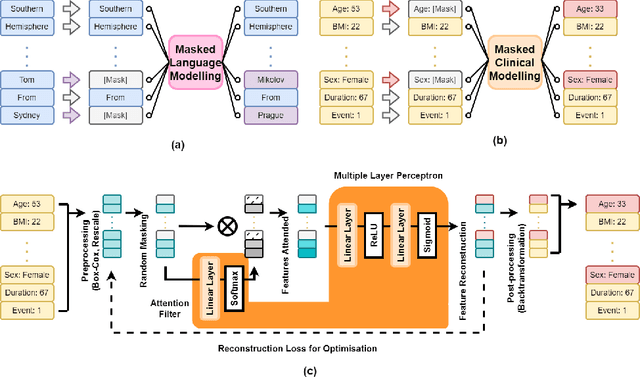
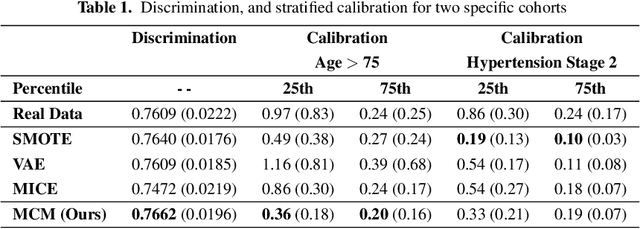
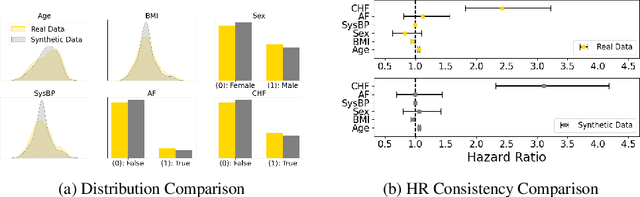
Access to real clinical data is often restricted due to privacy obligations, creating significant barriers for healthcare research. Synthetic datasets provide a promising solution, enabling secure data sharing and model development. However, most existing approaches focus on data realism rather than utility -- ensuring that models trained on synthetic data yield clinically meaningful insights comparable to those trained on real data. In this paper, we present Masked Clinical Modelling (MCM), a framework inspired by masked language modelling, designed for both data synthesis and conditional data augmentation. We evaluate this prototype on the WHAS500 dataset using Cox Proportional Hazards models, focusing on the preservation of hazard ratios as key clinical metrics. Our results show that data generated using the MCM framework improves both discrimination and calibration in survival analysis, outperforming existing methods. MCM demonstrates strong potential to support survival data analysis and broader healthcare applications.
CK4Gen: A Knowledge Distillation Framework for Generating High-Utility Synthetic Survival Datasets in Healthcare
Oct 22, 2024Access to real clinical data is heavily restricted by privacy regulations, hindering both healthcare research and education. These constraints slow progress in developing new treatments and data-driven healthcare solutions, while also limiting students' access to real-world datasets, leaving them without essential practical skills. High-utility synthetic datasets are therefore critical for advancing research and providing meaningful training material. However, current generative models -- such as Variational Autoencoders (VAEs) and Generative Adversarial Networks (GANs) -- produce surface-level realism at the expense of healthcare utility, blending distinct patient profiles and producing synthetic data of limited practical relevance. To overcome these limitations, we introduce CK4Gen (Cox Knowledge for Generation), a novel framework that leverages knowledge distillation from Cox Proportional Hazards (CoxPH) models to create synthetic survival datasets that preserve key clinical characteristics, including hazard ratios and survival curves. CK4Gen avoids the interpolation issues seen in VAEs and GANs by maintaining distinct patient risk profiles, ensuring realistic and reliable outputs for research and educational use. Validated across four benchmark datasets -- GBSG2, ACTG320, WHAS500, and FLChain -- CK4Gen outperforms competing techniques by better aligning real and synthetic data, enhancing survival model performance in both discrimination and calibration via data augmentation. As CK4Gen is scalable across clinical conditions, and with code to be made publicly available, future researchers can apply it to their own datasets to generate synthetic versions suitable for open sharing.
Harmonising the Clinical Melody: Tuning Large Language Models for Hospital Course Summarisation in Clinical Coding
Sep 24, 2024The increasing volume and complexity of clinical documentation in Electronic Medical Records systems pose significant challenges for clinical coders, who must mentally process and summarise vast amounts of clinical text to extract essential information needed for coding tasks. While large language models have been successfully applied to shorter summarisation tasks in recent years, the challenge of summarising a hospital course remains an open area for further research and development. In this study, we adapted three pre trained LLMs, Llama 3, BioMistral, Mistral Instruct v0.1 for the hospital course summarisation task, using Quantized Low Rank Adaptation fine tuning. We created a free text clinical dataset from MIMIC III data by concatenating various clinical notes as the input clinical text, paired with ground truth Brief Hospital Course sections extracted from the discharge summaries for model training. The fine tuned models were evaluated using BERTScore and ROUGE metrics to assess the effectiveness of clinical domain fine tuning. Additionally, we validated their practical utility using a novel hospital course summary assessment metric specifically tailored for clinical coding. Our findings indicate that fine tuning pre trained LLMs for the clinical domain can significantly enhance their performance in hospital course summarisation and suggest their potential as assistive tools for clinical coding. Future work should focus on refining data curation methods to create higher quality clinical datasets tailored for hospital course summary tasks and adapting more advanced open source LLMs comparable to proprietary models to further advance this research.
Continuous time recurrent neural networks: overview and application to forecasting blood glucose in the intensive care unit
Apr 14, 2023


Irregularly measured time series are common in many of the applied settings in which time series modelling is a key statistical tool, including medicine. This provides challenges in model choice, often necessitating imputation or similar strategies. Continuous time autoregressive recurrent neural networks (CTRNNs) are a deep learning model that account for irregular observations through incorporating continuous evolution of the hidden states between observations. This is achieved using a neural ordinary differential equation (ODE) or neural flow layer. In this manuscript, we give an overview of these models, including the varying architectures that have been proposed to account for issues such as ongoing medical interventions. Further, we demonstrate the application of these models to probabilistic forecasting of blood glucose in a critical care setting using electronic medical record and simulated data. The experiments confirm that addition of a neural ODE or neural flow layer generally improves the performance of autoregressive recurrent neural networks in the irregular measurement setting. However, several CTRNN architecture are outperformed by an autoregressive gradient boosted tree model (Catboost), with only a long short-term memory (LSTM) and neural ODE based architecture (ODE-LSTM) achieving comparable performance on probabilistic forecasting metrics such as the continuous ranked probability score (ODE-LSTM: 0.118$\pm$0.001; Catboost: 0.118$\pm$0.001), ignorance score (0.152$\pm$0.008; 0.149$\pm$0.002) and interval score (175$\pm$1; 176$\pm$1).
Synthetic Health-related Longitudinal Data with Mixed-type Variables Generated using Diffusion Models
Mar 22, 2023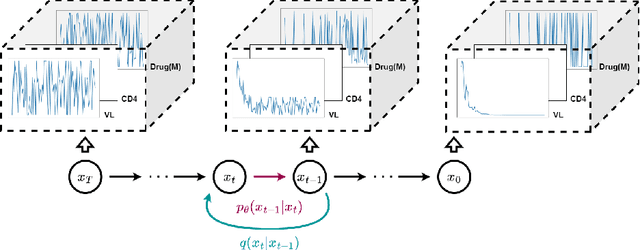
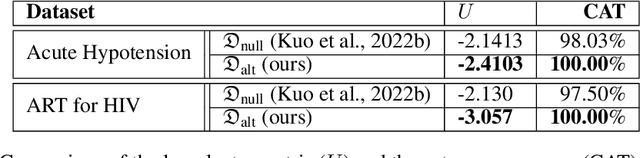
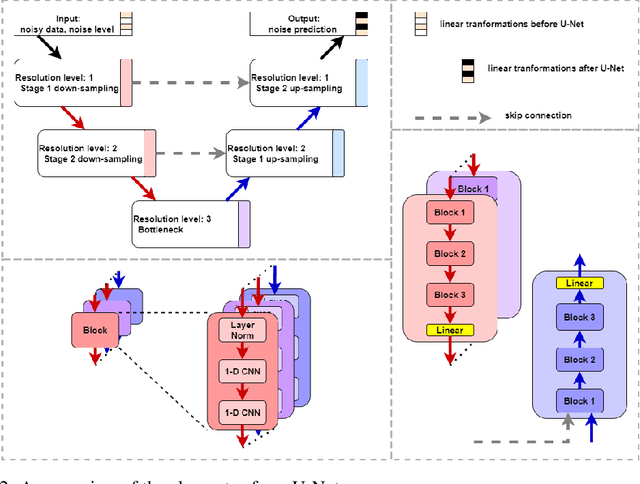
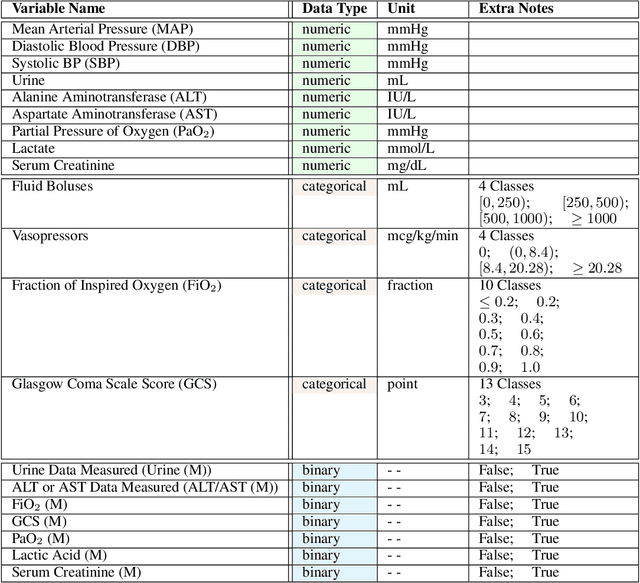
This paper presents a novel approach to simulating electronic health records (EHRs) using diffusion probabilistic models (DPMs). Specifically, we demonstrate the effectiveness of DPMs in synthesising longitudinal EHRs that capture mixed-type variables, including numeric, binary, and categorical variables. To our knowledge, this represents the first use of DPMs for this purpose. We compared our DPM-simulated datasets to previous state-of-the-art results based on generative adversarial networks (GANs) for two clinical applications: acute hypotension and human immunodeficiency virus (ART for HIV). Given the lack of similar previous studies in DPMs, a core component of our work involves exploring the advantages and caveats of employing DPMs across a wide range of aspects. In addition to assessing the realism of the synthetic datasets, we also trained reinforcement learning (RL) agents on the synthetic data to evaluate their utility for supporting the development of downstream machine learning models. Finally, we estimated that our DPM-simulated datasets are secure and posed a low patient exposure risk for public access.
Automated ICD Coding using Extreme Multi-label Long Text Transformer-based Models
Dec 13, 2022
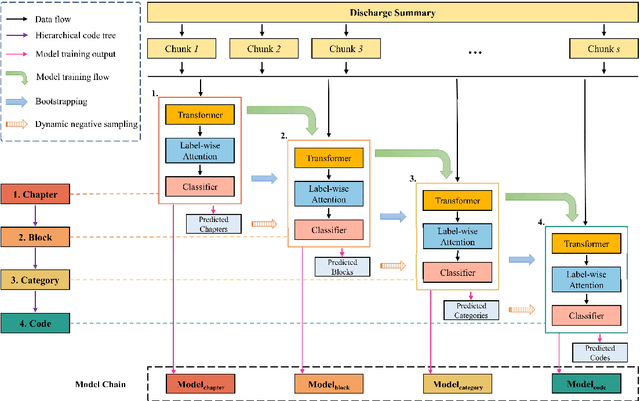

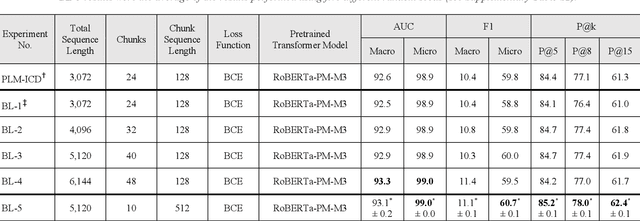
Background: Encouraged by the success of pretrained Transformer models in many natural language processing tasks, their use for International Classification of Diseases (ICD) coding tasks is now actively being explored. In this study, we investigate three types of Transformer-based models, aiming to address the extreme label set and long text classification challenges that are posed by automated ICD coding tasks. Methods: The Transformer-based model PLM-ICD achieved the current state-of-the-art (SOTA) performance on the ICD coding benchmark dataset MIMIC-III. It was chosen as our baseline model to be further optimised. XR-Transformer, the new SOTA model in the general extreme multi-label text classification domain, and XR-LAT, a novel adaptation of the XR-Transformer model, were also trained on the MIMIC-III dataset. XR-LAT is a recursively trained model chain on a predefined hierarchical code tree with label-wise attention, knowledge transferring and dynamic negative sampling mechanisms. Results: Our optimised PLM-ICD model, which was trained with longer total and chunk sequence lengths, significantly outperformed the current SOTA PLM-ICD model, and achieved the highest micro-F1 score of 60.8%. The XR-Transformer model, although SOTA in the general domain, did not perform well across all metrics. The best XR-LAT based model obtained results that were competitive with the current SOTA PLM-ICD model, including improving the macro-AUC by 2.1%. Conclusion: Our optimised PLM-ICD model is the new SOTA model for automated ICD coding on the MIMIC-III dataset, while our novel XR-LAT model performs competitively with the previous SOTA PLM-ICD model.