 Add to Chrome
 Add to Firefox
 Add to Edge
LaGSplat: Inferring Physics-Governed Interactive Simulation from Monocular Video Using Latent Lagrangian Gaussian Splatting
Aug 17, 2026
We present LaGSplat (Latent Lagrangian Gaussian Splatting), a framework that infers interactive, physics-governed dynamics from one or a few monocular videos. At inference it lets a user push on the filmed object, rigid or deformable, with an external force that was never measured, annotated, or seen during training. This is possible because a low-dimensional latent state $\mathbf{q} \in \mathbb{R}^d$ plays two roles at once: it is the generalised coordinate of a learned dissipative Lagrangian and the conditioning variable of a Gaussian Splatting decoder. The inductive bias of this decoder, whose primitives are explicit points $μ_i(\mathbf{q})$ that move with the object, is what lets a force $f$ applied in the image pull back into a latent generalised force $J(\mathbf{q})^\top f$ and enter the equations of motion, which pixel-space (CNN) or neural-field (NeRF) decoders cannot do. We validate LaGSplat on test cases of increasing difficulty, from rigid to deformable and from autonomous to forced real systems, combining monocular video and sensor measurements. We further demonstrate interactive use: forces of arbitrary magnitude and direction can be applied to the reconstructed object at any time, its response rendered in real time, in 2D or 3D. Assuming a dissipative Euler-Lagrange equation over a few generalised coordinates trades generality for a bounded, plausible response to unseen forces, where an unconstrained predictor diverges.

Deep Surrogate for Direct Time Fluid Dynamics
Dec 16, 2021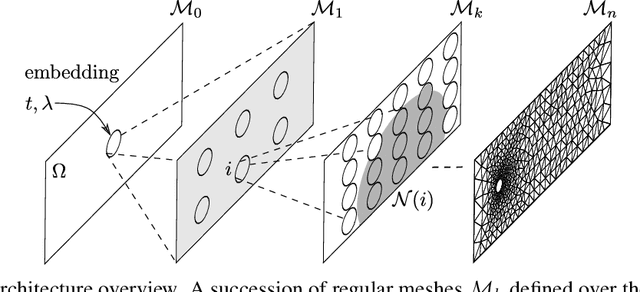
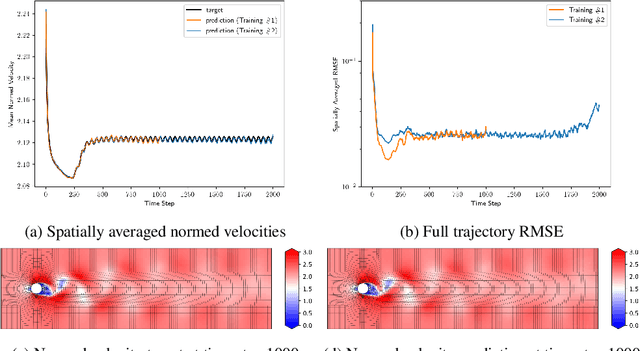
The ubiquity of fluids in the physical world explains the need to accurately simulate their dynamics for many scientific and engineering applications. Traditionally, well established but resource intensive CFD solvers provide such simulations. The recent years have seen a surge of deep learning surrogate models substituting these solvers to alleviate the simulation process. Some approaches to build data-driven surrogates mimic the solver iterative process. They infer the next state of the fluid given its previous one. Others directly infer the state from time input. Approaches also differ in their management of the spatial information. Graph Neural Networks (GNN) can address the specificity of the irregular meshes commonly used in CFD simulations. In this article, we present our ongoing work to design a novel direct time GNN architecture for irregular meshes. It consists of a succession of graphs of increasing size connected by spline convolutions. We test our architecture on the Von K{\'a}rm{\'a}n's vortex street benchmark. It achieves small generalization errors while mitigating error accumulation along the trajectory.