 Add to Chrome
 Add to Firefox
 Add to Edge
Do You Understand How I Feel?: Towards Verified Empathy in Therapy Chatbots
Jan 13, 2026
Conversational agents are increasingly used as support tools along mental therapeutic pathways with significant societal impacts. In particular, empathy is a key non-functional requirement in therapeutic contexts, yet current chatbot development practices provide no systematic means to specify or verify it. This paper envisions a framework integrating natural language processing and formal verification to deliver empathetic therapy chatbots. A Transformer-based model extracts dialogue features, which are then translated into a Stochastic Hybrid Automaton model of dyadic therapy sessions. Empathy-related properties can then be verified through Statistical Model Checking, while strategy synthesis provides guidance for shaping agent behavior. Preliminary results show that the formal model captures therapy dynamics with good fidelity and that ad-hoc strategies improve the probability of satisfying empathy requirements.

Optimized two-stage AI-based Neural Decoding for Enhanced Visual Stimulus Reconstruction from fMRI Data
Dec 17, 2024
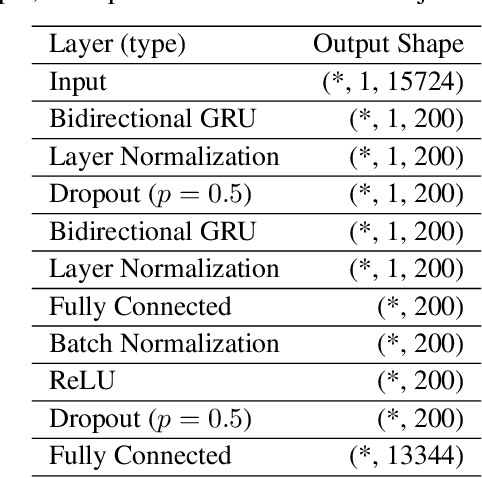
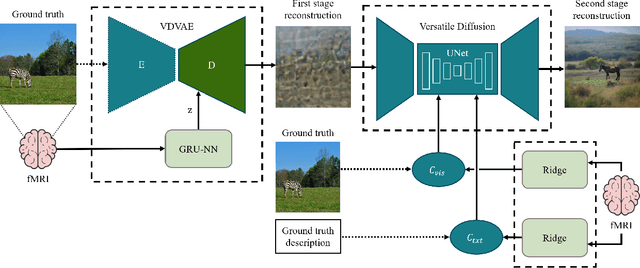
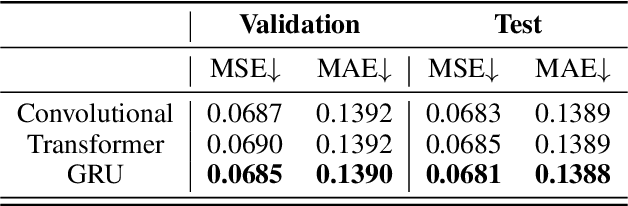
AI-based neural decoding reconstructs visual perception by leveraging generative models to map brain activity, measured through functional MRI (fMRI), into latent hierarchical representations. Traditionally, ridge linear models transform fMRI into a latent space, which is then decoded using latent diffusion models (LDM) via a pre-trained variational autoencoder (VAE). Due to the complexity and noisiness of fMRI data, newer approaches split the reconstruction into two sequential steps, the first one providing a rough visual approximation, the second on improving the stimulus prediction via LDM endowed by CLIP embeddings. This work proposes a non-linear deep network to improve fMRI latent space representation, optimizing the dimensionality alike. Experiments on the Natural Scenes Dataset showed that the proposed architecture improved the structural similarity of the reconstructed image by about 2\% with respect to the state-of-the-art model, based on ridge linear transform. The reconstructed image's semantics improved by about 4\%, measured by perceptual similarity, with respect to the state-of-the-art. The noise sensitivity analysis of the LDM showed that the role of the first stage was fundamental to predict the stimulus featuring high structural similarity. Conversely, providing a large noise stimulus affected less the semantics of the predicted stimulus, while the structural similarity between the ground truth and predicted stimulus was very poor. The findings underscore the importance of leveraging non-linear relationships between BOLD signal and the latent representation and two-stage generative AI for optimizing the fidelity of reconstructed visual stimuli from noisy fMRI data.