 Add to Chrome
 Add to Firefox
 Add to Edge
Boosting Data Augmentation with Stochastic Weight Averaging
Aug 14, 2026
The symmetries of a learning task have become an important factor in designing modern deep learning solutions. Data augmentation is a straightforward and effective way of incorporating symmetries into a generic neural network. Recent results show that infinitely large deep ensembles show perfect symmetry when trained on augmented data. However, since training ensembles requires repeating the training process many times, this method is costly. In this work, we study stochastic weight averaging (SWA) as an alternative ensembling technique that does not require repeated training runs. We analyze SWA by approximating the stochastic training trajectory at the end of training with an Ornstein--Uhlenbeck process. We show that in the infinite-width limit, SWA on augmented data provides an equiviariance boost that goes beyond what could be expected from the performance increase due to SWA alone. We verify our results with extensive numerical experiments on numerous models spanning computer vision and graph classification with both discrete and continuous symmetries.

Learning Chern Numbers of Topological Insulators with Gauge Equivariant Neural Networks
Feb 21, 2025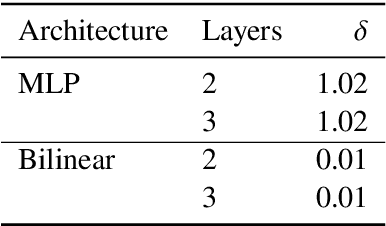
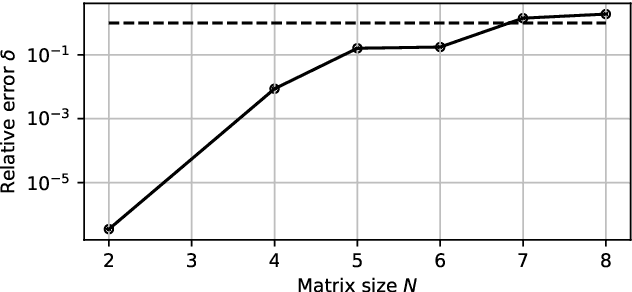
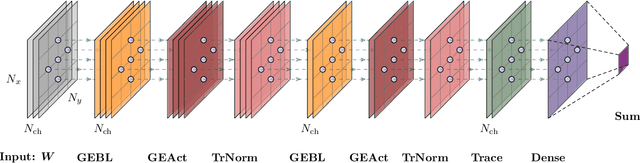
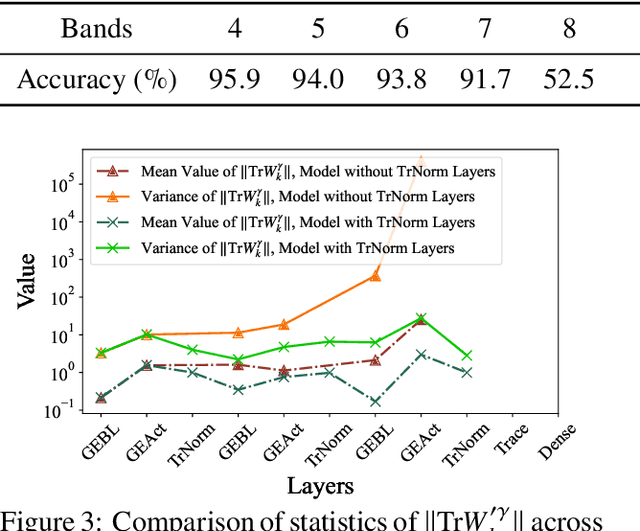
Equivariant network architectures are a well-established tool for predicting invariant or equivariant quantities. However, almost all learning problems considered in this context feature a global symmetry, i.e. each point of the underlying space is transformed with the same group element, as opposed to a local ``gauge'' symmetry, where each point is transformed with a different group element, exponentially enlarging the size of the symmetry group. Gauge equivariant networks have so far mainly been applied to problems in quantum chromodynamics. Here, we introduce a novel application domain for gauge-equivariant networks in the theory of topological condensed matter physics. We use gauge equivariant networks to predict topological invariants (Chern numbers) of multiband topological insulators. The gauge symmetry of the network guarantees that the predicted quantity is a topological invariant. We introduce a novel gauge equivariant normalization layer to stabilize the training and prove a universal approximation theorem for our setup. We train on samples with trivial Chern number only but show that our models generalize to samples with non-trivial Chern number. We provide various ablations of our setup. Our code is available at https://github.com/sitronsea/GENet/tree/main.