 Add to Chrome
 Add to Firefox
 Add to Edge
Limits of spectral learning under noise
Jun 11, 2026
Learning functional relationships from noisy data is a central problem in scientific inference. Spectral methods approximate unknown functions by expanding them in a basis and estimating the corresponding coefficients from data, but the stability of these coefficients under noise remains poorly understood. Here we study supervised regression with additive label noise using sparse spectral representations across multiple bases and dimensions. We show that noise induces a predictable drift in the learned coefficient vector whose magnitude depends on the effective number of active spectral modes. After whitening the empirical feature geometry, we derive a closed-form expression for the overlap between noisy and noiseless coefficient vectors, revealing a universal degradation curve governed by a single intrinsic noise scale. Numerical experiments across Fourier, Legendre, Bessel, and Haar bases confirm the theoretical prediction. The results demonstrate that spectral learning exhibits a fundamental noise threshold beyond which coefficient estimates become unstable, placing intrinsic limits on recovering functional structure from noisy data.

Predicting Hidden Links and Missing Nodes in Scale-Free Networks with Artificial Neural Networks
Sep 25, 2021There are many networks in real life which exist as form of Scale-free networks such as World Wide Web, protein-protein inter action network, semantic networks, airline networks, interbank payment networks, etc. If we want to analyze these networks, it is really necessary to understand the properties of scale-free networks. By using the properties of scale free networks, we can identify any type of anomalies in those networks. In this research, we proposed a methodology in a form of an algorithm to predict hidden links and missing nodes in scale-free networks where we combined a generator of random networks as a source of train data, on one hand, with artificial neural networks for supervised classification, on the other, we aimed at training the neural networks to discriminate between different subtypes of scale-free networks and predicted the missing nodes and hidden links among (present and missing) nodes in a given scale-free network. We chose Bela Bollobas's directed scale-free random graph generation algorithm as a generator of random networks to generate a large set of scale-free network's data.
Reconstructing dynamical networks via feature ranking
Feb 11, 2019
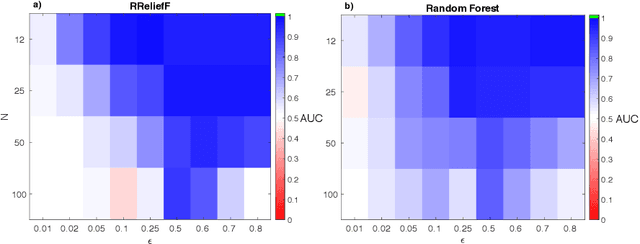


Empirical data on real complex systems are becoming increasingly available. Parallel to this is the need for new methods of reconstructing (inferring) the topology of networks from time-resolved observations of their node-dynamics. The methods based on physical insights often rely on strong assumptions about the properties and dynamics of the scrutinized network. Here, we use the insights from machine learning to design a new method of network reconstruction that essentially makes no such assumptions. Specifically, we interpret the available trajectories (data) as features, and use two independent feature ranking approaches -- Random forest and RReliefF -- to rank the importance of each node for predicting the value of each other node, which yields the reconstructed adjacency matrix. We show that our method is fairly robust to coupling strength, system size, trajectory length and noise. We also find that the reconstruction quality strongly depends on the dynamical regime.