 Add to Chrome
 Add to Firefox
 Add to Edge
A Sequence-to-Sequence ConvLSTM Approach for Leaf Area Index Forecasting over the South-Central United States
Aug 01, 2026
Leaf Area Index (LAI) is a fundamental biophysical variable governing land-atmosphere interactions; however, LAI forecasting at high spatial resolution remains an unsolved challenge. While recent machine learning approaches have demonstrated LAI estimation at point or regional scales, none provides a gridded, meteorology-driven prognostic forecast suitable for subseasonal land surface and climate modeling applications. Here we present a sequence-to-sequence Convolutional LSTM (ConvLSTM) framework that generates daily 1-km LAI forecasts up to 30 days ahead, driven by historical LAI sequences and daily meteorological forcing including temperature and precipitation. Trained and evaluated over the South-Central United States -- a region of strong climate gradients and diverse vegetation -- the model achieves a domain-averaged RMSE of 0.36 at a 30-day lead time, more than a third lower than the persistence baseline. Forecast skill remains robust across seasons, geographic distributions, and plant functional types, including forests, grasslands, shrublands, and croplands. To our knowledge, this is the first demonstration of skillful LAI forecasting at a 30-day horizon at 1-km resolution.

Predicting Tropical Cyclone Track Forecast Errors using a Probabilistic Neural Network
Mar 12, 2025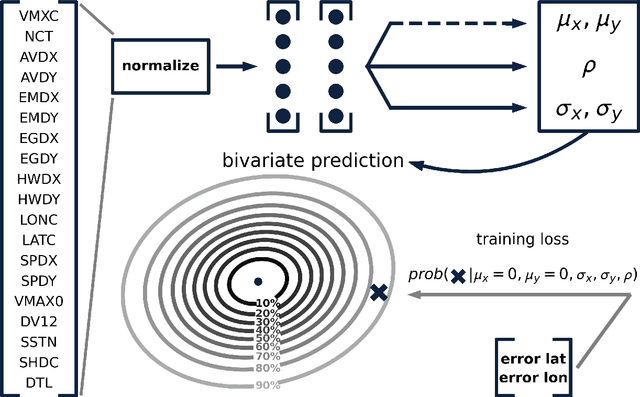

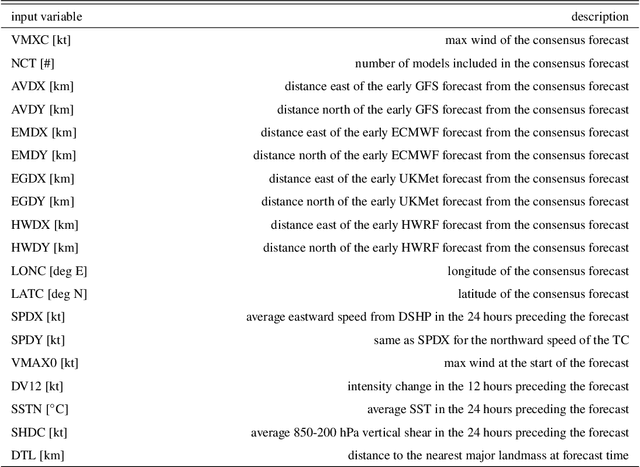
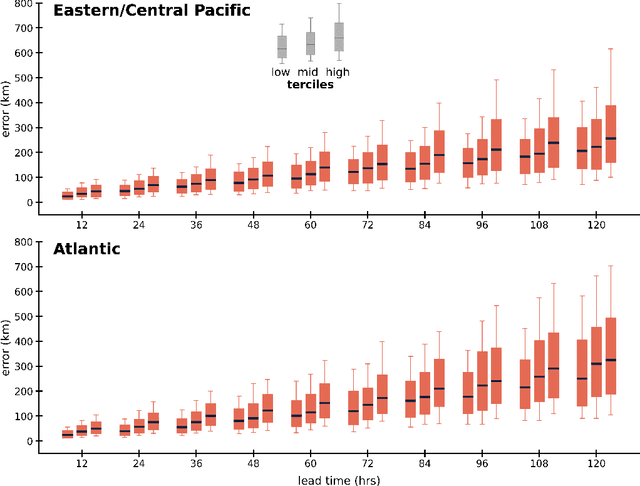
A new method for estimating tropical cyclone track uncertainty is presented and tested. This method uses a neural network to predict a bivariate normal distribution, which serves as an estimate for track uncertainty. We train the network and make predictions on forecasts from the National Hurricane Center (NHC), which currently uses static error distributions based on forecasts from the past five years for most applications. The neural network-based method produces uncertainty estimates that are dynamic and probabilistic. Further, the neural network-based method allows for probabilistic statements about tropical cyclone trajectories, including landfall probability, which we highlight. We show that our predictions are well calibrated using multiple metrics, that our method produces better uncertainty estimates than current NHC approaches, and that our method achieves similar performance to the Global Ensemble Forecast System. Once trained, the computational cost of predictions using this method is negligible, making it a strong candidate to improve the NHC's operational estimations of tropical cyclone track uncertainty.