 Add to Chrome
 Add to Firefox
 Add to Edge
OCOO-T : A Simple and Scalable Virtual Cell Model for Transcriptional Perturbation Response Prediction
Jun 11, 2026
Predicting single-cell transcriptional responses to genetic, chemical and cytokine perturbations is a fundamental challenge in computational biology and AI Virtual Cell (AIVC) modeling, with direct implications for drug discovery and the elucidation of gene regulatory networks. Existing approaches often rely on auxiliary cell-state encoders, hierarchical variational autoencoders, dedicated Transformer encoder-decoder modules, or gene-interaction priors to compress high-dimensional expression profiles into latent representations. While effective, these designs increase architectural complexity and may limit scalability and generalizability. This paper introduces OCOO-T, a minimalist flow-matching-based AIVC model for transcriptional perturbation response prediction. OCOO-T utilizes a vanilla Transformer stack that operates directly on continuous gene expression profiles and formulates perturbation response prediction as a continuous-time denoising process. Perturbation embeddings, dosage information, and cell-line/cell-type specificity are integrated through adaptive layer normalization and in-context tokens. Comprehensive evaluations on Tahoe100M, Replogle, and PBMC benchmarks demonstrate that OCOO-T achieves state-of-the-art performance across diverse perturbations and cell types while effectively scaling to long transcriptional profiles through patching and depatching of cellular contexts. By leveraging the simplicity of Transformer-based denoising for single-cell omics, OCOO-T provides an effective and scalable framework for in-silico cellular simulation.

siDPT: siRNA Efficacy Prediction via Debiased Preference-Pair Transformer
Sep 19, 2025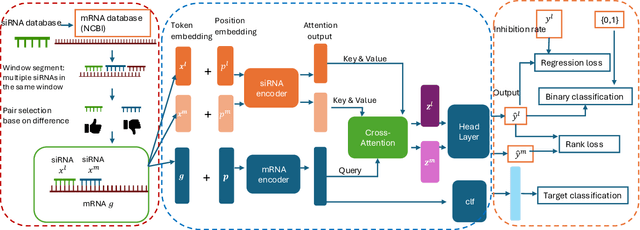
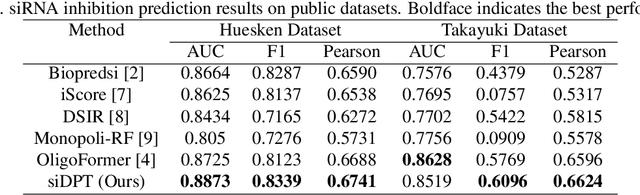
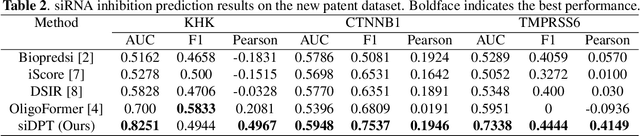
Small interfering RNA (siRNA) is a short double-stranded RNA molecule (about 21-23 nucleotides) with the potential to cure diseases by silencing the function of target genes. Due to its well-understood mechanism, many siRNA-based drugs have been evaluated in clinical trials. However, selecting effective binding regions and designing siRNA sequences requires extensive experimentation, making the process costly. As genomic resources and publicly available siRNA datasets continue to grow, data-driven models can be leveraged to better understand siRNA-mRNA interactions. To fully exploit such data, curating high-quality siRNA datasets is essential to minimize experimental errors and noise. We propose siDPT: siRNA efficacy Prediction via Debiased Preference-Pair Transformer, a framework that constructs a preference-pair dataset and designs an siRNA-mRNA interactive transformer with debiased ranking objectives to improve siRNA inhibition prediction and generalization. We evaluate our approach using two public datasets and one newly collected patent dataset. Our model demonstrates substantial improvement in Pearson correlation and strong performance across other metrics.
mRNA2vec: mRNA Embedding with Language Model in the 5'UTR-CDS for mRNA Design
Aug 16, 2024Messenger RNA (mRNA)-based vaccines are accelerating the discovery of new drugs and revolutionizing the pharmaceutical industry. However, selecting particular mRNA sequences for vaccines and therapeutics from extensive mRNA libraries is costly. Effective mRNA therapeutics require carefully designed sequences with optimized expression levels and stability. This paper proposes a novel contextual language model (LM)-based embedding method: mRNA2vec. In contrast to existing mRNA embedding approaches, our method is based on the self-supervised teacher-student learning framework of data2vec. We jointly use the 5' untranslated region (UTR) and coding sequence (CDS) region as the input sequences. We adapt our LM-based approach specifically to mRNA by 1) considering the importance of location on the mRNA sequence with probabilistic masking, 2) using Minimum Free Energy (MFE) prediction and Secondary Structure (SS) classification as additional pretext tasks. mRNA2vec demonstrates significant improvements in translation efficiency (TE) and expression level (EL) prediction tasks in UTR compared to SOTA methods such as UTR-LM. It also gives a competitive performance in mRNA stability and protein production level tasks in CDS such as CodonBERT.