 Add to Chrome
 Add to Firefox
 Add to Edge
a-TMFG: Scalable Triangulated Maximally Filtered Graphs via Approximate Nearest Neighbors
Mar 10, 2026
The traditional Triangular Maximally Filtered Graph (TMFG) construction requires pre-computation and storage of a dense correlation matrix; this limits its applicability to small and medium-sized datasets. Here we identify key memory and runtime complexity challenges when using TMFG at scale. We then present the Approximate Triangular Maximally Filtered Graph (a-TMFG) algorithm. This is a novel approach to scaling the construction of artificial graphs from data inspired by TMFG. The method employs k-Nearest Neighbors Graphs (kNNG) for initial construction, and implements a memory management strategy to search and estimate missing correlations on-the-fly. This provides representations to control combinatorial explosion. The algorithm is tested for robustness to the parameters and noise, and is evaluated on datasets with millions of observations. This new method provides a parsimonious way to construct graphs for use-cases where graphs are used as input to supervised and unsupervised learning but where no natural graph exists.

MS-IMAP -- A Multi-Scale Graph Embedding Approach for Interpretable Manifold Learning
Jun 06, 2024
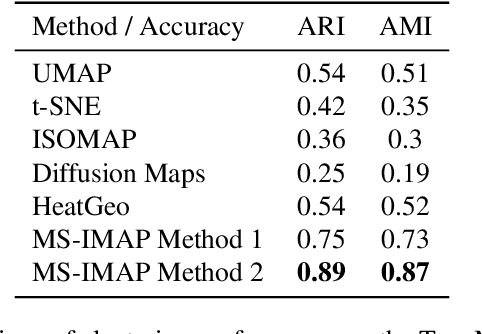
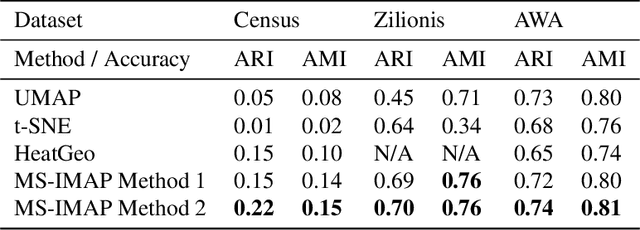
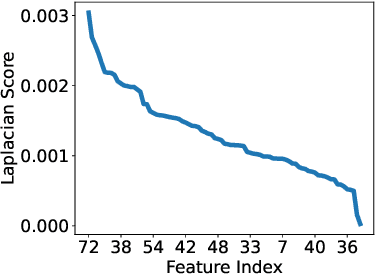
Deriving meaningful representations from complex, high-dimensional data in unsupervised settings is crucial across diverse machine learning applications. This paper introduces a framework for multi-scale graph network embedding based on spectral graph wavelets that employs a contrastive learning approach. A significant feature of the proposed embedding is its capacity to establish a correspondence between the embedding space and the input feature space which aids in deriving feature importance of the original features. We theoretically justify our approach and demonstrate that, in Paley-Wiener spaces on combinatorial graphs, the spectral graph wavelets operator offers greater flexibility and better control over smoothness properties compared to the Laplacian operator. We validate the effectiveness of our proposed graph embedding on a variety of public datasets through a range of downstream tasks, including clustering and unsupervised feature importance.
Agglomerative Fast Super-Paramagnetic Clustering
Aug 07, 2019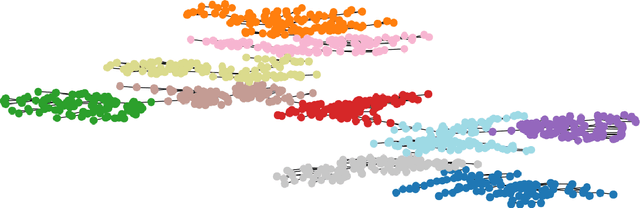
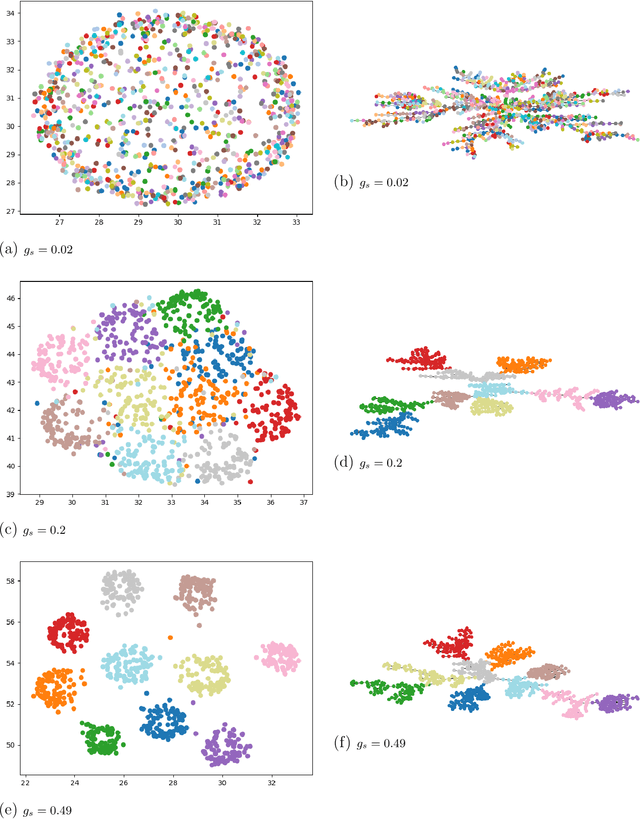
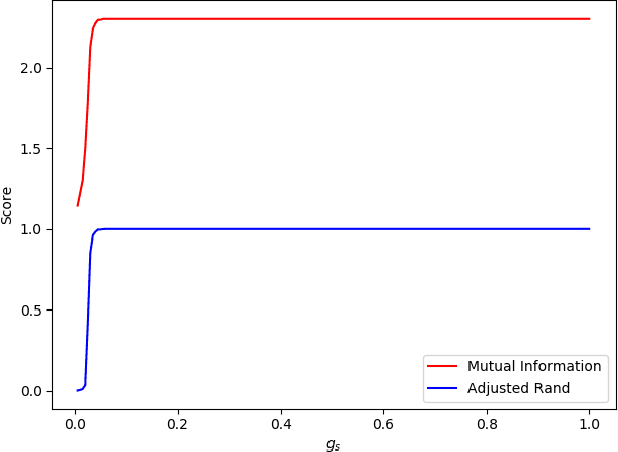
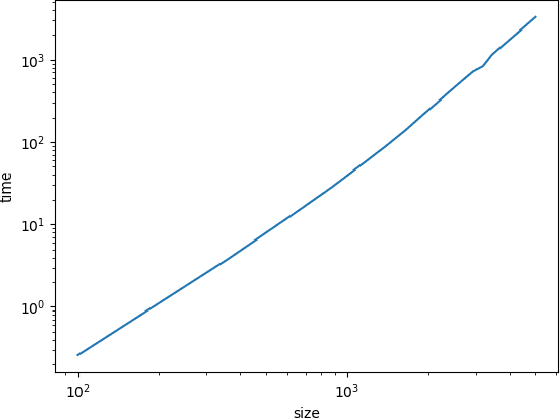
We consider the problem of fast time-series data clustering. Building on previous work modeling the correlation-based Hamiltonian of spin variables we present a fast non-expensive agglomerative algorithm. The method is tested on synthetic correlated time-series and noisy synthetic data-sets with built-in cluster structure to demonstrate that the algorithm produces meaningful non-trivial results. We argue that ASPC can reduce compute time costs and resource usage cost for large scale clustering while being serialized and hence has no obvious parallelization requirement. The algorithm can be an effective choice for state-detection for online learning in a fast non-linear data environment because the algorithm requires no prior information about the number of clusters.