 Add to Chrome
 Add to Firefox
 Add to Edge
Self-Regulated Learning in Essay Writing: Consistency of Strategies and Impact on Outcomes
May 14, 2026
Background: Abilities for effective self-regulated learning (SRL) are critical for lifelong learning, particularly during adolescence when these skills consolidate and strongly influence future learning. Their importance has grown with the rise of online and blended education. Yet, little is known about how secondary school students self-regulate in online environments, how their SRL processes and strategies evolve, or how they affect outcomes. In secondary education, understanding these processes can reveal patterns and indicators of learning success, informing the design of online support mechanisms. Evidence from repeated-measures designs remains scarce. Objectives: This study aims to examine how secondary school students enact SRL strategies during online essay writing, how these strategies change over time, and how they relate to learning outcomes. Methods: We analysed metacognition-related trace data collected from secondary students during a two-wave online essay-writing task conducted one week apart in two Colombian schools (N = 93 for session 1, N = 95 for session 2) via a digital learning platform. Using a combination of process mining and unsupervised machine learning techniques, we identified dominant SRL strategies grounded in established SRL processes and examined their stability and association with learning outcomes. Results and conclusions: Three dominant SRL strategies were identified. Results showed variability: many students remained in or shifted to Read first, write next, while none used Write intensively, read selectively in session 2. Although less common, latter strategy was positively associated with learning outcomes.

Scalable LLM-based Coding of Dialogue in Healthcare Simulation: Balancing Coding Performance, Processing Time, and Environmental Impact
Apr 25, 2026Research shows that dialogue, the interactive process through which participants articulate their thinking, plays a central role in constructing shared understanding, coordinating action, and shaping learning outcomes in teams. Analysing dialogue content has been central to advancing team learning theory and informing the design of computer-supported collaborative learning environments, yet this progress has depended on labour-intensive qualitative coding. LLMs offer new possibilities for automating and enhancing the dialogue layer within emerging multimodal learning analytics approaches, with recent studies showing that they can approximate human coding through few-shot prompting. However, prior work has focused on replicating human coding accuracy for research purposes, rather than addressing a more educationally consequential question: how can we design prompts that allow an LLM to label team dialogue accurately and fast enough to be useful in real settings, such as in-person healthcare simulations, where results must be returned quickly and computational cost and sustainability also matter? This paper investigates how prompt design and batching strategies can be optimised to balance coding accuracy, processing time, and environmental impact in team-based healthcare simulation debriefing. Using a dataset of 11,647 utterances coded across 6 dialogue constructs, we compared 4 prompt designs across varying batch sizes, evaluating coding performance, processing time, and energy consumption, as well as the trade-offs between these metrics. Results indicate that increasing batch size improves speed and reduces energy use, but negatively impacts coding performance. Beyond demonstrating the feasibility of LLM-based qualitative analysis, this study offers practical guidance for scaling dialogue analytics in contexts where timeliness, privacy, and sustainability are critical.
Toward Scalable Co-located Practical Learning: Assisting with Computer Vision and Multimodal Analytics
Mar 14, 2026This study examined whether a single ceiling-mounted camera could be used to capture fine-grained learning behaviours in co-located practical learning. In undergraduate nursing simulations, teachers first identified seven observable behaviour categories, which were then used to train a YOLO-based detector. Video data were collected from 52 sessions, and analyses focused on Scenario A because it produced greater behavioural variation than Scenario B. Annotation reliability was high (F1=0.933). On the held-out test set, the model achieved a precision of 0.789, a recall of 0.784, and an mAP@0.5 of 0.827. When only behaviour frequencies were compared, no robust differences were found between high- and low-performing groups. However, when behaviour labels were analysed together with spatial context, clear differences emerged in both task and collaboration performance. Higher-performing teams showed more patient interaction in the primary work area, whereas lower-performing teams showed more phone-related activity and more activity in secondary areas. These findings suggest that behavioural data are more informative when interpreted together with where they occur. Overall, the study shows that a single-camera computer vision approach can support the analysis of teamwork and task engagement in face-to-face practical learning without relying on wearable sensors.
From Complexity to Parsimony: Integrating Latent Class Analysis to Uncover Multimodal Learning Patterns in Collaborative Learning
Nov 23, 2024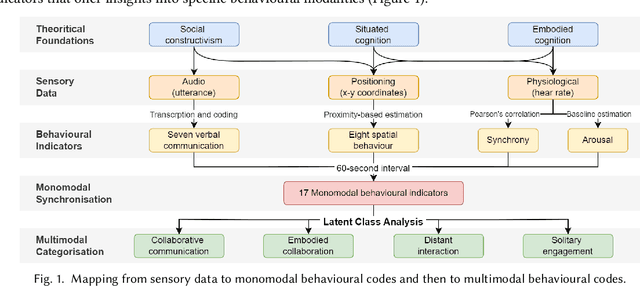
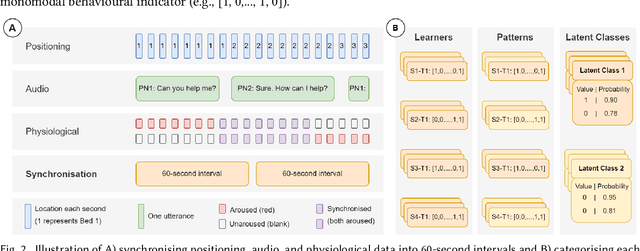
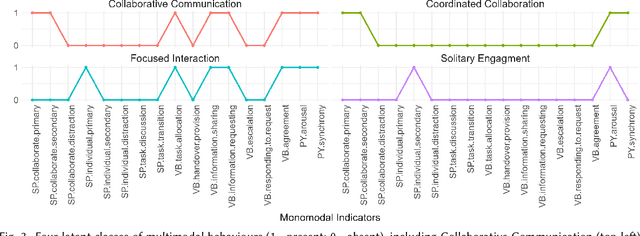
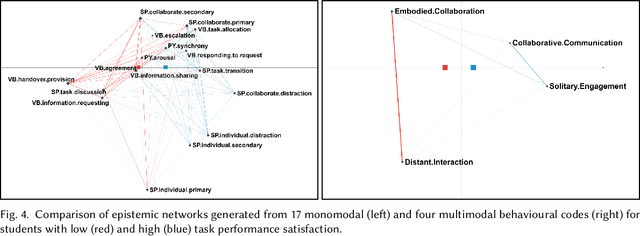
Multimodal Learning Analytics (MMLA) leverages advanced sensing technologies and artificial intelligence to capture complex learning processes, but integrating diverse data sources into cohesive insights remains challenging. This study introduces a novel methodology for integrating latent class analysis (LCA) within MMLA to map monomodal behavioural indicators into parsimonious multimodal ones. Using a high-fidelity healthcare simulation context, we collected positional, audio, and physiological data, deriving 17 monomodal indicators. LCA identified four distinct latent classes: Collaborative Communication, Embodied Collaboration, Distant Interaction, and Solitary Engagement, each capturing unique monomodal patterns. Epistemic network analysis compared these multimodal indicators with the original monomodal indicators and found that the multimodal approach was more parsimonious while offering higher explanatory power regarding students' task and collaboration performances. The findings highlight the potential of LCA in simplifying the analysis of complex multimodal data while capturing nuanced, cross-modality behaviours, offering actionable insights for educators and enhancing the design of collaborative learning interventions. This study proposes a pathway for advancing MMLA, making it more parsimonious and manageable, and aligning with the principles of learner-centred education.
Human-AI Collaboration in Thematic Analysis using ChatGPT: A User Study and Design Recommendations
Nov 07, 2023Generative artificial intelligence (GenAI) offers promising potential for advancing human-AI collaboration in qualitative research. However, existing works focused on conventional machine-learning and pattern-based AI systems, and little is known about how researchers interact with GenAI in qualitative research. This work delves into researchers' perceptions of their collaboration with GenAI, specifically ChatGPT. Through a user study involving ten qualitative researchers, we found ChatGPT to be a valuable collaborator for thematic analysis, enhancing coding efficiency, aiding initial data exploration, offering granular quantitative insights, and assisting comprehension for non-native speakers and non-experts. Yet, concerns about its trustworthiness and accuracy, reliability and consistency, limited contextual understanding, and broader acceptance within the research community persist. We contribute five actionable design recommendations to foster effective human-AI collaboration. These include incorporating transparent explanatory mechanisms, enhancing interface and integration capabilities, prioritising contextual understanding and customisation, embedding human-AI feedback loops and iterative functionality, and strengthening trust through validation mechanisms.
Practical and Ethical Challenges of Large Language Models in Education: A Systematic Literature Review
Mar 17, 2023
Educational technology innovations that have been developed based on large language models (LLMs) have shown the potential to automate the laborious process of generating and analysing textual content. While various innovations have been developed to automate a range of educational tasks (e.g., question generation, feedback provision, and essay grading), there are concerns regarding the practicality and ethicality of these innovations. Such concerns may hinder future research and the adoption of LLMs-based innovations in authentic educational contexts. To address this, we conducted a systematic literature review of 118 peer-reviewed papers published since 2017 to pinpoint the current state of research on using LLMs to automate and support educational tasks. The practical and ethical challenges of LLMs-based innovations were also identified by assessing their technological readiness, model performance, replicability, system transparency, privacy, equality, and beneficence. The findings were summarised into three recommendations for future studies, including updating existing innovations with state-of-the-art models (e.g., GPT-3), embracing the initiative of open-sourcing models/systems, and adopting a human-centred approach throughout the developmental process. These recommendations could support future research to develop practical and ethical innovations for supporting diverse educational tasks and benefiting students, teachers, and institutions.