 Add to Chrome
 Add to Firefox
 Add to Edge
Using Text-Based Causal Inference to Disentangle Factors Influencing Online Review Ratings
Jun 02, 2026
Online reviews provide valuable insights into the perceived quality of facets of a product or service. While aspect-based sentiment analysis has focused on extracting these facets from reviews, there is less work understanding the impact of each aspect on overall perception. This is particularly challenging given correlations among aspects, making it difficult to isolate the effects of each. This paper introduces a methodology based on recent advances in text-based causal analysis, specifically CausalBERT, to disentangle the effect of each factor on overall review ratings. We enhance CausalBERT with three key improvements: temperature scaling for better calibrated treatment assignment estimates; hyperparameter optimization to reduce confound overadjustment; and interpretability methods to characterize discovered confounds. In this work, we treat the textual mentions in reviews as proxies for real-world attributes. We validate our approach on real and semi-synthetic data from over 600K reviews of U.S. K-12 schools. We find that the proposed enhancements result in more reliable estimates, and that perception of school administration and performance on benchmarks are significant drivers of overall school ratings.
* HLT/NAACL 2025

Dynamic Inhomogeneous Quantum Resource Scheduling with Reinforcement Learning
May 25, 2024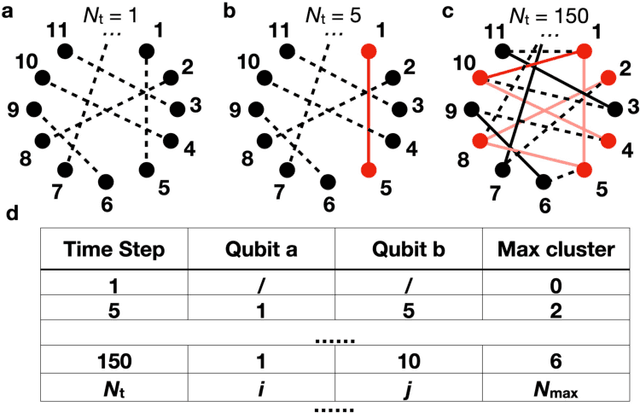
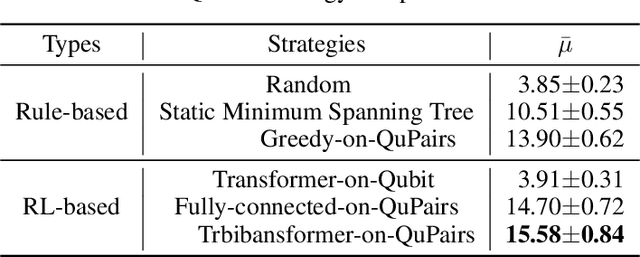
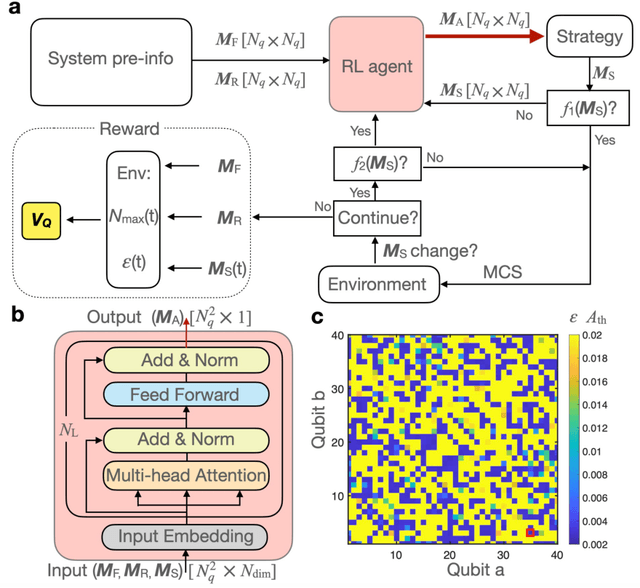

A central challenge in quantum information science and technology is achieving real-time estimation and feedforward control of quantum systems. This challenge is compounded by the inherent inhomogeneity of quantum resources, such as qubit properties and controls, and their intrinsically probabilistic nature. This leads to stochastic challenges in error detection and probabilistic outcomes in processes such as heralded remote entanglement. Given these complexities, optimizing the construction of quantum resource states is an NP-hard problem. In this paper, we address the quantum resource scheduling issue by formulating the problem and simulating it within a digitized environment, allowing the exploration and development of agent-based optimization strategies. We employ reinforcement learning agents within this probabilistic setting and introduce a new framework utilizing a Transformer model that emphasizes self-attention mechanisms for pairs of qubits. This approach facilitates dynamic scheduling by providing real-time, next-step guidance. Our method significantly improves the performance of quantum systems, achieving more than a 3$\times$ improvement over rule-based agents, and establishes an innovative framework that improves the joint design of physical and control systems for quantum applications in communication, networking, and computing.