 Add to Chrome
 Add to Firefox
 Add to Edge
WildRoadBench: A Wild Aerial Road-Damage Grounding Benchmark for Vision-Language Models and Autonomous Agents
May 19, 2026
We introduce WildRoadBench, a wild aerial road-damage grounding benchmark that couples direct visual grounding by vision-language models with autonomous research-and-engineering by LLM-driven agents on a single professionally annotated UAV corpus. The same image set and the same per-class AP_50 metric are evaluated under two protocols. The VLM Track measures whether a fixed VLM can localise domain-specific damage from one image and one short prompt under a unified prompting, decoding and parsing pipeline. The Agent Track measures whether an autonomous agent, given only a written task brief, a small exploratory slice and a fixed interaction budget, can search the public web, adapt pretrained components, write training and inference code, and submit predictions through a scalar-feedback oracle on a hidden holdout. We benchmark a broad pool of closed-source frontier models and open-source VLMs together with several frontier LLM-driven agents. Both routes remain far from reliable performance in this wild setting: closed-source frontier models lead the VLM leaderboard but still leave more than half of the metric on the table; open-source grounders plateau well below them, and newer generations or reasoning-style variants do not consistently improve grounding; small targets collapse for every open-source model; agents lag the strongest VLM despite richer affordances, and several fail to land a valid submission within the budget. We release the code and data at https://anonymous.4open.science/r/wildroadbench-0607 to support reproducible follow-up research.

VidNum-1.4K: A Comprehensive Benchmark for Video-based Numerical Reasoning
Apr 04, 2026Video-based numerical reasoning provides a premier arena for testing whether Vision-Language Models (VLMs) truly "understand" real-world dynamics, as accurate numerical deduction necessitates a profound grasp of temporal events, object permanence, and compositional logic beyond superficial pattern matching. However, existing benchmarks are often confined to narrow domains, such as repetitive athletic motions, or treat simple counting merely as a superficial regression task, failing to assess multi-step numerical logic within the inherent complexity of real-world multimedia content. We introduce VidNum-1.4K, a comprehensive VideoQA benchmark comprising 1,379 strictly human-annotated video-question pairs designed to evaluate genuine numerical reasoning across highly diverse environments, encompassing object, action, and event quantification. The VidNum-1.4K is uniquely structured into a three-level hierarchy that evolves from direct visual perception to video-based compositional numerical reasoning, requiring models to perform arithmetic operations, comparisons, and logical deductions grounded in temporal evidence. Our evaluations across a diverse suite of state-of-the-art VLMs reveal a striking reasoning gap: while the Gemini-3.1-pro barely reaches a 60% accuracy threshold, representative open-source families struggle heavily in the 25%--45% range. These findings demonstrate that current VLMs still lack a stable "internal world model", positioning VidNum-1.4K as a demanding diagnostic testbed for the next generation of numerical video intelligence.
Self-augmented Gaussian Splatting with Structure-aware Masks for Sparse-view 3D Reconstruction
Aug 09, 2024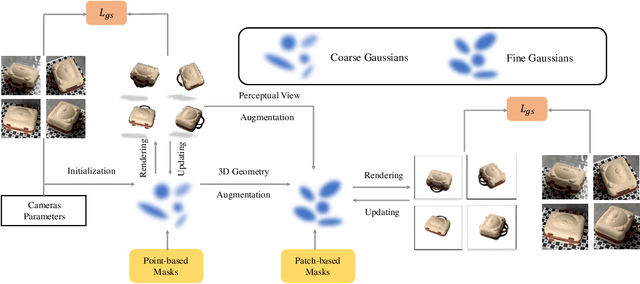
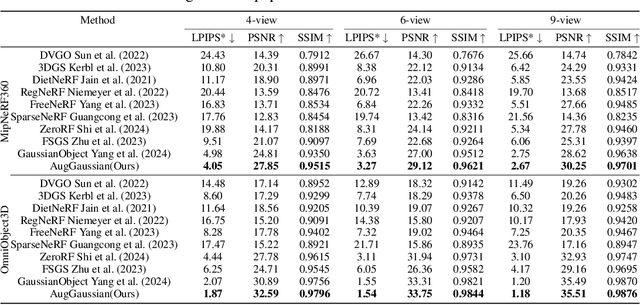
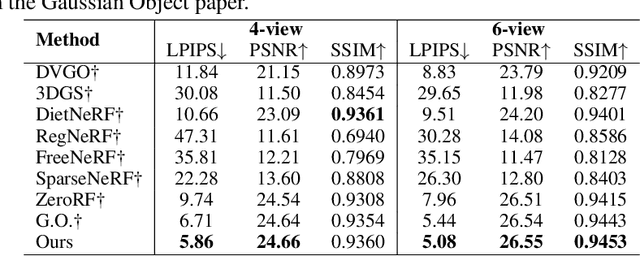
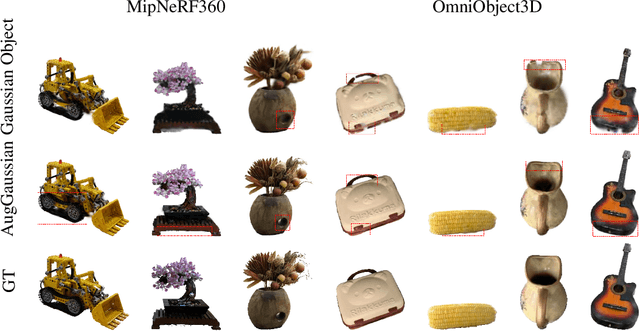
Sparse-view 3D reconstruction stands as a formidable challenge in computer vision, aiming to build complete three-dimensional models from a limited array of viewing perspectives. This task confronts several difficulties: 1) the limited number of input images that lack consistent information; 2) dependence on the quality of input images; and 3) the substantial size of model parameters. To address these challenges, we propose a self-augmented coarse-to-fine Gaussian splatting paradigm, enhanced with a structure-aware mask, for sparse-view 3D reconstruction. In particular, our method initially employs a coarse Gaussian model to obtain a basic 3D representation from sparse-view inputs. Subsequently, we develop a fine Gaussian network to enhance consistent and detailed representation of the output with both 3D geometry augmentation and perceptual view augmentation. During training, we design a structure-aware masking strategy to further improve the model's robustness against sparse inputs and noise.Experimental results on the MipNeRF360 and OmniObject3D datasets demonstrate that the proposed method achieves state-of-the-art performances for sparse input views in both perceptual quality and efficiency.