 Add to Chrome
 Add to Firefox
 Add to Edge
Attributed, But Not Incremental: Cannibalization-Corrected Attribution for Large-Scale Advertising
Jun 25, 2026
In large-scale paid acquisition and growth advertising systems, production attribution outputs are widely used for daily budget allocation and channel diagnosis. However, paid-attributed conversions such as daily new users (DNU) may systematically overstate true incremental growth when paid channels overlap with organic demand, brand-driven traffic, or other acquisition channels. This attribution-cannibalization mismatch can distort incremental ROI measurement and budget decisions at scale. We propose an experiment-calibrated attribution correction framework that uses incrementality experiments as causal anchors to convert sparse lift measurements into daily correction estimates. To make the corrected signal actionable at production granularity, we further allocate calibrated cannibalization volume across business hierarchies under structural consistency constraints. Offline forward-in-time validation against channel-level incrementality experiment readouts shows that the proposed framework substantially reduces calibration error relative to raw attribution and fine-grained ML baselines. Deployed across multiple global TikTok markets, the system supported budget and traffic strategy adjustments that were followed by an approximately 15-percentage-point reduction in the measured cannibalization rate.

Contextual Aware Joint Probability Model Towards Question Answering System
Apr 17, 2019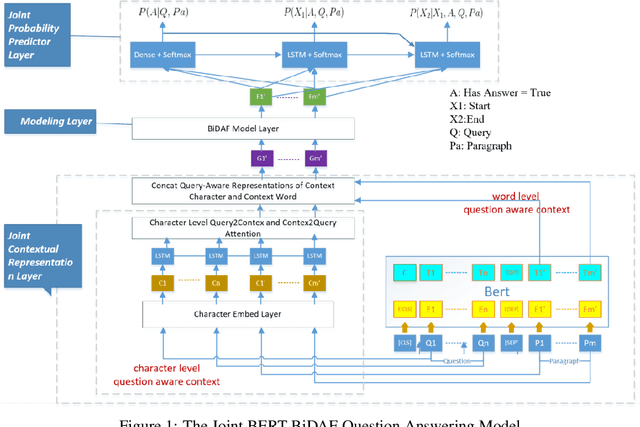
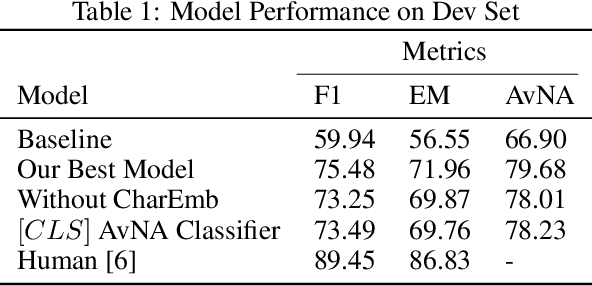
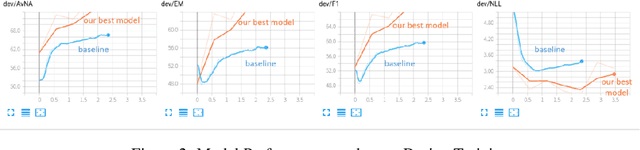
In this paper, we address the question answering challenge with the SQuAD 2.0 dataset. We design a model architecture which leverages BERT's capability of context-aware word embeddings and BiDAF's context interactive exploration mechanism. By integrating these two state-of-the-art architectures, our system tries to extract the contextual word representation at word and character levels, for better comprehension of both question and context and their correlations. We also propose our original joint posterior probability predictor module and its associated loss functions. Our best model so far obtains F1 score of 75.842% and EM score of 72.24% on the test PCE leaderboad.