 Add to Chrome
 Add to Firefox
 Add to Edge
When Differential Privacy Meets Wireless Federated Learning: An Improved Analysis for Privacy and Convergence
Mar 19, 2026
Differentially private wireless federated learning (DPWFL) is a promising framework for protecting sensitive user data. However, foundational questions on how to precisely characterize privacy loss remain open, and existing work is further limited by convergence analyses that rely on restrictive convexity assumptions or ignore the effect of gradient clipping. To overcome these issues, we present a comprehensive analysis of privacy and convergence for DPWFL with general smooth non-convex loss objectives. Our analysis explicitly incorporates both device selection and mini-batch sampling, and shows that the privacy loss can converge to a constant rather than diverge with the number of iterations. Moreover, we establish convergence guarantees with gradient clipping and derive an explicit privacy-utility trade-off. Numerical results validate our theoretical findings.

Nonlinear Multi-Carrier System with Signal Clipping: Measurement, Analysis, and Optimization
Oct 01, 2023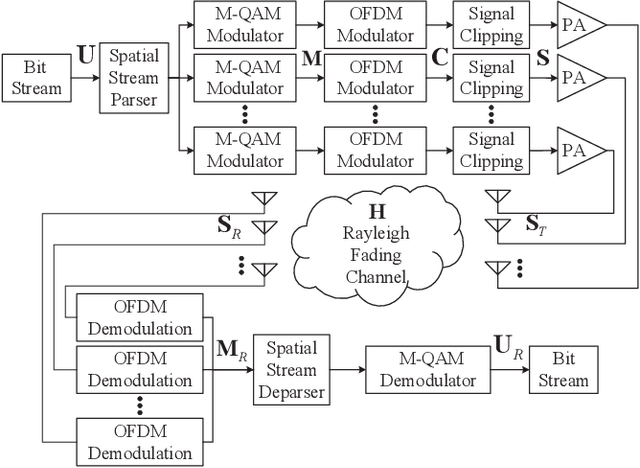
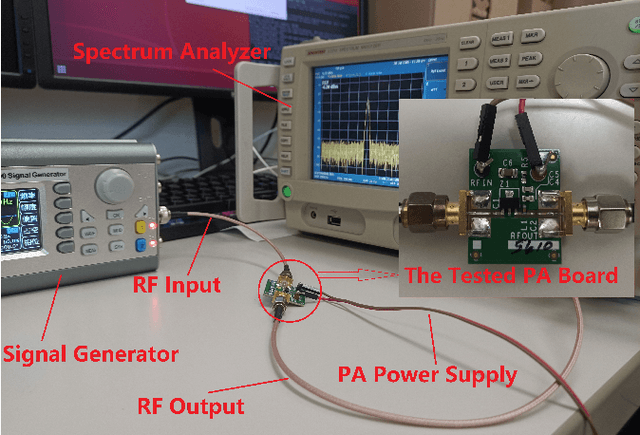
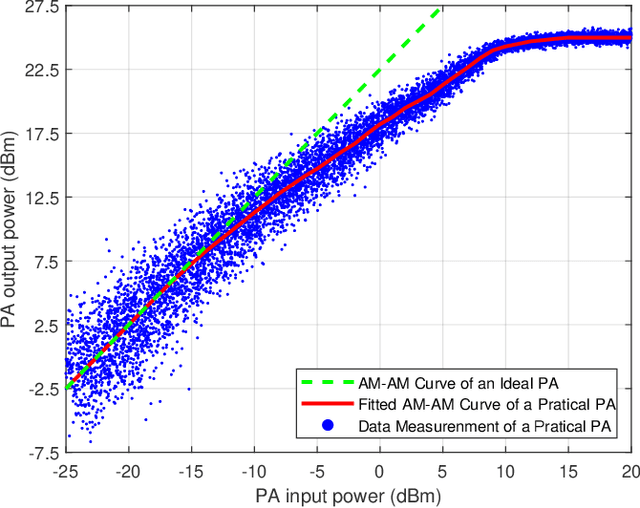

Signal clipping is a classic technique for reducing peak-to-average power ratio (PAPR) in orthogonal frequency division multiplexing (OFDM) systems. It has been widely applied in consumer electronic devices owing to its low complexity and high efficiency. Although clipping reduces the nonlinear distortion caused by power amplifiers (PAs), it induces additional clipping distortion. Optimizing the joint system performance with consideration of both PA nonlinearity and clipping distortion remains an open problem due to the complex PA modeling. In this paper, we analyze the PA nonlinearity through the Bessel-Fourier PA (BFPA) model and simplify its power expression using inter-modulation product (IMP) analysis. We derive expressions of the receiver signal-to-noise ratio (SNR) and system symbol error rate (SER) for the nonlinear clipped OFDM system. With the derivations, we investigate the optimal system setting to achieve the SER lower bound in a practical OFDM system that considers both PA nonlinearity and clipping distortion. The methods and results presented in this paper can serve as a useful reference for the system-level optimization of clipped OFDM systems with nonlinear PA.