 Add to Chrome
 Add to Firefox
 Add to Edge
On the convergence of graph Laplacians with a symmetric divergence
Jul 07, 2026
When analyzing a manifold learning algorithm for data lying on a smooth, compact, connected Riemannian submanifold $(\mathcal{M}, g)$ of $\mathbb{R}^d$, a key estimate for the geodesic distance $d_g$ is that there exists $K > 0$ such that $0 \leq d_g(p, q)^2 - \|p-q\|^2 \leq K d_g(p, q)^4$ for all $p, q \in \mathcal{M}$. We observe that more generally, when $\mathcal{M}$ is equipped with a smooth symmetric divergence $D$ satisfying a non-degeneracy condition and $g$ is given by $g_p := \frac{1}{2}\mathrm{Hess}_p(D(p, \cdot))$ for all $p \in \mathcal{M}$, there exists $K > 0$ such that $\left| D(p, q) - d_g(p, q)^2 \right| \leq K d_g(p, q)^4$ for all $p, q \in \mathcal{M}$. We demonstrate that this is sufficient for the pointwise convergence of graph Laplacians constructed with $D$ and discuss examples where $D$ is given by the Sinkhorn divergence on a family of probability measures parametrized by a manifold.

Manifold learning in metric spaces
Mar 20, 2025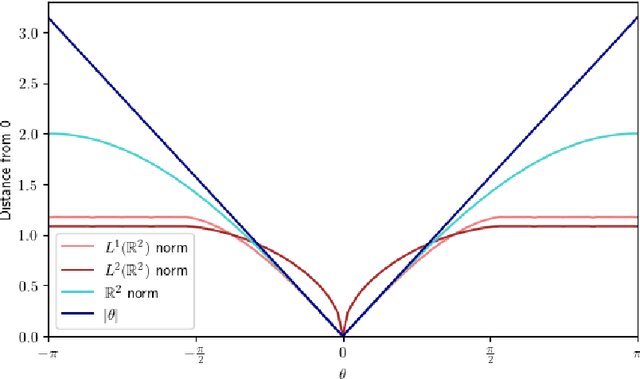
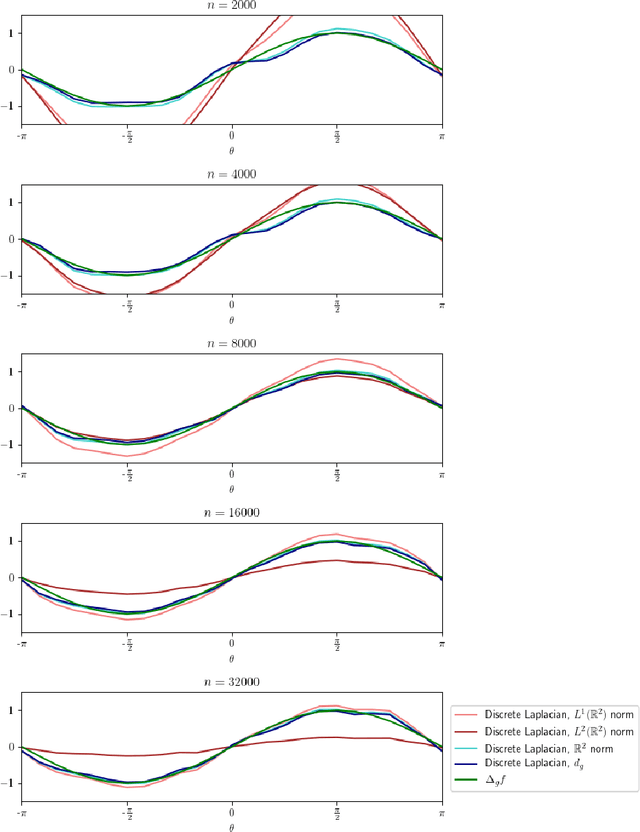
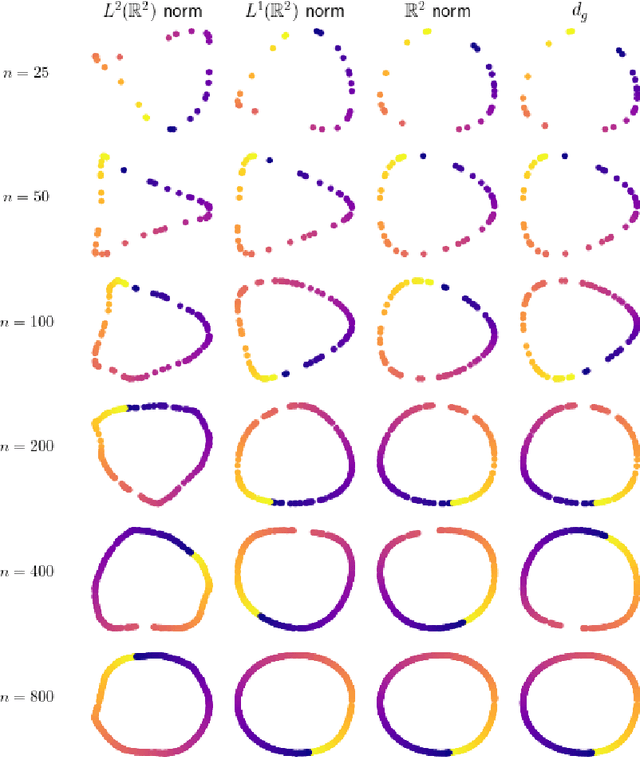
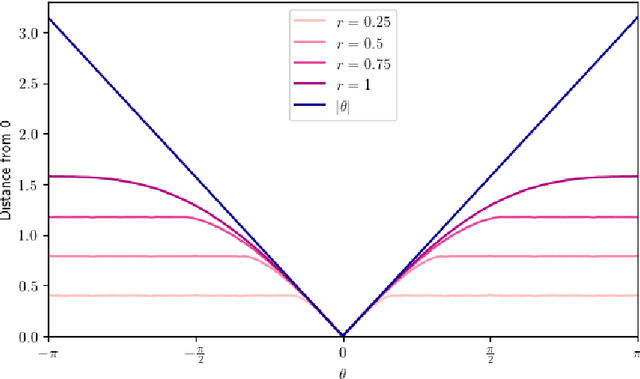
Laplacian-based methods are popular for dimensionality reduction of data lying in $\mathbb{R}^N$. Several theoretical results for these algorithms depend on the fact that the Euclidean distance approximates the geodesic distance on the underlying submanifold which the data are assumed to lie on. However, for some applications, other metrics, such as the Wasserstein distance, may provide a more appropriate notion of distance than the Euclidean distance. We provide a framework that generalizes the problem of manifold learning to metric spaces and study when a metric satisfies sufficient conditions for the pointwise convergence of the graph Laplacian.