 Add to Chrome
 Add to Firefox
 Add to Edge
Distributed Learning in Markovian Restless Bandits over Interference Graphs for Stable Spectrum Sharing
Dec 19, 2025
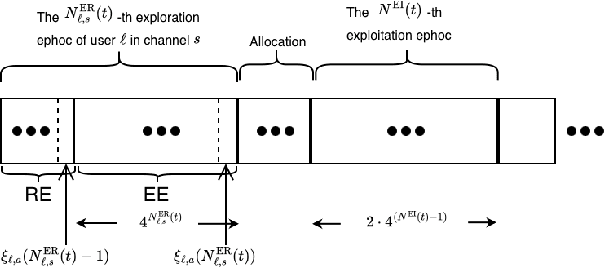
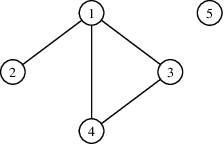
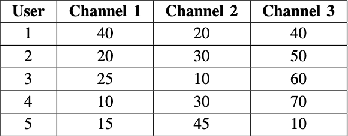
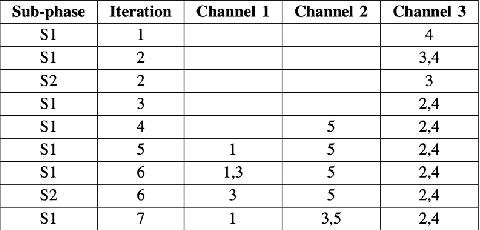
We study distributed learning for spectrum access and sharing among multiple cognitive communication entities, such as cells, subnetworks, or cognitive radio users (collectively referred to as cells), in communication-constrained wireless networks modeled by interference graphs. Our goal is to achieve a globally stable and interference-aware channel allocation. Stability is defined through a generalized Gale-Shapley multi-to-one matching, a well-established solution concept in wireless resource allocation. We consider wireless networks where L cells share S orthogonal channels and cannot simultaneously use the same channel as their neighbors. Each channel evolves as an unknown restless Markov process with cell-dependent rewards, making this the first work to establish global Gale-Shapley stability for channel allocation in a stochastic, temporally varying restless environment. To address this challenge, we develop SMILE (Stable Multi-matching with Interference-aware LEarning), a communication-efficient distributed learning algorithm that integrates restless bandit learning with graph-constrained coordination. SMILE enables cells to distributedly balance exploration of unknown channels with exploitation of learned information. We prove that SMILE converges to the optimal stable allocation and achieves logarithmic regret relative to a genie with full knowledge of expected utilities. Simulations validate the theoretical guarantees and demonstrate SMILE's robustness, scalability, and efficiency across diverse spectrum-sharing scenarios.

Asymptotically Optimal Search for a Change Point Anomaly under a Composite Hypothesis Model
Dec 27, 2024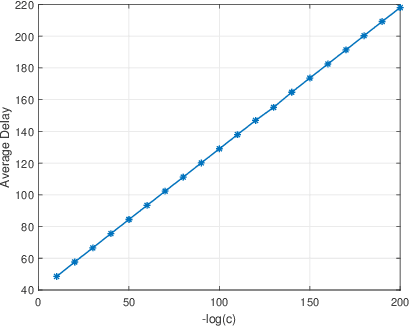
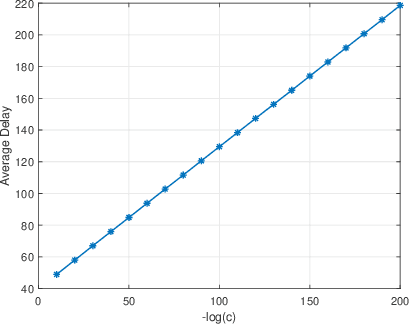
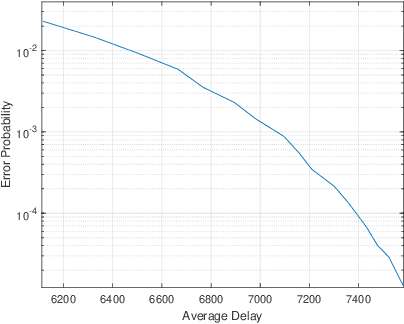
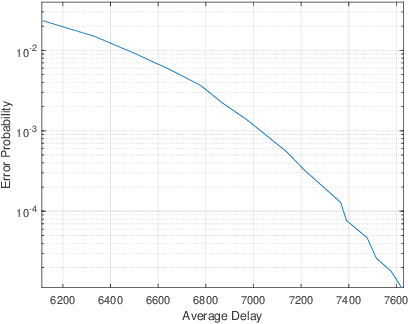
We address the problem of searching for a change point in an anomalous process among a finite set of M processes. Specifically, we address a composite hypothesis model in which each process generates measurements following a common distribution with an unknown parameter (vector). This parameter belongs to either a normal or abnormal space depending on the current state of the process. Before the change point, all processes, including the anomalous one, are in a normal state; after the change point, the anomalous process transitions to an abnormal state. Our goal is to design a sequential search strategy that minimizes the Bayes risk by balancing sample complexity and detection accuracy. We propose a deterministic search algorithm with the following notable properties. First, we analytically demonstrate that when the distributions of both normal and abnormal processes are unknown, the algorithm is asymptotically optimal in minimizing the Bayes risk as the error probability approaches zero. In the second setting, where the parameter under the null hypothesis is known, the algorithm achieves asymptotic optimality with improved detection time based on the true normal state. Simulation results are presented to validate the theoretical findings.