 Add to Chrome
 Add to Firefox
 Add to Edge
Nonlinear Characterization of Thin-Film LiNbO3 Acoustic Filters
Apr 13, 2026
Compact, high-performance components in millimeter-wave (mmWave) communication systems demand new acoustic filter technology at increasingly higher frequencies. Among various promising mmWave platforms, first-order antisymmetric (A1) mode laterally excited bulk acoustic resonators (XBARs) in thin-film lithium niobate (LiNbO3) have perhaps the most impressive linear performance. Despite these advances, there are few reports of nonlinear characterization of LiNbO3 filters at mmWaves. Here, we address this gap by developing a new nonlinear methodology for high-frequency filters. The result is a methodology for performing power-dependent S-parameters and third-order intermodulation (IMD3) measurements. To test our methodology, we fabricated filters on transferred single-crystal LiNbO3 films on sapphire (Al2O3) and silicon (Si) substrates with amorphous silicon (aSi) sacrificial layer. At 21.8 GHz, the filters on Al2O3 demonstrated an insertion loss of 1.48 dB, a 3 dB fractional bandwidth (FBW) of 17.7%, and in-band third-order input intercept points (IIP3) of 50.8 dBm. At 21.6 GHz, the filters on silicon demonstrated an insertion loss of 2.47 dB, a 3 dB FBW of 18.6%, and in-band IIP3 of 46.5 dBm. The nonlinear results conclusively show that thermal stability and passband distortion improved on the Al2O3 substrate, confirming that substrate selection plays a pivotal role in mitigating nonlinearity in acoustic front-end modules.

Transferred Thin Film Lithium Niobate as Millimeter Wave Acoustic Filter Platforms
Nov 21, 2023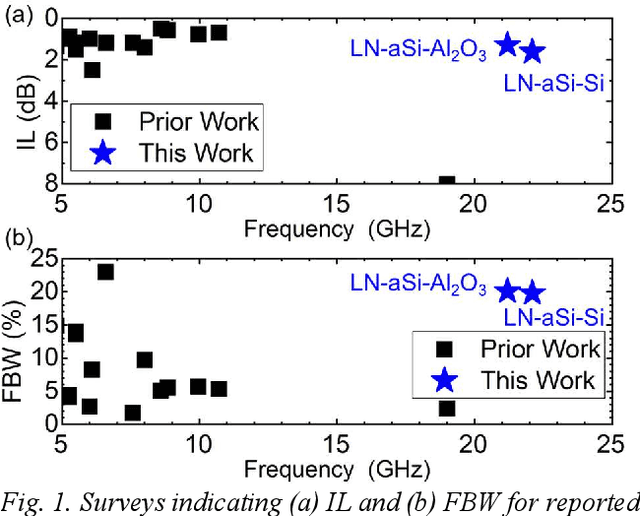
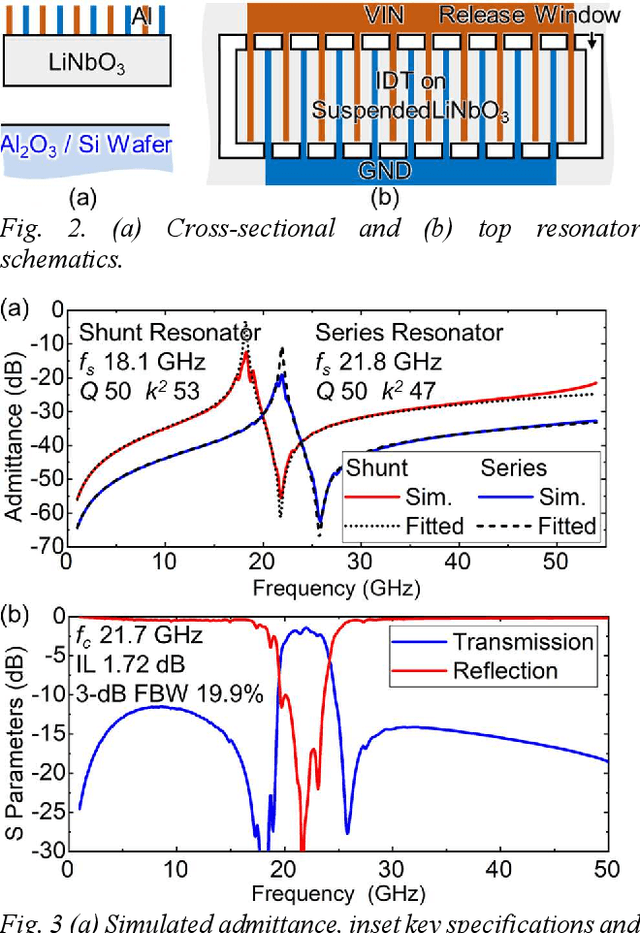
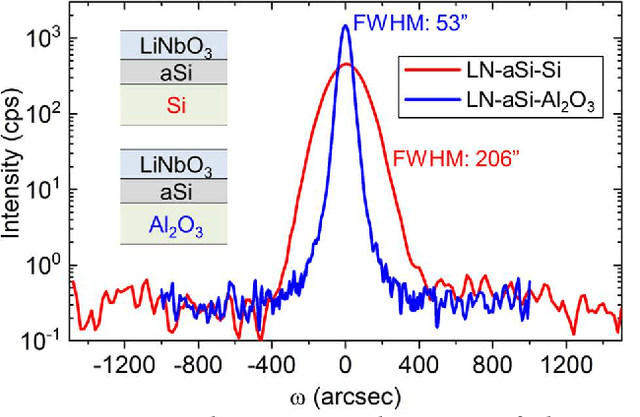
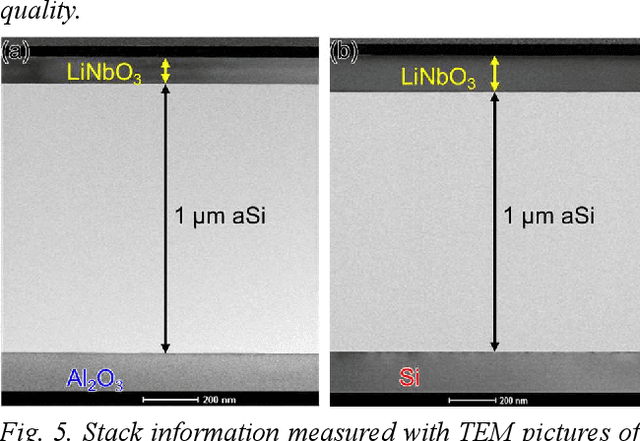
This paper reports the first high-performance acoustic filters toward millimeter wave (mmWave) bands using transferred single-crystal thin film lithium niobate (LiNbO3). By transferring LiNbO3 on the top of silicon (Si) and sapphire (Al2O3) substrates with an intermediate amorphous Si (aSi) bonding and sacrificial layer, we demonstrate compact acoustic filters with record-breaking performance beyond 20 GHz. In the LN-aSi-Al2O3 platform, the third-order ladder filter exhibits low insertion loss (IL) of 1.62 dB and 3-dB fractional bandwidth (FBW) of 19.8% at 22.1 GHz, while in the LN-aSi-Si platform, the filter shows low IL of 2.38 dB and FBW of 18.2% at 23.5 GHz. Material analysis validates the great crystalline quality of the stacks. The high-resolution x-ray diffraction (HRXRD) shows full width half maximum (FWHM) of 53 arcsec for Al2O3 and 206 arcsec for Si, both remarkably low compared to piezoelectric thin films of similar thickness. The reported results bring the state-of-the-art (SoA) of compact acoustic filters to much higher frequencies, and highlight transferred LiNbO3 as promising platforms for mmWave filters in future wireless front ends.
Thin-Film Lithium Niobate Acoustic Resonator with High Q of 237 and k2 of 5.1% at 50.74 GHz
Jul 11, 2023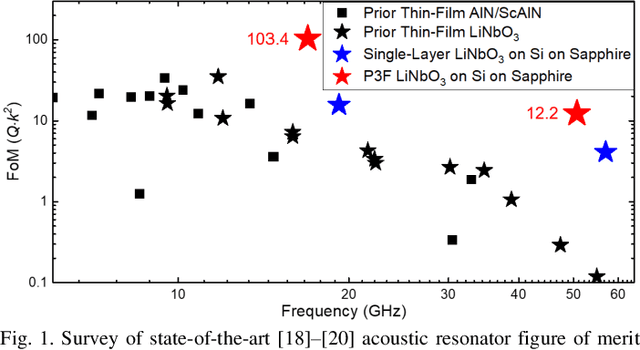
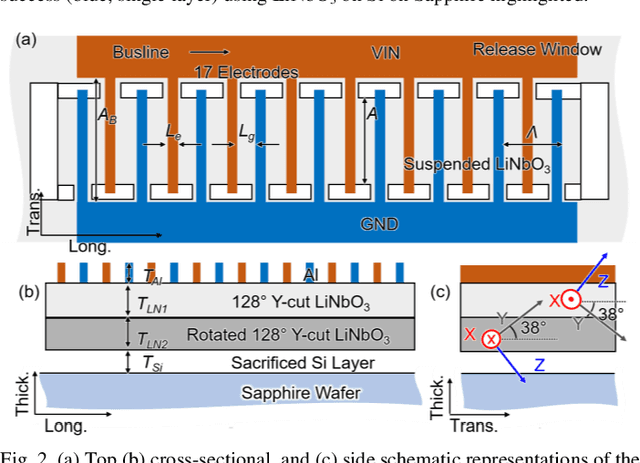
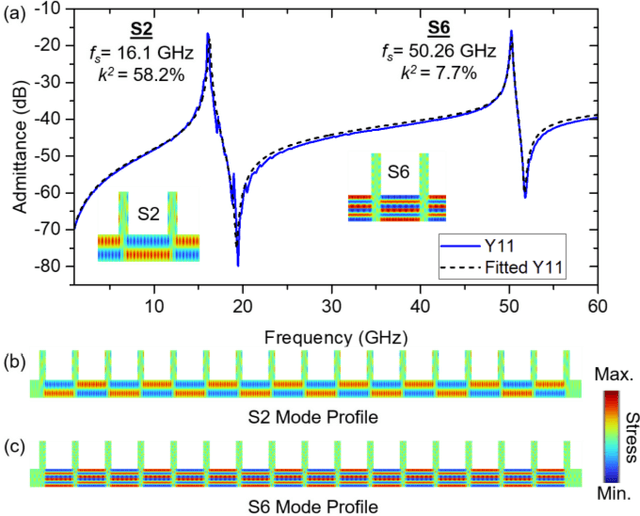
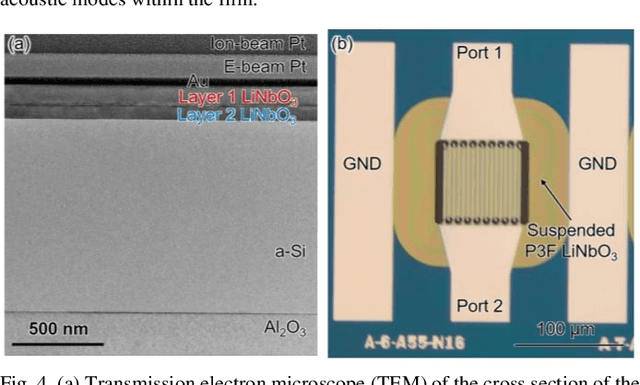
This work reports a 50.74 GHz lithium niobate (LiNbO3) acoustic resonator with a high quality factor (Q) of 237 and an electromechanical coupling (k2) of 5.17% resulting in a figure of merit (FoM, Q x k2) of 12.2. The LiNbO3 resonator employs a novel bilayer periodically poled piezoelectric film (P3F) 128 Y-cut LiNbO3 on amorphous silicon (a-Si) on sapphire stack to achieve low losses and high coupling at millimeter wave (mm-wave). The device also shows a Q of 159, k2 of 65.06%, and FoM of 103.4 for the 16.99 GHz tone. This result shows promising prospects of P3F LiNbO3 towards mm-wave front-end filters.
Thin-Film Lithium Niobate Acoustic Filter at 23.5 GHz with 2.38 dB IL and 18.2% FBW
Jul 10, 2023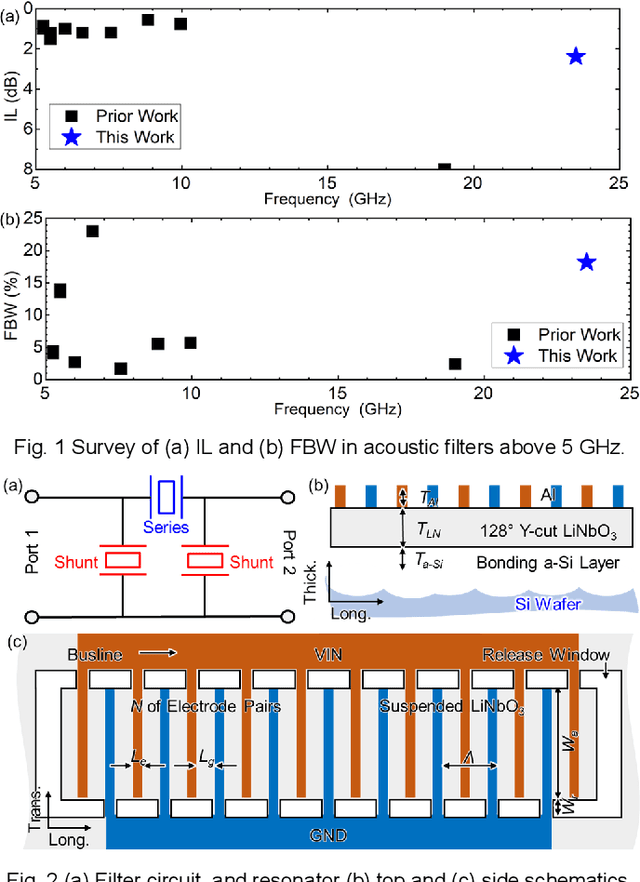
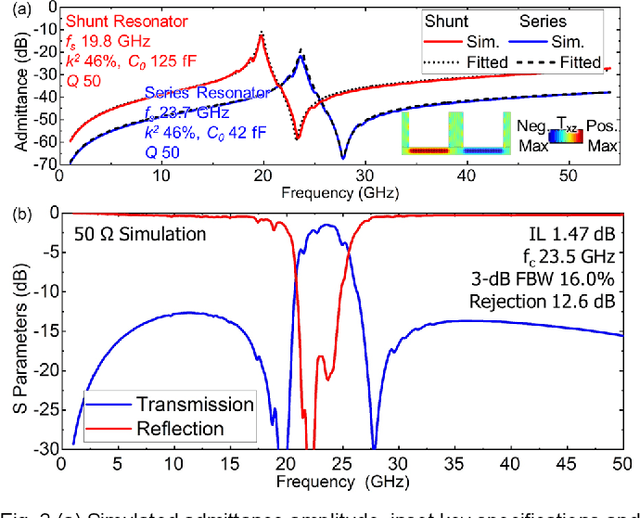
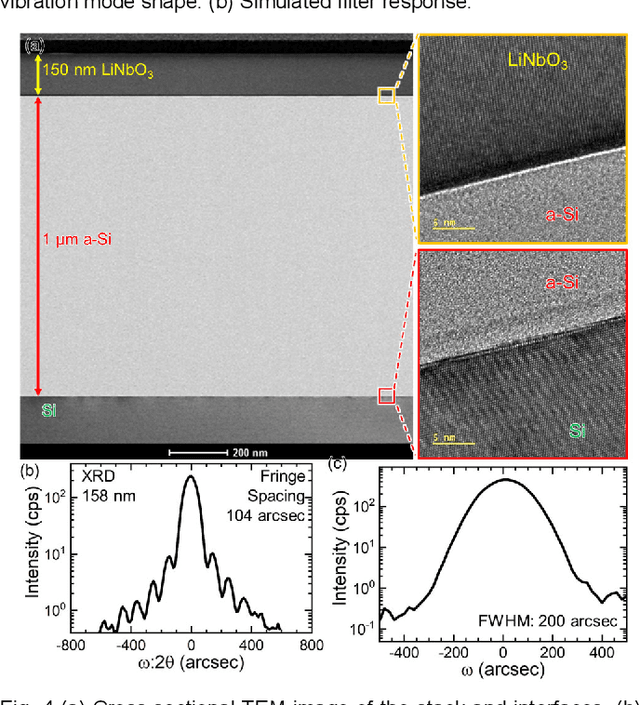
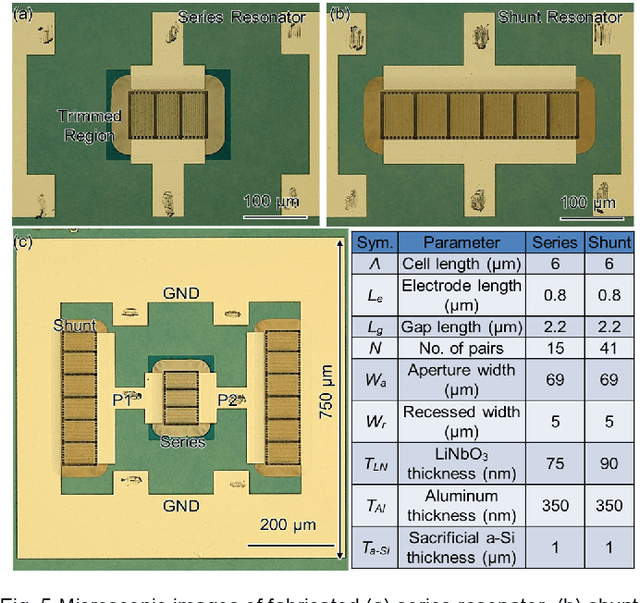
This work reports an acoustic filter at 23.5 GHz with a low insertion loss (IL) of 2.38 dB and a 3-dB fractional bandwidth (FBW) of 18.2%, significantly surpassing the state-of-the-art. The device leverages electrically coupled acoustic resonators in 100 nm 128{\deg} Y-cut lithium niobate (LiNbO3) piezoelectric thin film, operating in the first-order antisymmetric (A1) mode. A new film stack, namely transferred thin-film LiNbO3 on silicon (Si) substrate with an intermediate amorphous silicon (a-Si) layer, facilitates the record-breaking performance at millimeter-wave (mmWave). The filter features a compact footprint of 0.56 mm2. In this letter, acoustic and EM consideration, along with material characterization with X-ray diffraction and verified with cross-sectional electron microscopy are reported. Upon further development, the reported filter platform can enable various front-end signal-processing functions at mmWave.