 Add to Chrome
 Add to Firefox
 Add to Edge
SynthRAR: Ring Artifacts Reduction in CT with Unrolled Network and Synthetic Data Training
Feb 12, 2026
Defective and inconsistent responses in CT detectors can cause ring and streak artifacts in the reconstructed images, making them unusable for clinical purposes. In recent years, several ring artifact reduction solutions have been proposed in the image domain or in the sinogram domain using supervised deep learning methods. However, these methods require dedicated datasets for training, leading to a high data collection cost. Furthermore, existing approaches focus exclusively on either image-space or sinogram-space correction, neglecting the intrinsic correlations from the forward operation of the CT geometry. Based on the theoretical analysis of non-ideal CT detector responses, the RAR problem is reformulated as an inverse problem by using an unrolled network, which considers non-ideal response together with linear forward-projection with CT geometry. Additionally, the intrinsic correlations of ring artifacts between the sinogram and image domains are leveraged through synthetic data derived from natural images, enabling the trained model to correct artifacts without requiring real-world clinical data. Extensive evaluations on diverse scanning geometries and anatomical regions demonstrate that the model trained on synthetic data consistently outperforms existing state-of-the-art methods.

Low performing pixel correction in computed tomography with unrolled network and synthetic data training
Jan 28, 2026Low performance pixels (LPP) in Computed Tomography (CT) detectors would lead to ring and streak artifacts in the reconstructed images, making them clinically unusable. In recent years, several solutions have been proposed to correct LPP artifacts, either in the image domain or in the sinogram domain using supervised deep learning methods. However, these methods require dedicated datasets for training, which are expensive to collect. Moreover, existing approaches focus solely either on image-space or sinogram-space correction, ignoring the intrinsic correlations from the forward operation of the CT geometry. In this work, we propose an unrolled dual-domain method based on synthetic data to correct LPP artifacts. Specifically, the intrinsic correlations of LPP between the sinogram and image domains are leveraged through synthetic data generated from natural images, enabling the trained model to correct artifacts without requiring any real-world clinical data. In experiments simulating 1-2% detectors defect near the isocenter, the proposed method outperformed the state-of-the-art approaches by a large margin. The results indicate that our solution can correct LPP artifacts without the cost of data collection for model training, and it is adaptable to different scanner settings for software-based applications.
SynBT: High-quality Tumor Synthesis for Breast Tumor Segmentation by 3D Diffusion Model
Sep 03, 2025Synthetic tumors in medical images offer controllable characteristics that facilitate the training of machine learning models, leading to an improved segmentation performance. However, the existing methods of tumor synthesis yield suboptimal performances when tumor occupies a large spatial volume, such as breast tumor segmentation in MRI with a large field-of-view (FOV), while commonly used tumor generation methods are based on small patches. In this paper, we propose a 3D medical diffusion model, called SynBT, to generate high-quality breast tumor (BT) in contrast-enhanced MRI images. The proposed model consists of a patch-to-volume autoencoder, which is able to compress the high-resolution MRIs into compact latent space, while preserving the resolution of volumes with large FOV. Using the obtained latent space feature vector, a mask-conditioned diffusion model is used to synthesize breast tumors within selected regions of breast tissue, resulting in realistic tumor appearances. We evaluated the proposed method for a tumor segmentation task, which demonstrated the proposed high-quality tumor synthesis method can facilitate the common segmentation models with performance improvement of 2-3% Dice Score on a large public dataset, and therefore provides benefits for tumor segmentation in MRI images.
Modality-Independent Explainable Detection of Inaccurate Organ Segmentations Using Denoising Autoencoders
Apr 16, 2025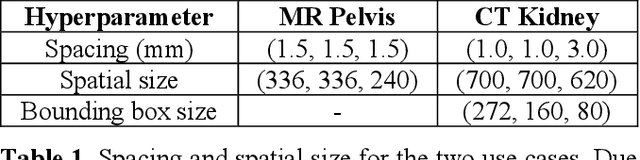
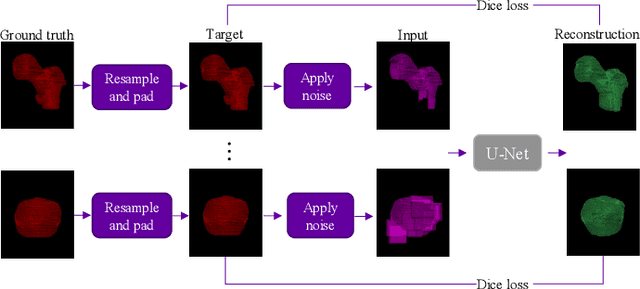
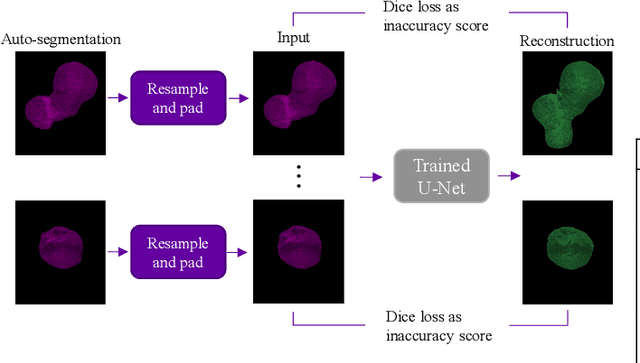
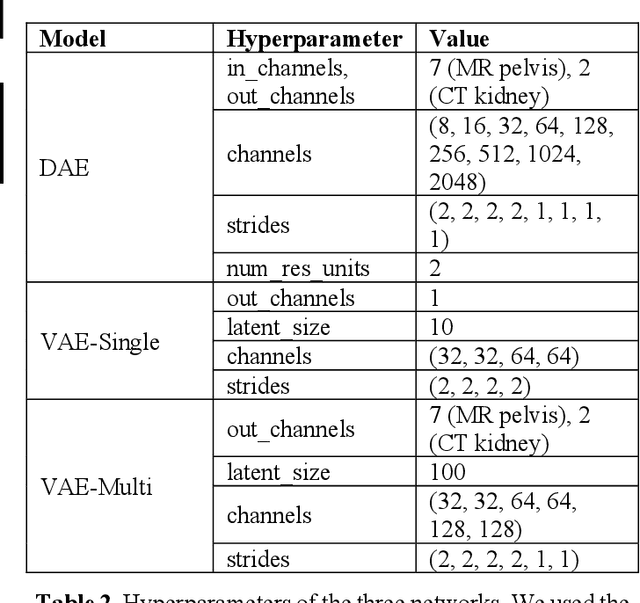
In radiation therapy planning, inaccurate segmentations of organs at risk can result in suboptimal treatment delivery, if left undetected by the clinician. To address this challenge, we developed a denoising autoencoder-based method to detect inaccurate organ segmentations. We applied noise to ground truth organ segmentations, and the autoencoders were tasked to denoise them. Through the application of our method to organ segmentations generated on both MR and CT scans, we demonstrated that the method is independent of imaging modality. By providing reconstructions, our method offers visual information about inaccurate regions of the organ segmentations, leading to more explainable detection of suboptimal segmentations. We compared our method to existing approaches in the literature and demonstrated that it achieved superior performance for the majority of organs.