 Add to Chrome
 Add to Firefox
 Add to Edge
Size Doesn't Matter: Cosine-Scored Sparse Autoencoders
Jun 13, 2026
Sparse autoencoders (SAEs) detect features via inner product, so a feature's activation scales with both its directional alignment and the input's norm. Under BatchTopK, high-norm tokens inflate all pre-activations simultaneously, claiming dictionary slots regardless of content alignment. This matters because sublayer normalization has already discarded the magnitude the score measures, so the encoder detects a quantity the model does not read. We replace the score with a learned blend of cosine similarity and input magnitude, letting the optimizer choose how much norm to use; a per-feature extension lets each feature decide independently. In both regimes, training is free to recover inner product but never does, with no feature ever choosing more than half-magnitude dependence. At matched reconstruction, the cosine encoder learns features that align with human-recognizable concepts far more often than standard, filling dictionary slots that inner product wastes on norm detectors. Loss reweighting that equalizes gradients barely closes the gap, confirming forward-pass score geometry as the lever. The advantage is not universal across tasks or depths, but we believe cosine scoring should be the default for dictionary learning on normalized representations.

Provably Overwhelming Transformer Models with Designed Inputs
Feb 09, 2025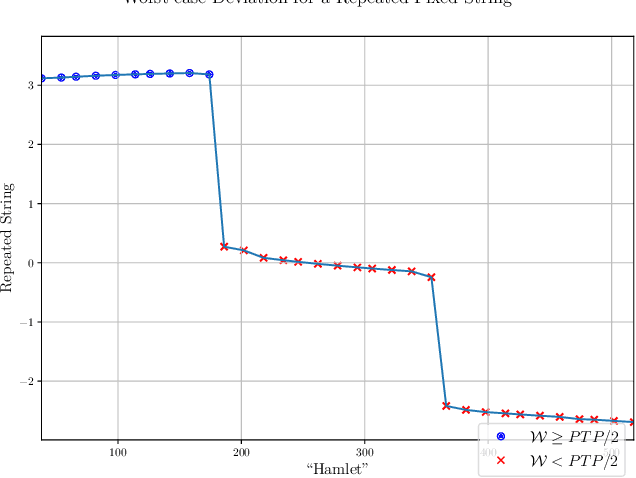


We develop an algorithm which, given a trained transformer model $\mathcal{M}$ as input, as well as a string of tokens $s$ of length $n_{fix}$ and an integer $n_{free}$, can generate a mathematical proof that $\mathcal{M}$ is ``overwhelmed'' by $s$, in time and space $\widetilde{O}(n_{fix}^2 + n_{free}^3)$. We say that $\mathcal{M}$ is ``overwhelmed'' by $s$ when the output of the model evaluated on this string plus any additional string $t$, $\mathcal{M}(s + t)$, is completely insensitive to the value of the string $t$ whenever length($t$) $\leq n_{free}$. Along the way, we prove a particularly strong worst-case form of ``over-squashing'', which we use to bound the model's behavior. Our technique uses computer-aided proofs to establish this type of operationally relevant guarantee about transformer models. We empirically test our algorithm on a single layer transformer complete with an attention head, layer-norm, MLP/ReLU layers, and RoPE positional encoding. We believe that this work is a stepping stone towards the difficult task of obtaining useful guarantees for trained transformer models.