 Add to Chrome
 Add to Firefox
 Add to Edge
DiffuSAM: Diffusion-Based Prompt-Free SAM2 for Few-Shot and Source-Free Medical Image Segmentation
Apr 27, 2026
Segmentation models such as Segment Anything Model (SAM) and SAM2 achieve strong prompt-driven zero-shot performance. However, their training on natural images limits domain transfer to medical data. Consequently, accurate segmentation typically requires extensive fine-tuning and expert-designed prompts. We propose DiffuSAM, a diffusion-based adaptation of SAM2 for prompt-free medical image segmentation. Our framework synthesizes SAM2-compatible segmentation mask-like embeddings via a lightweight diffusion-prior from off-the-shelf frozen SAM2 image features. The generated embeddings are integrated into SAM2's mask decoder to produce accurate segmentations, thereby eliminating the need for user prompts. The diffusion prior is further conditioned on previously segmented slices, enforcing spatial consistency across volumes. Evaluated on the BTCV and CHAOS datasets for CT and MRI under Source-Free Unsupervised Domain Adaptation (SF-UDA) and Few-Shot settings, DiffuSAM achieves competitive performance with efficient training and inference. Code is available upon request from the corresponding author.

Anatomical Token Uncertainty for Transformer-Guided Active MRI Acquisition
Mar 23, 2026Full data acquisition in MRI is inherently slow, which limits clinical throughput and increases patient discomfort. Compressed Sensing MRI (CS-MRI) seeks to accelerate acquisition by reconstructing images from under-sampled k-space data, requiring both an optimal sampling trajectory and a high-fidelity reconstruction model. In this work, we propose a novel active sampling framework that leverages the inherent discrete structure of a pretrained medical image tokenizer and a latent transformer. By representing anatomy through a dictionary of quantized visual tokens, the model provides a well-defined probability distribution over the latent space. We utilize this distribution to derive a principled uncertainty measure via token entropy, which guides the active sampling process. We introduce two strategies to exploit this latent uncertainty: (1) Latent Entropy Selection (LES), projecting patch-wise token entropy into the $k$-space domain to identify informative sampling lines, and (2) Gradient-based Entropy Optimization (GEO), which identifies regions of maximum uncertainty reduction via the $k$-space gradient of a total latent entropy loss. We evaluate our framework on the fastMRI singlecoil Knee and Brain datasets at $\times 8$ and $\times 16$ acceleration. Our results demonstrate that our active policies outperform state-of-the-art baselines in perceptual metrics, and feature-based distances. Our code is available at https://github.com/levayz/TRUST-MRI.
ProtoSAM -- One Shot Medical Image Segmentation With Foundational Models
Jul 09, 2024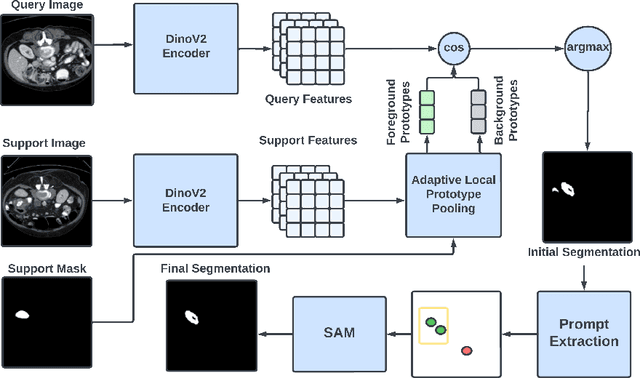
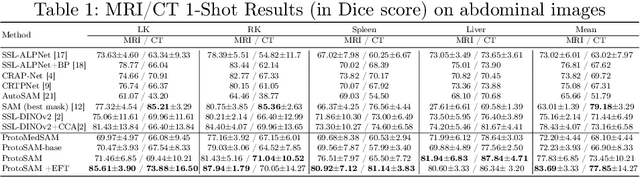

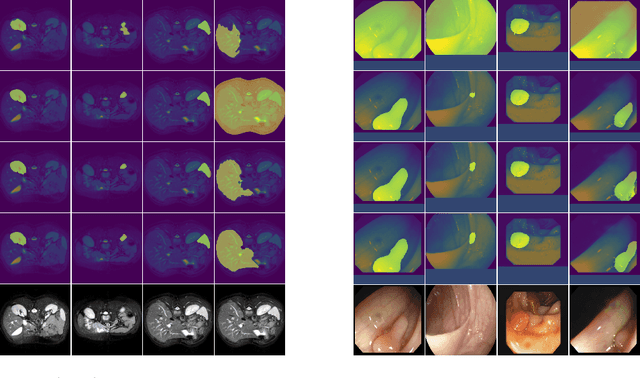
This work introduces a new framework, ProtoSAM, for one-shot medical image segmentation. It combines the use of prototypical networks, known for few-shot segmentation, with SAM - a natural image foundation model. The method proposed creates an initial coarse segmentation mask using the ALPnet prototypical network, augmented with a DINOv2 encoder. Following the extraction of an initial mask, prompts are extracted, such as points and bounding boxes, which are then input into the Segment Anything Model (SAM). State-of-the-art results are shown on several medical image datasets and demonstrate automated segmentation capabilities using a single image example (one shot) with no need for fine-tuning of the foundation model.
DINOv2 based Self Supervised Learning For Few Shot Medical Image Segmentation
Mar 05, 2024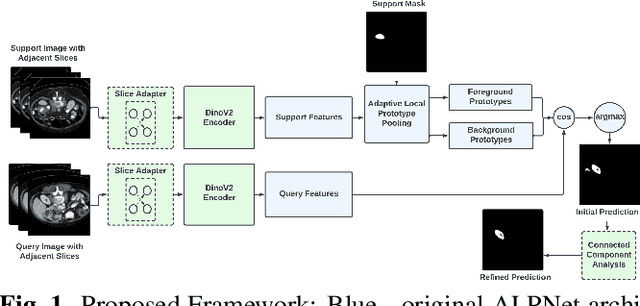
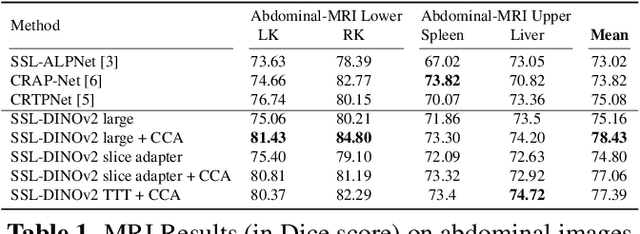
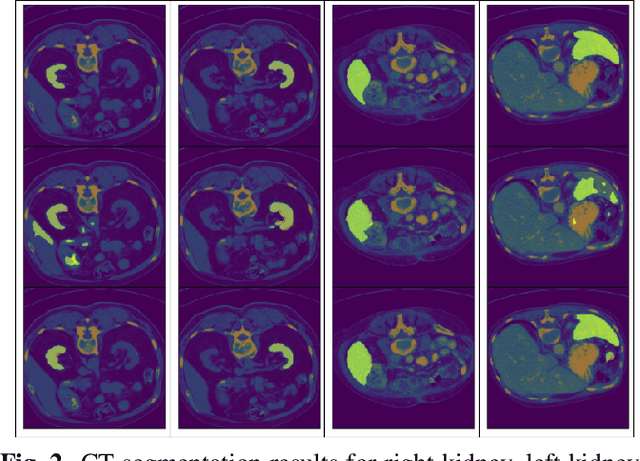
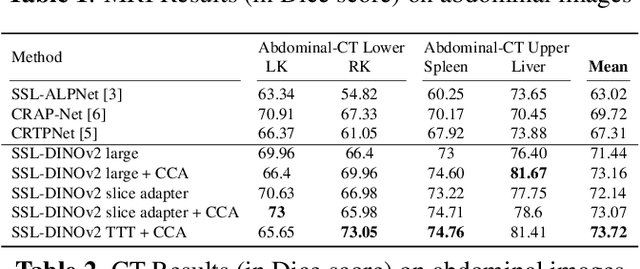
Deep learning models have emerged as the cornerstone of medical image segmentation, but their efficacy hinges on the availability of extensive manually labeled datasets and their adaptability to unforeseen categories remains a challenge. Few-shot segmentation (FSS) offers a promising solution by endowing models with the capacity to learn novel classes from limited labeled examples. A leading method for FSS is ALPNet, which compares features between the query image and the few available support segmented images. A key question about using ALPNet is how to design its features. In this work, we delve into the potential of using features from DINOv2, which is a foundational self-supervised learning model in computer vision. Leveraging the strengths of ALPNet and harnessing the feature extraction capabilities of DINOv2, we present a novel approach to few-shot segmentation that not only enhances performance but also paves the way for more robust and adaptable medical image analysis.