 Add to Chrome
 Add to Firefox
 Add to Edge
Deep Image Prior for photoacoustic tomography can mitigate limited-view artifacts
Apr 21, 2026
We study the deep image prior (DIP) framework applied to photoacoustic tomography (PAT) as an unsupervised reconstruction approach to mitigate limited-view artifacts and noise commonly encountered in experimental settings. Efficient implementation is achieved by employing recently published fast forward and adjoint algorithms for circular measurement geometries. Initialization via a fast inverse and total variation (TV) regularization are applied to further suppress noise and mitigate overfitting. For comparison, we compute a classical TV reconstruction. Our experiments comprise simulated PAT measurements under limited-view geometries and varying levels of added noise as well as experimental measurements together with using a digital twin for quality assessment. Our findings suggest that DIP framework provides an effective unsupervised strategy for robust PAT reconstruction even in the challenging case of a limited view geometry providing improvement in several quantitative measures over total variation reconstructions.

Digital twins enable full-reference quality assessment of photoacoustic image reconstructions
May 30, 2025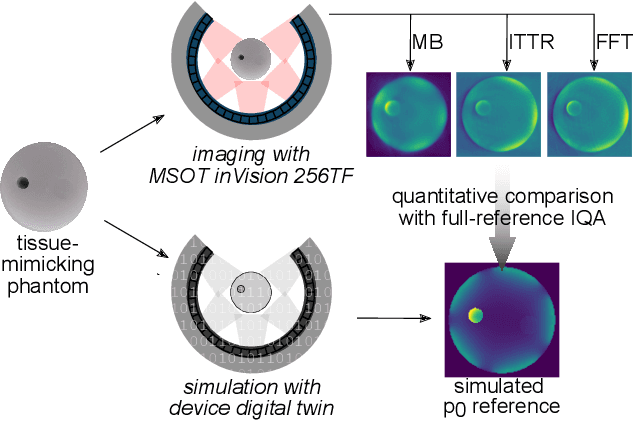
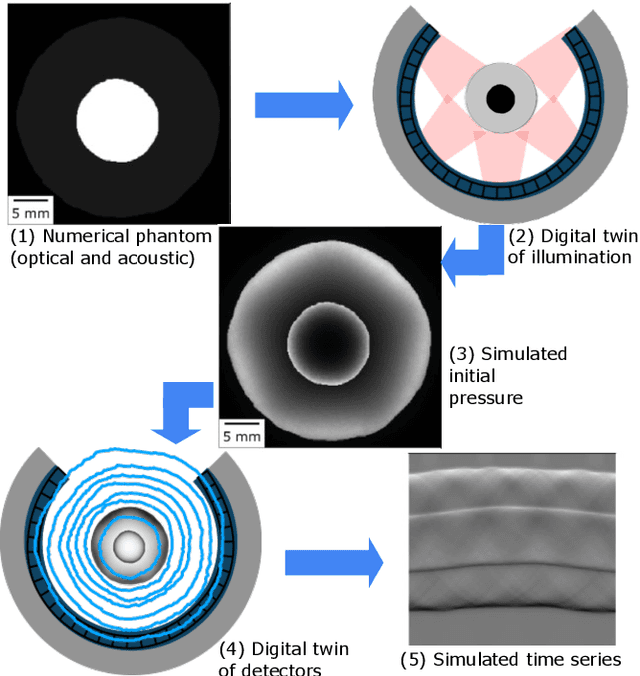
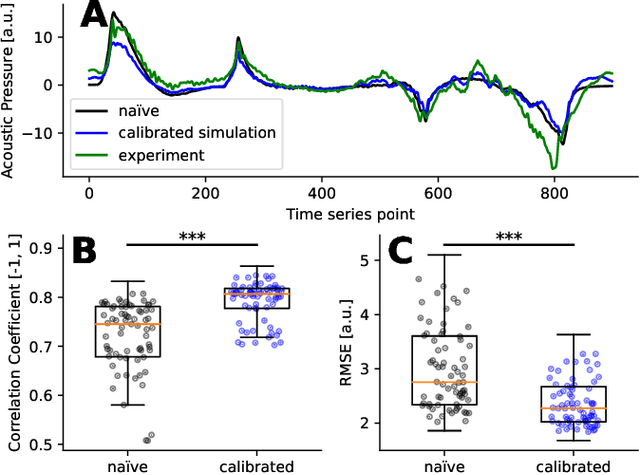
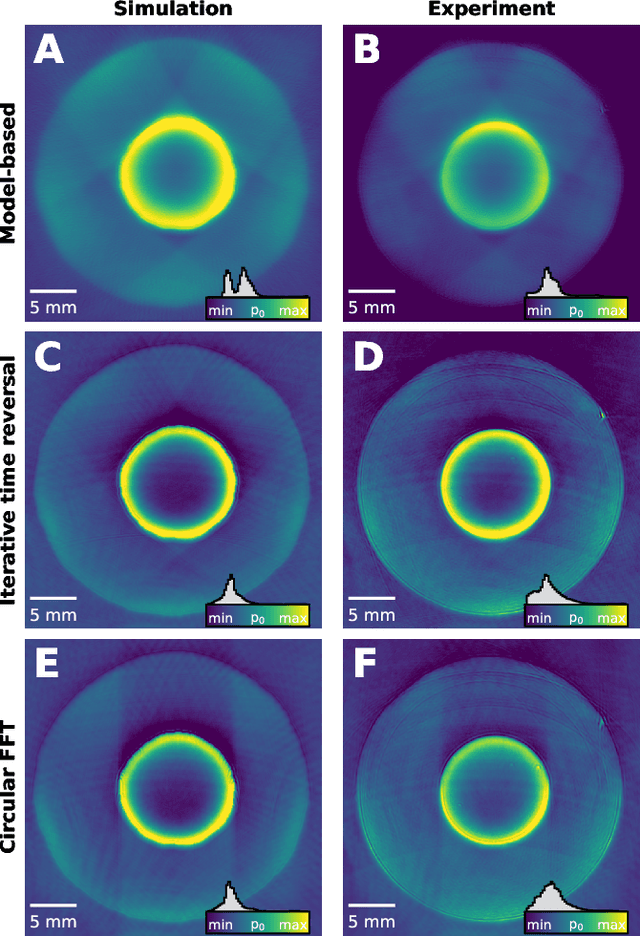
Quantitative comparison of the quality of photoacoustic image reconstruction algorithms remains a major challenge. No-reference image quality measures are often inadequate, but full-reference measures require access to an ideal reference image. While the ground truth is known in simulations, it is unknown in vivo, or in phantom studies, as the reference depends on both the phantom properties and the imaging system. We tackle this problem by using numerical digital twins of tissue-mimicking phantoms and the imaging system to perform a quantitative calibration to reduce the simulation gap. The contributions of this paper are two-fold: First, we use this digital-twin framework to compare multiple state-of-the-art reconstruction algorithms. Second, among these is a Fourier transform-based reconstruction algorithm for circular detection geometries, which we test on experimental data for the first time. Our results demonstrate the usefulness of digital phantom twins by enabling assessment of the accuracy of the numerical forward model and enabling comparison of image reconstruction schemes with full-reference image quality assessment. We show that the Fourier transform-based algorithm yields results comparable to those of iterative time reversal, but at a lower computational cost. All data and code are publicly available on Zenodo: https://doi.org/10.5281/zenodo.15388429.