 Add to Chrome
 Add to Firefox
 Add to Edge
HoToPy: A toolbox for X-ray holo-tomography in Python
Jun 13, 2025
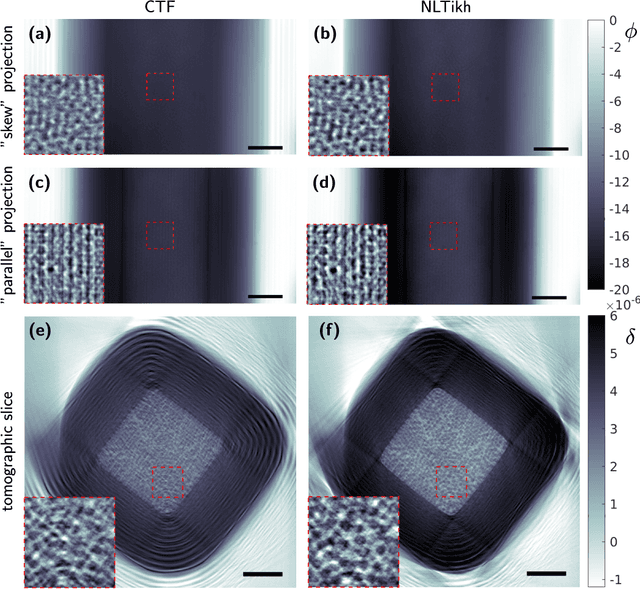
We present a Python toolbox for holographic and tomographic X-ray imaging. It comprises a collection of phase retrieval algorithms for the deeply holographic and direct contrast imaging regimes, including non-linear approaches and extended choices of regularization, constraint sets, and optimizers, all implemented with a unified and intuitive interface. Moreover, it features auxiliary functions for (tomographic) alignment, image processing, and simulation of imaging experiments. The capability of the toolbox is illustrated by the example of a catalytic nanoparticle, imaged in the deeply holographic regime at the 'GINIX' instrument of the P10 beamline at the PETRA III storage ring (DESY, Hamburg). Due to its modular design, the toolbox can be used for algorithmic development and benchmarking in a lean and flexible manner, or be interfaced and integrated in the reconstruction pipeline of other synchrotron or XFEL instruments for phase imaging based on propagation.

Fast algorithms for nonlinear and constrained phase retrieval in near-field X-ray holography based on Tikhonov regularization
May 02, 2022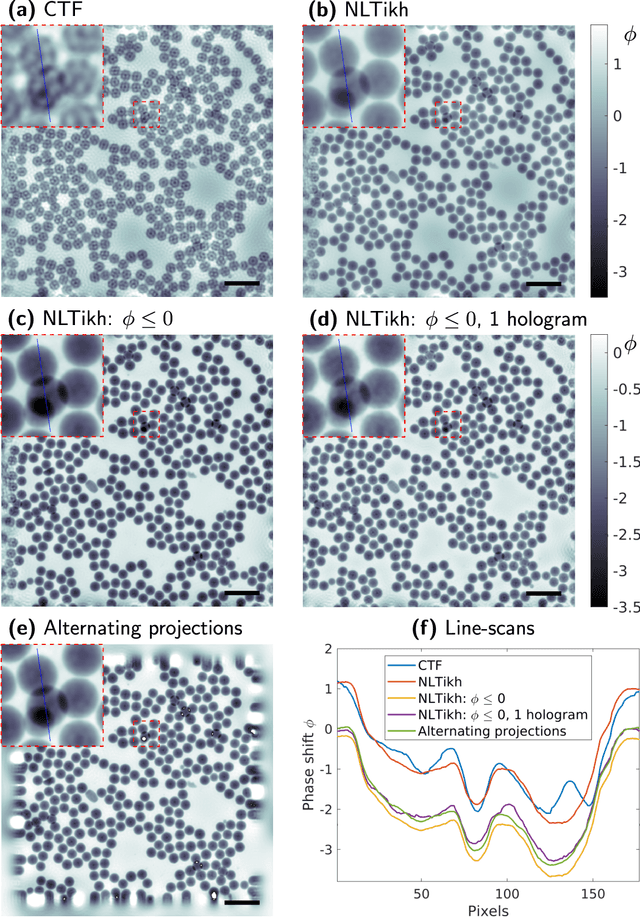
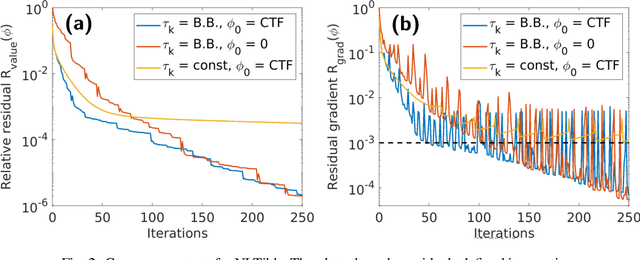
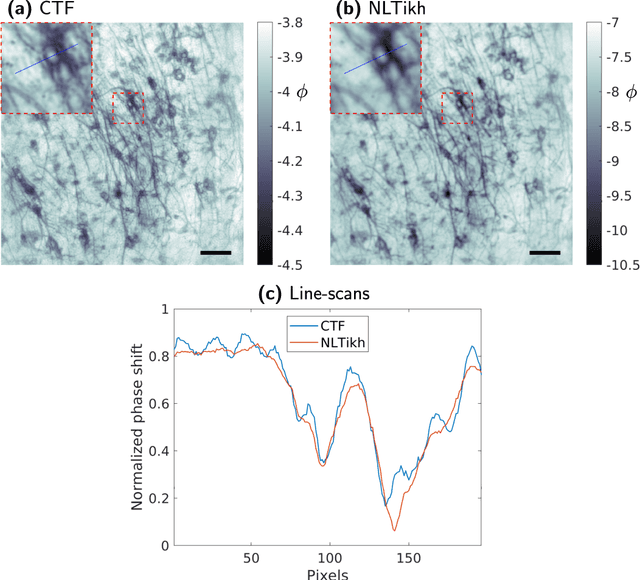
Based on phase retrieval, lensless coherent imaging and in particular holography offers quantitative phase and amplitude images. This is of particular importance for spectral ranges where suitable lenses are challenging, such as for hard x-rays. Here, we propose a phase retrieval approach for inline x-ray holography based on Tikhonov regularization applied to the full nonlinear forward model of image formation. The approach can be seen as a nonlinear generalization of the well-established contrast-transfer-function (CTF) reconstruction method. While similar methods have been proposed before, the current work achieves nonlinear, constrained phase retrieval at competitive computation times. We thus enable high-throughput imaging of optically strong objects beyond the scope of CTF. Using different examples of inline holograms obtained from illumination by a x-ray waveguide-source, we demonstrate superior image quality even for samples which do not obey the assumption of a weakly varying phase. Since the presented approach does not rely on linearization, we expect it to be well suited also for other probes such as visible light or electrons, which often exhibit strong phase interaction.