 Add to Chrome
 Add to Firefox
 Add to Edge
Generalised Transcoding Framework for Arbitrary Spatial Audio Capture and Playback Formats
Jun 16, 2026
This article introduces a unified framework for the parametric analysis and reproduction of spatial sound scenes captured either as Ambisonic signals or as raw microphone array signals. The proposed method estimates time-frequency-dependent spatial metadata that characterises a variable number of primary source components and an ambience component with its own angular power distribution, whose parameters fit the observed spatial covariances of the captured signals. This metadata is used to construct spatial covariances of the target playback formats, which are then used to derive optimal mixing matrices for transcoding the scene for playback over the target reproduction system. The method additionally handles independent rotations of both capture and playback setups. Real-time implementations of the method and other existing state-of-the-art parametric renderers are compared in a listening test using simulated scenes from Ambisonic, spherical, and head-worn arrays. The results highlight perceptual benefits of the proposed framework across a diverse range of content and receiver configurations, particularly for lower-order and geometrically constrained microphone arrays.

Perceptually-motivated Spatial Audio Codec for Higher-Order Ambisonics Compression
Jan 24, 2024
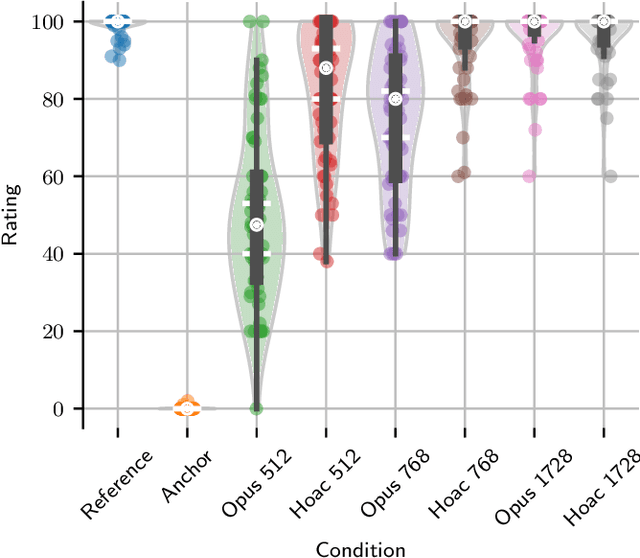

Scene-based spatial audio formats, such as Ambisonics, are playback system agnostic and may therefore be favoured for delivering immersive audio experiences to a wide range of (potentially unknown) devices. The number of channels required to deliver high spatial resolution Ambisonic audio, however, can be prohibitive for low-bandwidth applications. Therefore, this paper proposes a compression codec, which is based upon the parametric higher-order Directional Audio Coding (HO-DirAC) model. The encoder downmixes the higher-order Ambisonic (HOA) input audio into a reduced number of signals, which are accompanied by perceptually-motivated scene parameters. The downmixed audio is coded using a perceptual audio coder, whereas the parameters are grouped into perceptual bands, quantized, and downsampled. On the decoder side, low Ambisonic orders are fully recovered. Not fully recoverable HOA components are synthesized according to the parameters. The results of a listening test indicate that the proposed parametric spatial audio codec can improve the adopted perceptual audio coder, especially at low to medium-high bitrates, when applied to fifth-order HOA signals.
Dataset of Spatial Room Impulse Responses in a Variable Acoustics Room for Six Degrees-of-Freedom Rendering and Analysis
Nov 23, 2021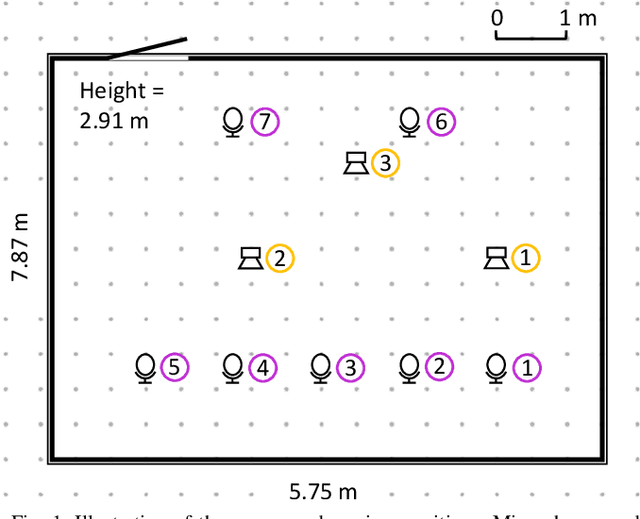

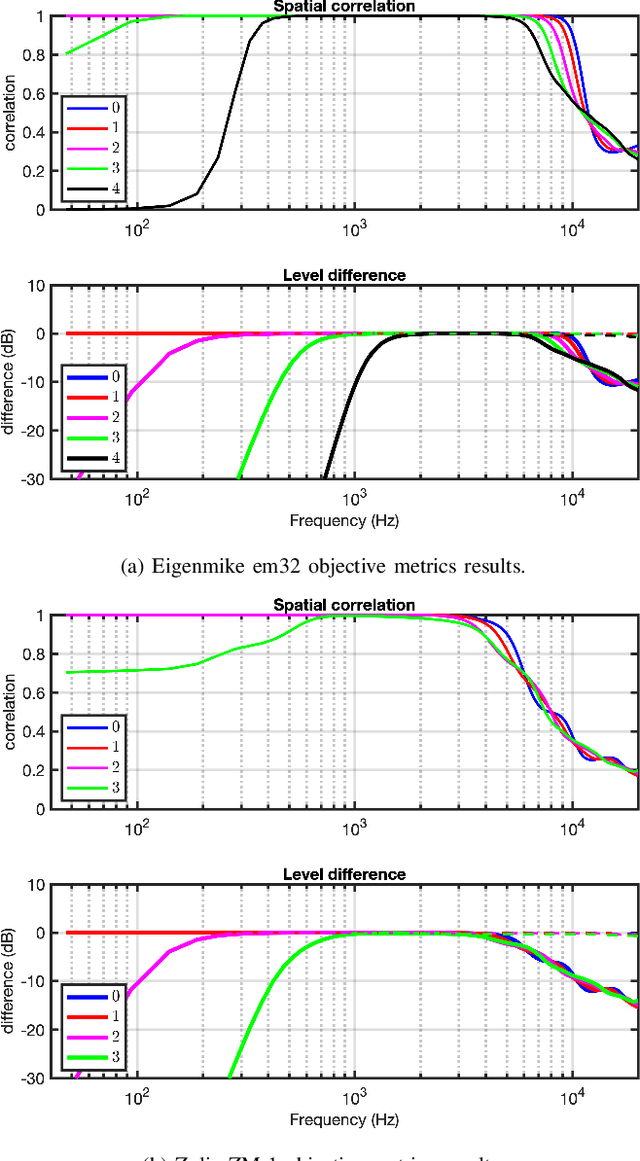
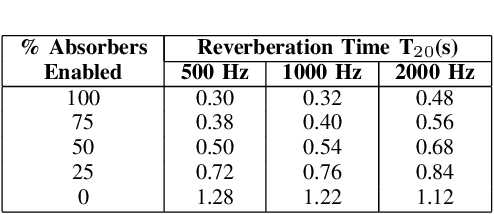
Room acoustics measurements are used in many areas of audio research, from physical acoustics modelling and speech enhancement to virtual reality applications. This paper documents the technical specifications and choices made in the measurement of a dataset of spatial room impulse responses (SRIRs) in a variable acoustics room. Two spherical microphone arrays are used: the mh Acoustics Eigenmike em32 and the Zylia ZM-1, capable of up to fourth- and third-order Ambisonic capture, respectively. The dataset consists of three source and seven receiver positions, repeated with five configurations of the room's acoustics with varying levels of reverberation. Possible applications of the dataset include six degrees-of-freedom (6DoF) analysis and rendering, SRIR interpolation methods, and spatial dereverberation techniques.